
Israeli ground invasion in Lebanon reflects deepening failure: Haaretz
 4 Min Read
Haaretz warns that the Israeli occupation's southern Lebanon maneuver deepens strategic failure, displacing civilians and risking prolonged confrontations with Hezbollah.
-
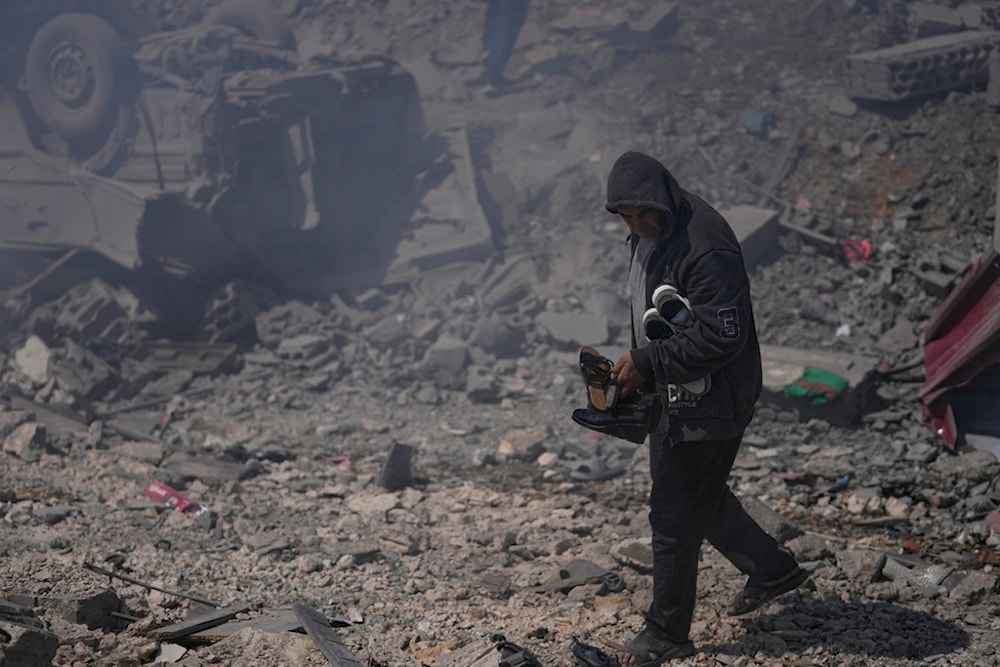
A man carries shoes from his destroyed house that was hit by Israeli airstrikes that destroyed several houses in Sir al-Gharbiyeh village, south Lebanon, Sunday, March 8, 2026 (AP)
Israeli newspaper Haaretz reports that War Minister Israel Katz’s declaration of a ground operation in southern Lebanon is a sign of the dangerous entrenchment of a policy that has already proven itself a failure, warning that the approach risks repeating past strategic mistakes and exacerbating civilian suffering.
On Sunday, Katz stated that he and Prime Minister Benjamin Netanyahu had ordered the Israeli occupation forces “to immediately destroy all bridges on the Litani River.” He added that residents of southern Lebanon would be allowed to evacuate northward beyond the river, and that the army was also instructed to accelerate the demolition of homes in border villages, following the “Beit Hanoun and Rafah model” used in Gaza.
Haaretz notes that this approach effectively separates southern Lebanon from the rest of the country, paralyzes civilian infrastructure, and entrenches Israeli military control on the ground. Katz further emphasized on Tuesday that “the principle is clear: there is terrorism and rockets – no homes or civilians, and the Israeli army is inside,” adding that hundreds of thousands of residents forcibly displaced north of the Litani would not be allowed to return "until full security is guaranteed."
'Main threat lies north of the Litani'
Analysts cited by Haaretz argue that the maneuver misreads the strategic reality, as the main threat to the Israeli occupation lies north of the Litani River. Expanding operations into areas of limited Hezbollah presence may create unnecessary friction and prolonged war without achieving any security objectives for the Israeli regime.
The systematic destruction of bridges and crossings disrupts civilian life and could reinforce Hezbollah’s image as a resistance movement. Haaretz emphasizes that past Israeli military campaigns in occupied areas have consistently fueled cycles of violence.
Haaretz highlights that Lebanon’s current political and security context differs significantly from previous decades, noting the actions taken by President Joseph Aoun and Prime Minister Nawaf Salam against Hezbollah's military wing. Damage to civilian infrastructure and the undermining of Lebanese leadership, the analysis warns, risks eroding these efforts and drawing the Israeli forces into another prolonged Lebanese quagmire.
Hundreds of Lebanese civilians killed
To top off the Israeli regime's strategic blunders, Lebanon’s Ministry of Public Health has reported a sharp surge in casualties following the renewed Israeli aggression that escalated on March 2, after more than 15 months of continuous violations and attacks that disregarded the ceasefire.
According to official figures, the latest phase of the assault has led to the martyrdom of 1,094 people and the injury of 3,119 others, as Israeli strikes continue to target populated areas across Lebanon.
The ministry stressed that the attacks have been indiscriminate, with civilians bearing the overwhelming burden of the aggression, as homes, neighborhoods, and essential infrastructure come under repeated bombardment.
Children have been among the most affected. At least 121 have been martyred and 395 injured, reflecting the devastating human cost of the ongoing campaign.
Civilians targeted disproportionately
Earlier today, Hezbollah Deputy Secretary-General Sheikh Naim Qassem said that the Israeli occupation has not adhered to the ceasefire, stressing that it has “continued its aggression continuously over a period of fifteen months.”
He stated that the US-Israeli aggression has deliberately targeted civilians and critical infrastructure, citing the destruction of homes, the displacement of entire communities, and attempts to devastate livelihoods and future generations. He further described the aggression as “cowardly,” noting that Israeli forces avoid direct confrontation with resistance fighters.
Sheikh Qassem’s remarks align with statements by Lebanese President Joseph Aoun, who said the war on Lebanon could have been avoided had "Israel" respected the ceasefire and withdrawn from the occupied territories. Aoun characterized the attacks as violations of international law and a form of collective punishment targeting the Lebanese population.


