
Aoun says war on Lebanon avoidable had 'Israel' honored ceasefire
 3 Min Read
Lebanese President Joseph Aoun says the war on Lebanon could have been avoided if the Israeli occupation forces had withdrawn from the occupied territories and upheld the 2024 agreement.
-
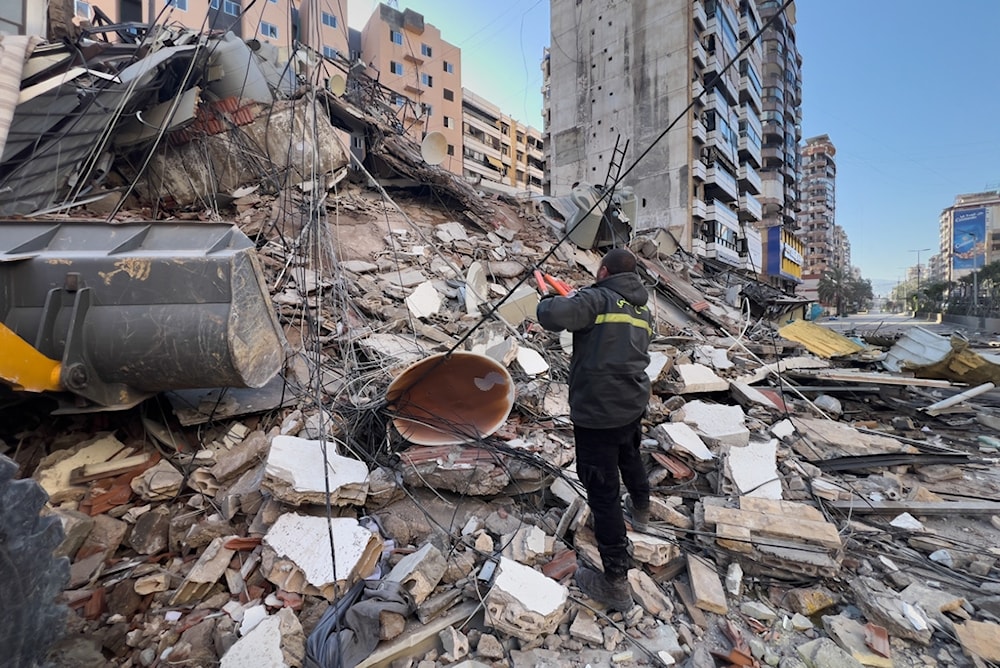
A civil defense worker cuts a power cable in front of a destroyed building that was hit by an Israeli airstrike in Dahiyeh, Beirut's southern suburbs, Lebanon, Tuesday, March 24, 2026 (AP)
Lebanese President Joseph Aoun said on Tuesday that the war could have been avoided had the Israeli regime responded to calls to withdraw from the territories it had occupied in Lebanon and complied with the 2024 ceasefire agreement.
Aoun made the remarks during a meeting at Baabda Palace with the UK’s Senior Defense Advisor for the Middle East and North Africa, Admiral Edward Ahlgren, and British Ambassador to Lebanon Hamish Cowell.
The Lebanese president said the Israeli attacks resulted in more than 1,000 casualties, hundreds of injuries, and the displacement of nearly one million Lebanese citizens.
Official decisions 'irreversible'
He added that the aggression caused widespread destruction across towns and villages targeted by bombardment, noting that strikes on bridges were aimed at isolating areas south of the Litani River from the rest of the country, with serious humanitarian and economic consequences.
Aoun stressed that there would be no reversal of government decisions regarding the exclusivity of arms and the authority over decisions of war and peace, underscoring the state’s commitment to maintaining sovereignty and control over national security.
Aoun had strongly condemned Israeli attacks targeting vital infrastructure in southern Lebanon, describing them as a serious escalation and a direct violation of national sovereignty.
The strikes reportedly hit key civilian structures, including the al-Qasmiyeh Bridge and other major crossings, disrupting essential connectivity across the region.
Collective punishment and international law violations
The Lebanese president further characterized the attacks as a form of collective punishment against civilians, pointing to the systematic destruction of infrastructure, residential areas, and public facilities.
“These actions reflect a dangerous shift toward the systematic destruction of infrastructure, civilian facilities, and residential areas in Lebanese villages, constituting a policy of collective punishment against civilians, which is unacceptable, condemnable, and unjustified,” he said.
He added that such actions “clearly violate the international humanitarian law prohibiting attacks on civilians and their essential facilities.”
Aoun also affirmed that "there is no going back on the government's decisions regarding the monopoly of arms and the decision of peace and war."
Civilian toll, health sector under attack
The ongoing aggression has triggered a severe humanitarian crisis, with large-scale displacement across the country. The death toll has risen to over 1,024, with at least 2,740 others wounded, Lebanon’s Ministry of Health announced on Saturday.
Moreover, Lebanese Health Minister Rakan Nasereddine stated that the number of displaced people has exceeded one million, representing more than 20% of Lebanon’s population.
The health sector has come under sustained pressure as attacks increasingly impact medical infrastructure and personnel.
Nasereddine reported 67 documented attacks on healthcare facilities and services. As a result, 40 healthcare workers and paramedics have been killed, while 96 others have been injured.
Additionally, at least five hospitals have been forced to shut down due to direct attacks or threats, severely limiting access to medical care for affected populations.


