
Lebanon's Aoun to Steinmeier: Occupation divides nations
 3 Min Read
Lebanese President Aoun receives Germany's president in Baabda to discuss reconstruction and sovereignty as Israeli strikes persist across South Lebanon.
-
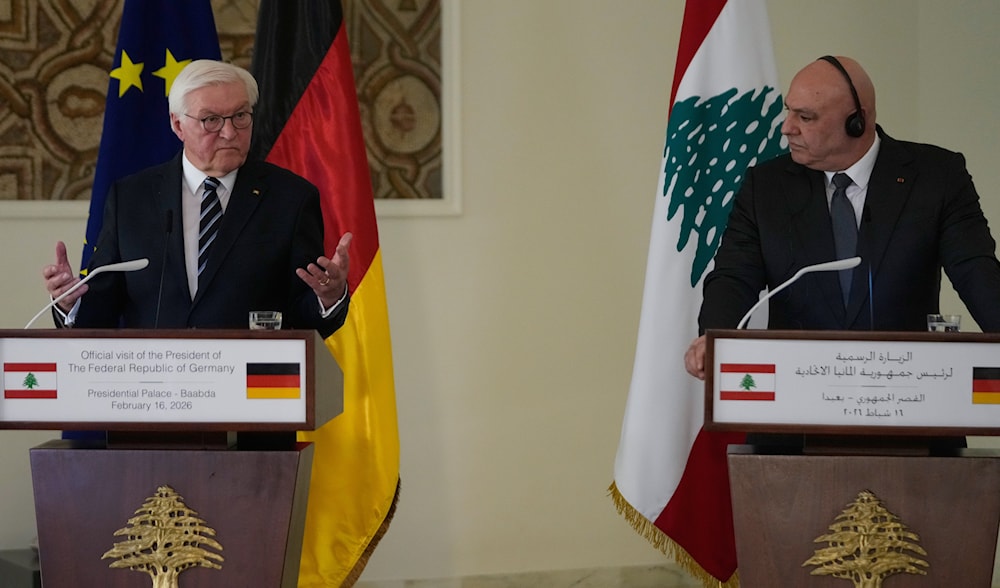
German President Frank-Walter Steinmeier, left, speaks during a joint press conference with his Lebanese counterpart Joseph Aoun, at the presidential palace in Baabda, east of Beirut, Lebanon, Monday, February 16, 2026. (AP Photo/Hussein Malla)
German President Frank-Walter Steinmeier visited Lebanon on Monday, meeting with his Lebanese counterpart Joseph Aoun at the Presidential Palace in Baabda, where the two leaders discussed reconstruction, sovereignty, and the continued Israeli violations ravaging the country's south.
During a joint press conference, Aoun warned that foreign interference and external interests only deepen division among the people of one nation. He affirmed Lebanon's commitment to rebuilding what was destroyed through national unity and liberating its land through its own army, stressing that the country can no longer bear conflicts or burdens and wants nothing but the prosperity of its people and the future of its children. He also reaffirmed Lebanon's insistence on absolute peace and the rejection of any conditions other than justice and goodness.
Drawing a pointed parallel, Aoun told his German counterpart that Lebanon has much to learn from Germany, noting that even the most united of nations can fall victim to division when occupied, and that unity can only be achieved through effective independence.
He added that the harshest destruction can be erased by a free and united national will, before telling Steinmeier directly that he was there to support, help, and stand with Lebanon as Germany always has.
Berlin's pledges amid ongoing Israeli aggression
Steinmeier highlighted Germany's 20-year involvement in the UNIFIL peacekeeping mission, saying Berlin had contributed to maintaining stability in a complex regional security environment.
He pledged that Germany would remain at Lebanon's side even after UNIFIL's mandate ends, aiming to strengthen the Lebanese army's monopoly on the use of force, and stressed that stability is what Lebanon needs for internal calm. He also noted that only a strong and effective state can guarantee citizens' welfare and withstand external interference.
The visit unfolds against a continued Israeli aggression on Lebanon. On Monday morning, an Israeli drone struck a car in Hanin, South Lebanon, killing one civilian and injuring several others. A day earlier, a strike near the Lebanon-Syria border killed four people. On Saturday, Israeli warplanes targeted multiple areas across the Jezzine and Nabatieh districts.
These attacks persist in flagrant violation of the November 2024 cessation of hostilities agreement and UN Security Council Resolution 1701. Israeli settlers have also infiltrated Lebanese territory, while UNIFIL warned of "unacceptable" Israeli dispersal of chemical substances near the Blue Line.
German officials sided with "Israel" during the occupation's aggression on Lebanon in the fall of 2024. Throughout the war, Berlin endorsed the Israeli regime's so-called "right to defend itself," while repeatedly branding the resistance as a "terrorist organization," effectively equating the armed faction that arose in response to decades of Israeli occupation with the occupying force itself. All while Israeli strikes devastated civilian infrastructure, killed thousands, displaced hundreds of thousands, and pushed hospitals to breaking point.


