
Joseph Aoun marks first year as Lebanese President
 5 Min Read
One year since taking office, Lebanese President Joseph Aoun navigated complex regional pressures and advanced internal reforms amid ongoing negotiations and ceasefire challenges.
-
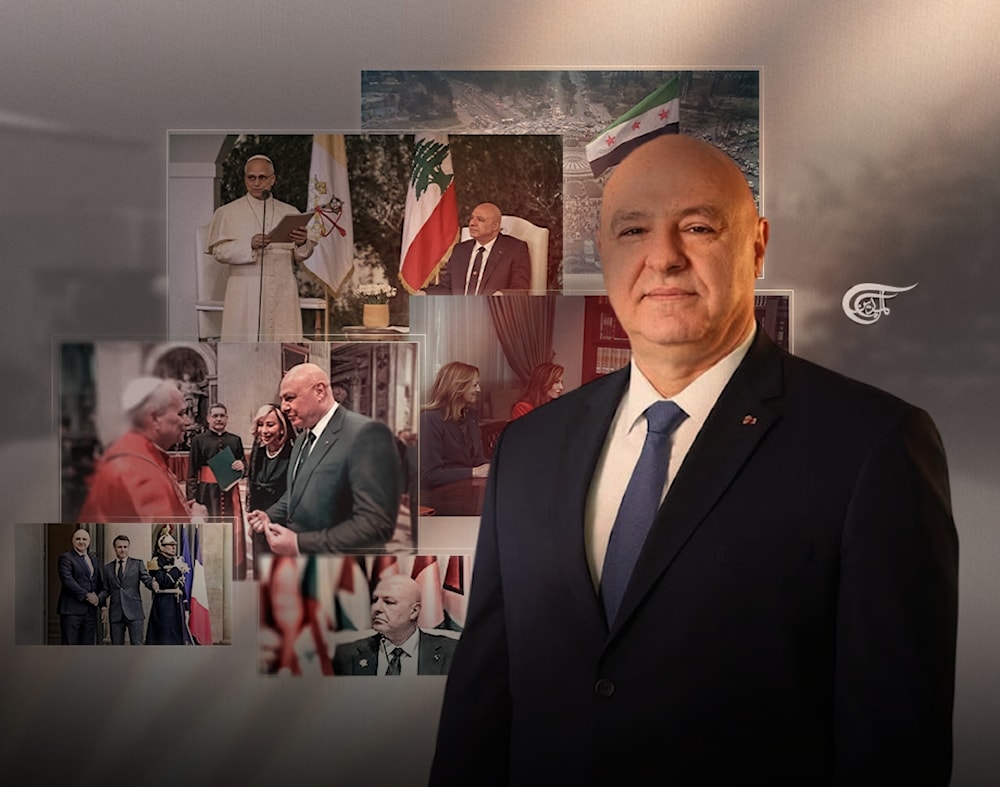
Joseph Aoun marks his first year as Lebanese President. (Illustrated by: Batoul Chamas/Al Mayadeen English)
One year into his presidency, Lebanese President Joseph Aoun's term has been marked by a bid to maintain national sovereignty, navigate mounting US disarmament pressures, and confront persistent Israeli violations against Lebanese territory. Aoun was elected on January 9, 2025, with 99 out of 128 parliamentary votes, ending a 26-month presidential vacuum.
He moved to appoint Nawaf Salam as Prime Minister, forming a technocratic cabinet tasked with implementing reform and restoring institutional trust, while launching e-governance initiatives, conducting payroll audits, and securing new financial pledges from Gulf states.
Aoun's presidency was defined and marked by pressure from Washington, which linked over $1 billion in annual aid and diplomatic support to a phased disarmament plan targeting Hezbollah. US envoys Amos Hochstein, Tom Barrack, and Morgan Ortagus pushed for a time-bound roadmap culminating in the transfer of Hezbollah's arms to the Lebanese Army by the end of 2025.
Rather than rejecting disarmament outright, Aoun restructured the discussion. He insisted that any internal disarmament must follow, not precede, verifiable de-escalation by "Israel". His administration drafted a counter-framework prioritizing Lebanese sovereignty, setting clear pre-conditions: full Israeli withdrawal from occupied territory, prisoner exchanges, and internal guarantees along the Blue Line.
By September 2025, the cabinet approved a timeline for Lebanese Army deployments in the south, delayed by ongoing Israeli strikes, effectively situating the disarmament process within a conditional, nationally determined framework.
Aoun rejects normalization
US proposals also sought to reengineer Lebanon's security and border arrangements, linking Hezbollah disarmament with expanded army presence and Israeli withdrawals. Aoun rejected frameworks that resembled de facto normalization with the occupation or allowed foreign oversight of the Lebanese security decisions.
Instead, President Aoun anchored all discussions within the bounds of existing international mechanisms, UNSC Resolution 1701, and UNIFIL's mandate.
Throughout late 2025, Aoun resisted speculative proposals that hinted at land swaps or border adjustments as part of a wider regional bargain, while dismissing such notions as affronts to Lebanese sovereignty, insisting that all territorial matters must be addressed solely through internationally recognized negotiations.
On the economic front, Aoun countered US attempts to link financial aid directly to disarmament benchmarks, arguing that no aid package could override national decision-making or force premature security confrontations.
President Aoun consistently reiterated that the monopoly on arms belongs to the state and that no foreign actor would determine Lebanon's internal trajectory. His approach sought to reclaim Baabda as the central node of decision-making, free from external interference.
The Lebanese Army had completed the first phase of its deployment plan across the south by early 2026. This involved dismantling infrastructure belonging to the Resistance, marking a pivotal step in asserting Lebanese Army presence in the south of the Litani River, as per Resolution 1701.
Ongoing Israeli violations and the Five-Point plan
Despite the November 2024 ceasefire, the Israeli occupation committed over 10,000 violations from late 2024 through 2025, including airstrikes, drone attacks, and ground incursions. The construction of walls inside Lebanese territory near Yaroun, the targeting of civilians, and "Israel's" occupation of five additional locations inside Lebanese territory deepened tensions.
In response, Beirut filed complaints with the UN Security Council and demanded immediate enforcement of Resolution 1701, especially after the US and Israeli demands to expand from the south to the north of the Litani River, which violates the agreement.
In November 2025, Aoun introduced a five-point national security initiative, calling for:
- Full Lebanese Army control over the southern territories
- Reinforced international engagement to uphold peace
- Infrastructure reconstruction
- Return of displaced citizens
This plan positioned Lebanon as willing to diplomatically engage within frameworks that respect its sovereignty and territorial rights. While challenges and pressures remain, including the ongoing Israeli violations, Aoun positioned Lebanon to navigate the road to stability on its own terms.
Lebanese Presidency backs Army efforts
The culmination of his first year was seen in his statement on Thursday, wherein he expressed his full support for the Lebanese Army's efforts to extend state authority south of the Litani River. Aoun described the deployment as a sovereign national decision aimed at consolidating the state's monopoly over arms and reestablishing security and stability, particularly in southern Lebanon.
Aoun said the move is grounded in the Constitution, state decisions, and Lebanon’s international commitments, underscoring that decisions of war and peace rest solely with constitutional institutions. He described the approach as irreversible and necessary to protect Lebanon’s national interest and prevent the country from being used as a platform for hostile acts.
The president warned that lasting stability remains contingent on addressing ongoing obstacles, foremost among them "Israel’s" continued occupation of Lebanese territory and repeated land, sea, and air violations. He called on the international community to uphold the cessation of hostilities agreement, support the Lebanese Army, prevent arms transfers to any party other than the state, and help enable the return of displaced civilians and reconstruction in the south.


