
Journalist Amal Khalil died after 'Israel' delayed, blocked her rescue
 5 Min Read
A Washington Post investigation finds that Lebanese journalist Amal Khalil died as "Israel" prevented rescue teams from reaching her for hours despite repeated efforts to evacuate her.
-
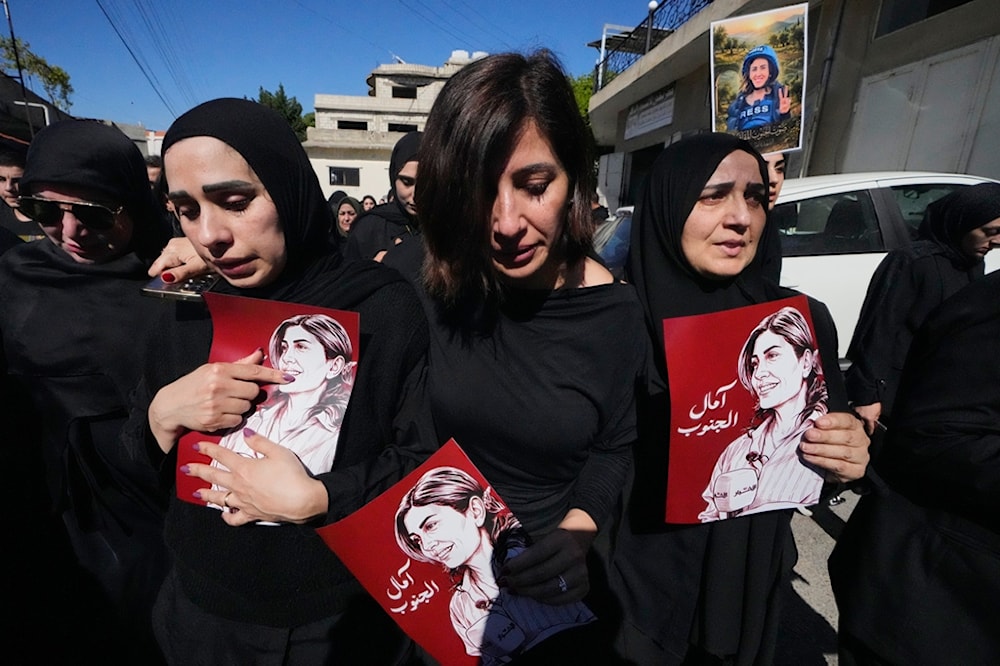
Mourners hold posters that show portraits of Lebanese journalist Amal Khalil, who was killed Wednesday in an Israeli airstrike, during her funeral procession in the village of Baysariyeh in southern Lebanon on Thursday, April 23, 2026 (AP)
Lebanese journalist Amal Khalil was killed by Israeli attacks in southern Lebanon after rescue teams were prevented from reaching her for hours despite repeated efforts to evacuate her while she was still alive, a Washington Post investigation published on Monday concluded.
According to the newspaper's reconstruction of the events of April 22, Khalil survived multiple Israeli strikes near the border village of al-Teeri and remained trapped under the rubble of a destroyed building as Lebanese rescue workers waited for clearance to enter the area.
Medical records reviewed by the newspaper indicate that Khalil died at 7 pm, more than two hours before emergency crews were finally allowed to return to the targeted site.
The investigation, based on medical documents, phone records, satellite imagery, and interviews with witnesses, survivors and first responders, found that the delay deprived Khalil of critical medical assistance during the final hours of her life.
Trapped after repeated Israeli strikes
Khalil, a journalist for the Al-Akhbar newspaper, was documenting the destruction caused by ongoing Israeli attacks in southern Lebanon alongside fellow journalist Zeinab Faraj.
The first Israeli strike targeted a vehicle traveling ahead of the journalists, killing two men. Khalil and Faraj fled and took shelter nearby, only for a second Israeli strike to destroy their own vehicle.
A third strike then brought down the building where the two journalists had taken refuge.
Before becoming trapped beneath the rubble, Khalil contacted relatives and colleagues seeking help.
At 2:56 pm, she sent a voice message to her brother saying, "They hit a car that was driving in front of us. But don't worry, nothing happened to us."
She added, "I'm okay, my loves, do not worry. I am good."
Faraj, who survived the attack, later described the terror caused by the successive bombardments.
"The sound was horrifying and scary. The whole world around us lit up in red," she said.
Rescue efforts obstructed
The Post reported that the Lebanese Army, Civil Defense, the Red Cross, and UNIFIL began coordinating rescue efforts shortly after the first strike.
However, emergency teams remained unable to reach the wounded journalists as permission to enter the area was repeatedly delayed.
Rescuers briefly approached the site before withdrawing following another assault nearby. According to individuals involved in coordination efforts cited by the newspaper, approval for their return did not arrive until roughly 8:15 pm.
By then, Khalil had already succumbed to her injuries.
The newspaper reported that first responders eventually entered the area with ambulances, rescue vehicles and excavators before beginning a lengthy search through the debris.
Hours later, they located Khalil beneath collapsed concrete after discovering that a structural column had fallen on her.
Growing calls for accountability
The killing of Khalil has drawn condemnation from press freedom organizations and human rights advocates, who argue that the targeting of journalists and the denial of prompt medical access constitute serious violations of international humanitarian law.
Committee to Protect Journalists chief executive Jodie Ginsberg said, "Journalists are civilians and protected under international law. Israel's blatant disregard for such norms — and the international community's failure to hold them accountable — is abhorrent."
UNESCO Director-General Khaled el-Enany also called for an investigation into the killing.
"Journalists play a crucial role in ensuring the flow of information essential for peacebuilding in conflict situations," he said. "Their protection is paramount for all parties."
Part of a broader pattern
Khalil's killing has renewed scrutiny of Israeli attacks on journalists in Lebanon, with press freedom organizations arguing that her death is part of a broader pattern that has unfolded since the beginning of the war.
Among the most prominent cases was the killing of Reuters videographer Issam Abdallah near Alma al-Shaab in October 2023. Investigations conducted by Reuters, the United Nations, Amnesty International, Human Rights Watch, and Reporters Without Borders concluded that the group of journalists was clearly identifiable as press when it came under Israeli fire. The attack killed Abdallah and wounded six other journalists.
The following month, Al Mayadeen's correspondent Farah Omar and cameraman Rabih Me'mari were killed in an Israeli strike in southern Lebanon while carrying out their reporting duties.
In October 2024, an Israeli airstrike targeted a compound housing journalists in Hasbaya, killing Al Mayadeen's correspondent Ghassan Najjarn and cameraman Wissam Qassem, as well as Al-Manar's technician Mohammad Reda. The attack drew international condemnation and was described by Reuters as the deadliest day for journalists in Lebanon during the conflict.
On March 28, 2026, Al Mayadeen's reporter Fatima Ftouni and her brother, video journalist Mohammad Ftouni, were killed alongside veteran Al-Manar's correspondent Ali Shoeib when an Israeli strike hit their vehicle in southern Lebanon. Ftouni had been reporting from the frontlines shortly before the attack. "Israel" later claimed Shoeib was the target but did not provide evidence for its allegations and did not explain the killing of the two Al Mayadeen journalists, although the attack on them was a double-tap strike.
Press freedom organizations say these incidents, together with the killing of Amal Khalil, point to a persistent pattern of attacks on media workers operating in Lebanon. The Committee to Protect Journalists and other watchdogs have repeatedly called for independent international investigations and accountability for the killings of journalists.
Read more: Al-Akhbar sues French commentator for justifying Amal Khalil's murder


