
Katz-Zamir feud exposes deep rift in Israeli army leadership
 4 Min Read
A fierce dispute between the Israeli security minister and army chief escalates into a political-military showdown over post-war leadership and control of the army.
-
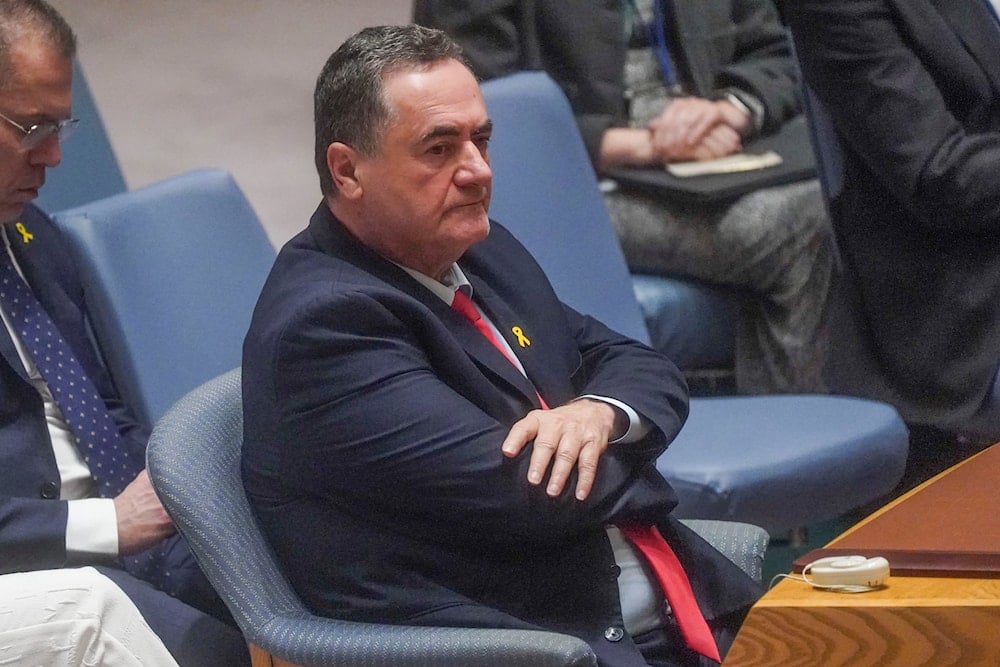
Israel Katz listens during a meeting of the United Nations Security Council on the war in Gaza, on March 11, 2024, at UN headquarters. (AP Photo/Bebeto Matthews)
The ongoing tensions between Israeli Security Minister Israel Katz and the Israeli Chief of Staff Eyal Zamir have escalated into a full-blown army leadership crisis. What began as a dispute over appointments and investigations related to the Israeli failures on October 7, 2023, has morphed into a public confrontation between the political and military echelons over control of the army and the boundaries of political interference.
The tension between Katz and Zamir, which had been simmering for weeks, erupted after Zamir circulated a comprehensive document to senior officers suggesting the formation of an official commission of inquiry into the events of October 7.
The very next day, Katz countered his move by publishing his own version of events on social media, insisting the disagreement was "neither personal nor political," and claiming that no new appointments should proceed before current investigations conclude. Katz emphasized that he had already approved the internal "Turjman Committee" created by Zamir to look into the matter and that its findings had recommended the reopening of specific cases.
The rift became public when Zamir imposed professional sanctions on senior officers over their roles in operational and intelligence failures without consulting Katz.
The move was seen by Katz as a clear overreach of authority. In response, Katz froze a series of high-level military appointments for 30 days and ordered the Ministry of Security’s inspector general to conduct a parallel review. Unmoved, Zamir pushed forward, announcing the appointment of 38 senior officers, effectively ignoring the freeze. This decision deepened the standoff, reflecting a wider crisis in the command structure.
Concerns over political interference in the IOF
Within the security and military establishment, Katz’s actions have sparked concern over a possible wave of new resignations among professional officers, in a military already suffering from widespread attrition following the war. Military sources have warned that political interference in the IOF could jeopardize the careers of officers, linking promotions to political loyalty or ideological leanings.
Zamir’s camp accuses Katz of exploiting the crisis to bolster his standing within the Likud party, framing the conflict as politically motivated.
The crisis deepened when Katz canceled the appointment of Colonel (Res.) German Giltman, citing his past involvement in the "Brothers in Arms" movement, a group associated with anti-government protests. Senior military officials condemned the decision as a troubling precedent, warning that it signaled an increasing encroachment of political agendas into the military's professional domain.
Media coverage in "Israel" has become sharply divided, echoing the deepening institutional rift. Analysts across the political spectrum agree that the dispute has moved far beyond administrative boundaries and now represents a direct power struggle over post-war army leadership and the future direction of the military after the war on Gaza.
Some commentators argue that Zamir is working to rebuild a fractured command structure, while Katz is undermining these efforts by freezing key appointments, a move they describe as a "serious blow" to an institution that urgently needs stable leadership, not further internal division.
Analysts warn of structural erosion in the military
Military correspondents view Zamir’s document as a carefully crafted, implicit critique of the political leadership, deliberately worded to avoid a direct clash with Netanyahu. Still, the underlying message is clear: a formal inquiry is needed, akin to the Agranat Commission that examined the failures of the 1973 "Yom Kippur" war.
Other analysts go further, describing the document as a "written outcry" that places responsibility on the political echelon for years of systemic failure, arguing that accountability cannot rest solely with the army.
Zamir is said to favor an independent investigation that would extend beyond the military to include the government, Shin Bet, and the "National Security Council". In this context, several media narratives have emerged depicting Zamir as a commander trying to pull the army out of political quicksand, while portraying Katz as attempting to keep the institution entangled to shield the political echelon from accountability.
Meanwhile, right-wing media outlets have unleashed a fierce campaign against Zamir, calling for his dismissal and criticizing his appointment as a "political mistake" by Netanyahu and Katz. Some have even linked him to the anti-government protests along Kaplan Street, characterizing him as part of the broader opposition movement.


