
Khalil al-Hayya urges mediators to halt Israeli ceasefire violations
 6 Min Read
Hamas political bureau chief Khalil al-Hayya urges mediating and guarantor states to act swiftly to stop Israeli violations and enforce ceasefire commitments in Gaza.
-
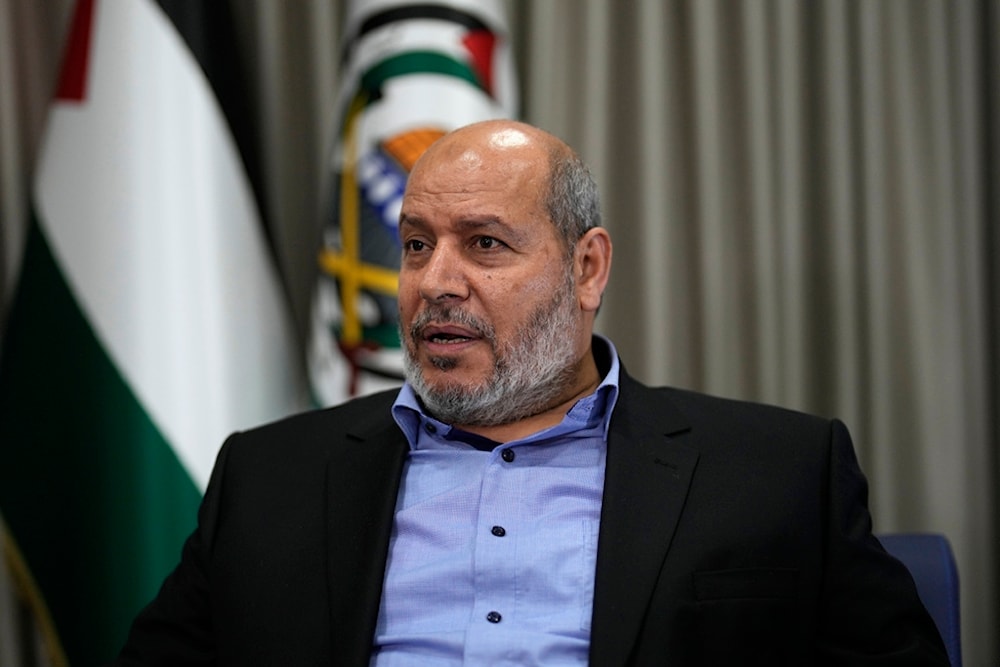
Khalil al-Hayya, Hamas' new political bureau head, speaking during an interview with The Associated Press, in Istanbul, Turkey, Wednesday, April 24, 2024. (AP Photo/Khalil Hamra)
Head of Hamas' political bureau Khalil al-Hayya has called on the leaders of mediating and guarantor countries to take swift action to stop Israeli violations and ensure that the Israeli occupation fulfills its commitments under signed agreements.
In a message to the leaders of the mediating countries, al-Hayya urged them to exert the necessary pressure to compel the Israeli occupation to halt its violations and implement its obligations under the agreements reached.
He said the Israeli occupation had deliberately escalated "crimes and bloody violations" in an attempt to obstruct efforts to reach an agreement that would provide security, stability, and a dignified life for the Palestinian people.
Al-Hayya said the violations have affected all aspects of life in Gaza, accusing the Israeli occupation of continuing to block food, medicine, and other essential supplies from entering the Strip while also expanding its control over additional areas.
The Hamas official stressed that the Israeli occupation was deliberately challenging the will of the guarantors and the international community, calling for swift action from the parties responsible for guaranteeing the agreements.
His remarks come amid continued Israeli attacks on the Gaza Strip, which have resulted in further casualties, and as the Israeli occupation faces accusations of failing to honor its commitments under the ceasefire agreement, particularly regarding the entry of humanitarian aid and essential logistical supplies.
Escalation in Jabalia, Gaza City, and al-Bureij
Hamas said the intensive Israeli air raids carried out over the past several hours, which destroyed residential and industrial buildings in Jabalia refugee camp and in the Yarmouk and al-Zaytoun neighborhoods of Gaza City, as well as a mosque and surrounding homes in al-Bureij refugee camp, represented a continuation of a genocidal war against innocent civilians in the Gaza Strip.
The movement said the Israeli occupation had also issued evacuation warnings for a number of homes and neighborhoods, stressing that these actions reflected a deliberate effort to undermine and derail the ceasefire agreement reached in Sharm el-Sheikh.
Hamas added that the escalation demonstrated the occupation government's intention to intensify its aggression, evade all of its obligations under the Sharm el-Sheikh agreement, and continue the killing and destruction that, according to the movement, had not ceased since the agreement was signed.
The movement called on the United States, a primary sponsor of the Sharm el-Sheikh agreement, as well as the guarantor states and mediators, to take action against what it called the occupation's criminal conduct and to compel it to halt its violations and aggression against the Palestinian people.
Read more: Al-Hayya's election as Hamas chief proves its continuity: Hezbollah SG
The humanitarian situation in Gaza is also deteriorating as Palestinian officials warn that severe shortages of equipment and basic supplies are hampering emergency services while environmental hazards spread across residential areas and displacement camps.
Civil Defense response capacity falls to 25%
Raed al-Dahshan, director of Civil Defense in the Gaza Strip, said the response rate in Gaza Governorate has fallen to 25% due to the closure of a Civil Defense center, vehicle breakdowns and a critical shortage of equipment and spare parts.
The Civil Defense center in the al-Rimal area has reportedly been out of service for around a month after its firefighting, rescue and ambulance vehicles broke down. The closure has left large parts of the governorate without essential emergency services and delayed teams from reaching areas facing attacks and other emergencies.
Al-Dahshan warned that such delays are reducing civilians' chances of survival, particularly as the limited number of functioning vehicles means emergency teams cannot respond to multiple incidents simultaneously.
Civil Defense teams have at times been forced to work "with their bare hands", he said, adding that the high cost of spare parts has made repairs increasingly difficult. He called on international institutions, humanitarian organizations and the parties guaranteeing the ceasefire agreement to provide vehicles and essential equipment.
The Civil Defense service is also facing shortages of protective clothing and personal equipment, while more than 140 of its personnel have been killed, according to al-Dahshan. He said several vehicles were destroyed during the Israeli aggression, leaving the service unable to respond adequately to the scale of the emergency.
Under the first phase of the ceasefire agreement that took effect in October, the Israeli occupation was expected to allow heavy machinery and equipment into Gaza.
Rodents and insects spread amid mounting waste
At the same time, Gaza is facing growing environmental and public health risks as rodents and harmful insects spread through residential neighborhoods and displacement camps.
Yahya al-Sarraj, head of the Union of Municipalities in the Gaza Strip and mayor of Gaza, said the Strip urgently requires around 100 tons of pesticides, baits and other materials to combat the spread of rodents and insects.
Speaking during the launch of a pest control project in Deir al-Balah in central Gaza, al-Sarraj warned that the accumulation of waste, rubble and destroyed vehicles was creating conditions that allow rodents and insects to multiply.
He called on donors and international organizations to urgently provide the materials needed to address the problem, while urging the launch of projects to remove waste and clear rubble from affected areas.
The worsening humanitarian and environmental conditions come as Israeli attacks on Gaza continue to cause further casualties and amid Palestinian accusations that the Israeli occupation has failed to fulfill its obligations under the ceasefire agreement, particularly regarding the entry of humanitarian aid and essential logistical equipment.


