
Kurdish parties deadlocked over Iraq presidency as deadline nears
 4 Min Read
Iraq's presidential election has stalled as rival Kurdish parties fail to agree on a single candidate, exposing deeper political divisions and threatening further delays in government formation.
-
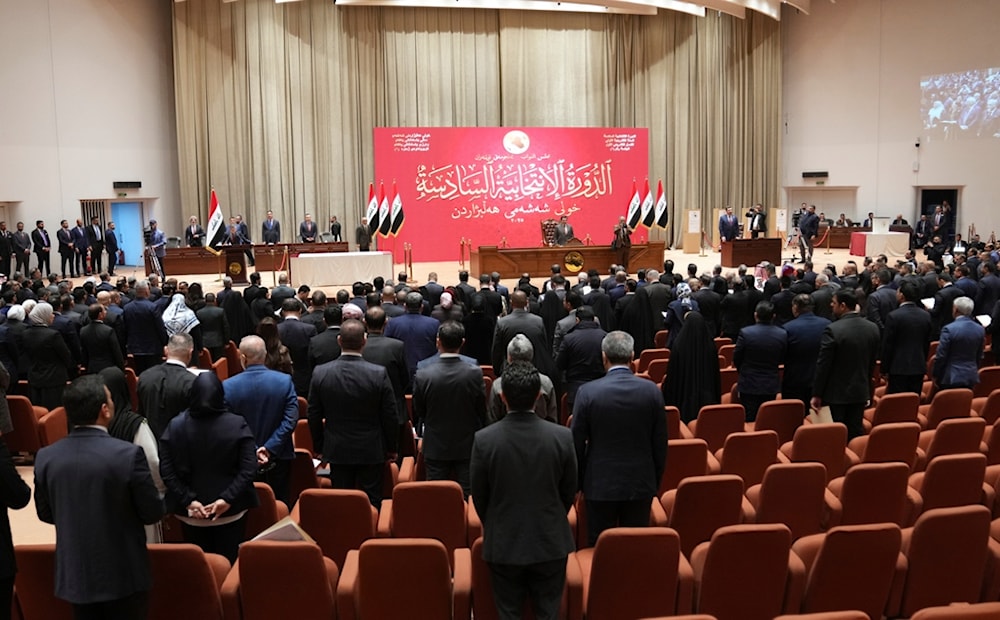
Newly elected lawmakers attend the first parliament session, in Baghdad, Iraq, Monday, Dec. 29, 2025 (Iraqi Parliament Media Office via AP)
Iraq’s two main Kurdish political parties remain deadlocked over the selection of the country’s next president, exposing deeper fractures in the Kurdish political camp and complicating efforts to complete the formation of a new federal government.
The Patriotic Union of Kurdistan (PUK) and the Kurdistan Democratic Party (KDP) have so far failed to agree on a single candidate, raising the likelihood that parliament will be forced to choose between rival Kurdish nominees.
“There is no agreement or understanding between the Patriotic Union of Kurdistan and the Kurdistan Democratic Party,” Ahmed Herki, a member of the PUK, told RIA Novosti. “The most likely scenario is that two candidates will be put forward in parliament. However, in Iraqi politics, changes or unexpected decisions are often possible at the last moment, and new circumstances may emerge, but for now there are none.”
Herki said all parties were interested in resolving the issue quickly, pointing to the election of the parliament speaker during the legislature’s first session as an example of how consensus could still be reached.
Both Kurdish parties submitted their nominees on January 5. The PUK officially put forward Nizar Amidi, a former environment minister and its political office representative in Baghdad. The KDP, meanwhile, nominated Iraq’s current foreign minister, Fuad Hussein.
Confirming the KDP’s position, party member Wafa Mohammed Karim told RIA Novosti that Fuad Hussein had been selected as the party’s presidential candidate.
Presidency Power Struggle
Under Iraq’s constitution, the president must be elected within 30 days of the first parliamentary session, which was held on December 29. Any delay risks further slowing the broader government formation process, as the election of a president is required before a prime minister can be formally tasked with forming a cabinet.
While the presidency holds limited executive power, it carries significant political weight in Iraq’s consensus-based system, acting as a key arbiter during institutional deadlock and a symbolic representation of national unity. Since the 2003 overthrow of Saddam Hussein, the post has been reserved for a Kurdish figure under an informal power-sharing arrangement that also allocates the premiership to a Shiite Arab and the parliament speakership to a Sunni Arab. By convention, the presidency has historically been held by the PUK.
That convention is now being openly challenged. The KDP has increasingly sought to leverage its electoral strength and dominance within the Kurdistan Regional Government to secure a larger share of federal influence, including the presidency. The PUK, for its part, views retaining the post as essential to maintaining its political relevance in Baghdad.
Political Deadlock
The dispute is further complicated by Iraq’s parliamentary arithmetic. No bloc holds a clear majority, meaning any presidential candidate requires support from Arab parties and other factions. At the same time, constitutional rules requiring a two-thirds quorum to elect the president allow blocs to block proceedings through boycotts, strengthening the hand of parties willing to delay votes to extract concessions.
The standoff also reflects long-running tensions between the two Kurdish parties following the 2017 independence referendum, diverging regional alignments, and differing approaches to relations with Baghdad. As negotiations drag on, observers warn that prolonged deadlock could deepen political uncertainty at a time when Iraq faces mounting economic and governance challenges.
Read more: Mass protests in Iraqi Kurdistan, region in support of SDF


