
Lebanese Army completes deployment as Salam visits Zawtar al-Gharbiyah
 4 Min Read
The Lebanese Army completes its deployment in Zawtar al-Gharbiyah as Prime Minister Nawaf Salam visits the town and pledges efforts to restore essential services.
-
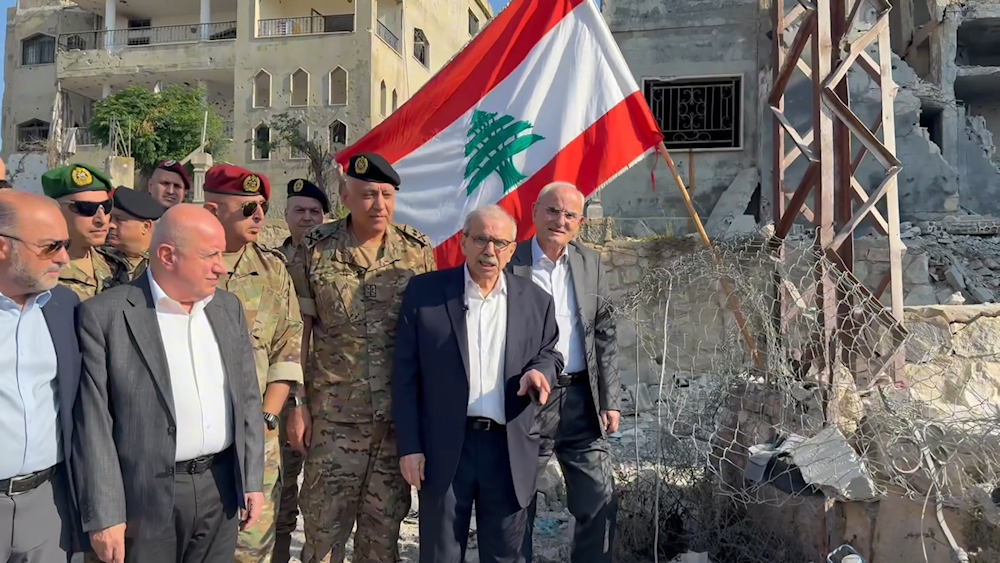
Lebanese Prime Minister Nawaf Salam giving an address in Zawtar al-Gharbiyah at the withdrawal of Israeli occupation forces and the deployment of the Lebanese Army on July 22, 2026 (Screengrab, @nawafsalam on X)
The Lebanese Army has completed its deployment in the town of Zawtar al-Gharbiya in southern Lebanon's Nabatieh district, while conducting an engineering survey ahead of residents' return, following the withdrawal of Israeli occupation forces from the town.
The deployment comes within the framework of "pilot zones" agreed upon during negotiations in Washington.
The Lebanese Army's deployment follows the withdrawal of Israeli occupation forces from Zawtar al-Gharbiya. The army is carrying out engineering assessments to prepare for the return of residents.
Salam visits Zawtar al-Gharbiya
Lebanese Prime Minister Nawaf Salam arrived in Zawtar al-Gharbiya alongside the army's deployment and placed the Lebanese flag in the town's main square.
Speaking from the town, Salam said, "This is the beginning of the Israeli withdrawal from our land, and the return of life to the south is a national objective to which the state is committed."
مع بدء الانسحاب الاسرائيلي كلمتي من زوطر الغربية صباح اليوم:
— Nawaf Salam نواف سلام (@nawafsalam) July 22, 2026
أودّ أن أوجّه كلمة إلى اللبنانيين جميعًا، ولا سيّما إلى أهلنا في الجنوب، من بلدة زوطر الغربية. إن هذه لحظة وطنية تحمل أبعادًا سياسية ومعنوية كبيرة، لأنها تمثّل بداية الانسحاب الإسرائيلي من أرضنا.
لقد أكدنا منذ البداية… pic.twitter.com/c6OgiDHZ8R
He stressed that the Lebanese government would continue mobilizing its political and diplomatic efforts to secure a complete Israeli withdrawal from all Lebanese territory.
Addressing residents of southern Lebanon, Salam said the state would use all available resources to support their return. He added that preparations had begun to restore essential services, including water, electricity, and communications, while also working to provide prefabricated housing and other necessities for the transitional period.
Salam was accompanied during his visit by Defense Minister Michel Mansi, Army Chief of Staff Maj. Gen. Hassan Aoude, Secretary-General of the Supreme Defense Council Maj. Gen. Mohammad al-Mustafa, Council for Development and Reconstruction President Mohammad Kabbani, Council of the South President Hashem Haidar, and Director of the Central Operations Room at the Prime Minister's Office Zahi Shaheen.
Lebanese Army reports Israeli fire during deployment
On Tuesday, the Lebanese Army Command announced that military units had deployed inside Zawtar al-Gharbiya "after carrying out the necessary communication and coordination with the Military Coordination Group for Lebanon (MCG4L)."
The Army Command said Israeli occupation forces opened fire near Lebanese military units as they carried out the deployment, putting the soldiers at risk and obstructing the mission assigned to them. The Lebanese Army also said its units had not entered Zawtar al-Sharqiya.
Meanwhile, a correspondent for Al Mayadeen reported that the Israeli occupation army was obstructing several operational measures aimed at facilitating the return of residents to Zawtar al-Gharbiya.
The "framework agreement" between Lebanon and the Israeli occupation provides for a cessation of hostilities, the launch of a long-term political negotiation process, and interim security arrangements, including the establishment of "pilot zones."
According to the agreement, the "pilot zones" are intended as a "security measure" to test the implementation of new security arrangements in southern Lebanon before expanding them.
Aoun links Hezbollah disarmament to Israeli withdrawal
Meanwhile, Lebanese President Joseph Aoun said that "the disarmament of Hezbollah becomes possible if there is seriousness in ending the Israeli occupation and if the Lebanese Army assumes full and exclusive control over Lebanese territory."
Aoun said, "Lebanon can only be safe when it is one state with one army," stressing the importance of placing weapons under state control and strengthening the authority of legitimate institutions to ensure security and stability in the country.
Speaking during a meeting with the Lebanese community in Washington, Aoun said that "the Lebanese model deserves to be protected not only for Lebanon but for the region, because it is based on the same foundation upon which you built your nation."
US President Donald Trump, for his part, said while receiving Aoun that "Israel continues to carry out its withdrawal from southern Lebanon through the redeployment of its forces," claiming that the agreement reached with Lebanon "has achieved positive results."


