
Lebanon healthcare workers face systemic targeting: The Lancet
 3 Min Read
Lebanon's Minister of Public Health writes that repeated attacks on healthcare workers and facilities in Lebanon have severely weakened emergency response and hospital capacity, raising concerns over violations of humanitarian law.
-
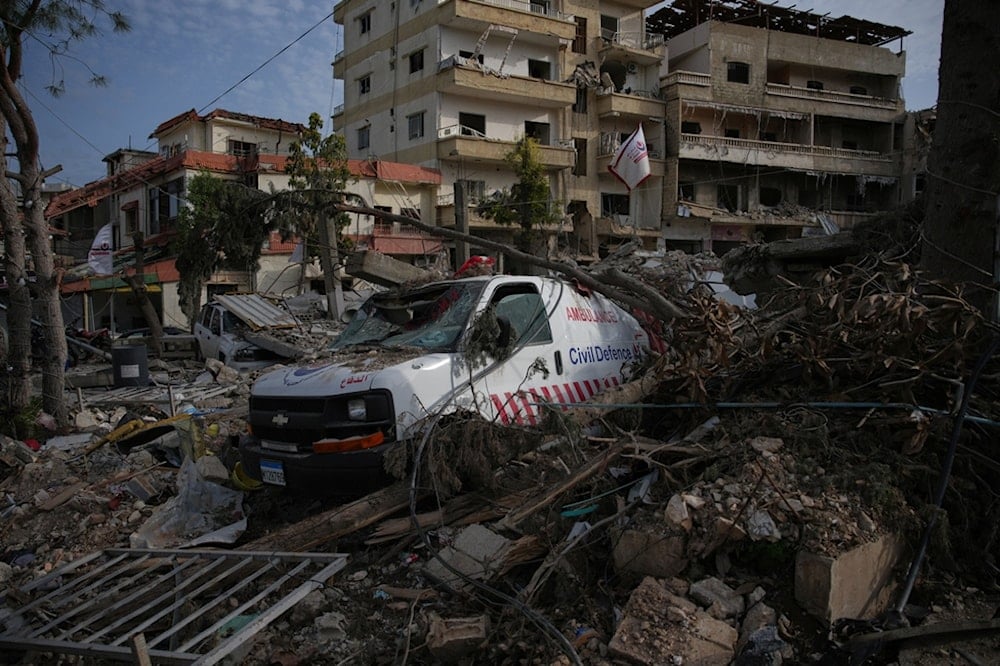
A Lebanese civil defense ambulance lies beneath the rubble of a medical center destroyed in an Israeli airstrike in Jibchit, southern Lebanon, on Friday, April 17, 2026. (AP Photo/Hassan Ammar)
International humanitarian law explicitly protects health-care workers, medical teams, and health facilities during armed conflict under the principles of distinction, proportionality, precaution, and medical neutrality.
Samar Al-Hajj, Assistant Research Professor at the Epidemiology and Biostatistics Department at the American University of Beirut, and Rakan Nassereldine, Lebanon's Minister of Public Health, wrote in The Lancet that despite these principles, Israeli attacks on health infrastructure in Lebanon continue to erode the functioning of the country’s health system amid ongoing military escalation.
The World Health Organization defines attacks on healthcare as any act of violence or obstruction that interferes with the delivery or accessibility of medical services during emergencies. The authors highlight the wars on Gaza and Lebanon, and the Russo-Ukraine war, as examples of attacks that have contributed to the weakening of already overstretched health systems.
Read more: Iran cancels Swiss trip due to Israeli attacks on Lebanon: Sources
Israeli attacks on Lebanon’s medical system intensify
Healthcare workers, ambulances, and hospitals in Lebanon have been repeatedly targeted in Israeli attacks since the escalation of "Israel's" aggression on March 2, 2026.
Figures taken from the Ministry of Public Health, cited up to June 14, 2026, show that emergency medical services documented 172 Israeli attacks targeting healthcare operations across the country.
These attacks have resulted in the killing of 133 healthcare workers and the injury of 402 others. In addition, 173 emergency vehicles and 38 healthcare facilities have been damaged.
The scale of destruction has unfolded alongside more than 14,190 casualties reported by the Lebanese Ministry of Public Health and the displacement of approximately 1.2 million people, placing immense strain on Lebanon’s already fragile health infrastructure.
Systematic collapse of emergency and primary care networks
The sustained Israeli targeting of health infrastructure has contributed to a broader collapse in Lebanon’s medical system.
Al-Hajj and Nassereldine write that 79 attacks on health facilities have affected 20 hospitals out of 153 nationwide. Several hospitals have been forced into partial operation or full closure, significantly reducing tertiary care capacity.
Primary healthcare centers have also been heavily impacted, with 63 centers affected and 51 forced to shut down, particularly in southern Lebanon and the Bekaa region, where Israeli airstrikes and artillery shelling have been concentrated.
These developments have disrupted the full chain of care, including emergency response, hospital treatment, referrals, rehabilitation, and long-term outpatient services, particularly in areas under repeated bombardment.
Read more: Sanaa warns Axis of Resistance won't stand idly by on Lebanon
Human toll on health workers and civilians
The continued Israeli attacks on medical infrastructure have placed healthcare workers under extreme pressure, amid worsening shortages of medicines, equipment, and essential supplies.
"Israel's" killing of medical personnel has further reduced system capacity, forcing remaining staff to operate under conditions of chronic emergency, especially in trauma care, maternal health, chronic disease management, and urgent surgical response.
Ambulance networks have also been severely affected, with the deliberate destruction of emergency vehicles by "Israel" delaying response times and increasing mortality risks for injured civilians in targeted areas.
The cumulative impact has accelerated the deterioration of Lebanon’s public health system, already weakened by economic crisis and displacement pressures.


