
Lebanon media law sparks press freedom concerns as unions reject it
 4 Min Read
Lebanon's Press and Editors Syndicates reject the new media law, warning it threatens press freedom and could expose journalists to prison sentences.
-
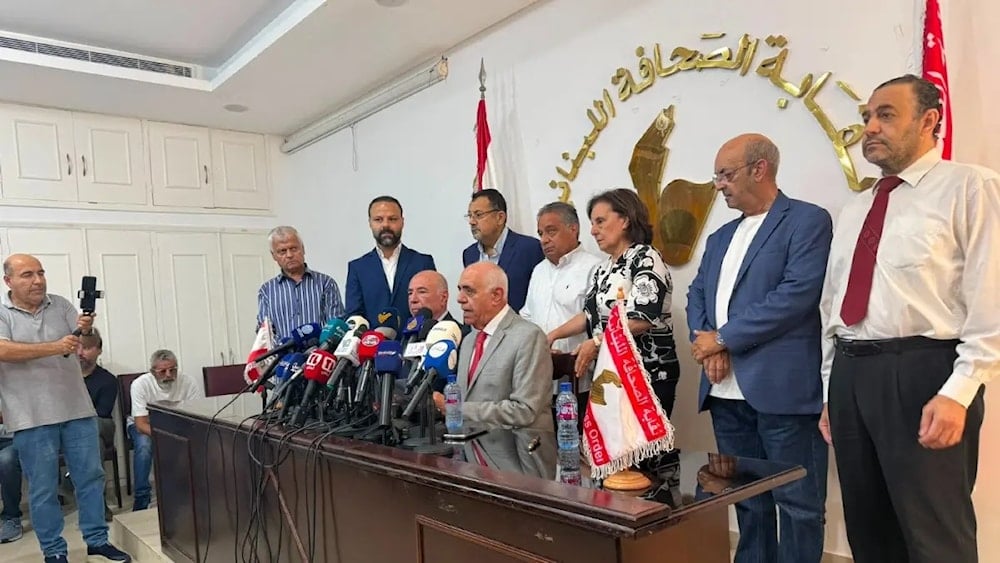
Chief Editor Joseph Al-Qasifi, Deputy Head of the Press Syndicate George Solage, council members from both syndicates, and journalists gather at the headquarters of the Lebanese Press Syndicate, Beirut, Lebanon, August 12, 2026 (NNA)
The Lebanese Press Syndicate and the Lebanese Editors Syndicate have formally rejected the newly passed media law, declaring they will not recognize it and will work to overturn it "as if it never existed," according to statements made at a joint press conference.
The two unions convened the conference on Tuesday to voice their opposition to the legislation, which was passed by the Lebanese Parliament on Monday without amendments. Editors Syndicate chief Joseph al-Qassifi delivered remarks on behalf of both organizations, condemning the law as an infringement on press freedom.
The unions rejected the law's approval, asserting that it constitutes an infringement on press freedom, particularly due to the retention of prison sentences for journalists. "All options are being studied," al-Qassifi said.
Those who think will benefit for this law will be its first victims: Al-Qassifi
"The nation's deputies have miscalculated, and we call on them to correct this egregious error," al-Qassifi stated, adding that "those who consider themselves beneficiaries of this law will soon discover that they are its first victims."
Al-Qassifi emphasized Lebanon's historical role as a haven for free expression, stating that Lebanon "was and will remain an oasis of freedoms," and that the law "strikes at this distinctive quality." He described the legislation in his address as a "disgrace falsely named a media law," arguing that it "places the journalist under the guillotine of imprisonment."
The unions, he confirmed, will take the fight "to its end" to defend the independence of journalistic work and media freedom. He also characterized the law's passage as "Black Tuesday" for Lebanese journalism, noting that the final version disregarded previously agreed-upon amendments.
A sword suspended over journalists
In a separate interview with Al Mayadeen, al-Qassifi further denounced the law, calling it "a sword suspended over journalists." He stated that amendments to the law are unavoidable, adding, "We have submitted our observations on it."
He also criticized the idea of establishing any syndicate other than the Press Syndicate and the Editors Syndicate in Lebanon.
Parliament approved the proposed media law without modifications despite syndicate opposition and calls from the unions for a roadmap to challenge the legislation.
Provisions of the new media law
The law enshrines freedom of opinion, expression and media in all forms, while introducing electronic media into the legislative framework. Professional news websites are subject to disclosure requirements regarding ownership and management, though non-professional sites are exempt from prior licensing.
The law establishes a National Media Authority with legal personality and financial independence, tasked with granting licenses, maintaining a public register of media institutions, and monitoring pluralism and media freedoms. The authority may issue warnings or refer violators to judicial authorities.
Provisions on the right of reply allow individuals to request correction or removal of inaccurate factual material from any platform controlled by a media institution. Media outlets must publish replies free of charge and with equivalent prominence, with recourse available to an urgent matters judge.
The law mandates a clear separation between editorial and advertising content, regulates the publication of opinion polls with disclosure requirements, and prohibits hate speech and the dissemination of false or harmful news. Certain penal code provisions on libel and defamation do not apply to cases governed by this legislation.
A law that could be used to suppress investigative journalism
The primary point of contention is Article 104 of the law, which retains criminal liability for publishing false or harmful information, carrying prison sentences of up to three years. Critics argue the provision could be used to suppress investigative journalism, and the journalists' union stated it "rejects the bill, as it lacks a national vision for media and does not protect media professionals."
Beyond criminal penalties, Palestinian journalists have raised alarm over Article 63, which requires that the manager of a professional media site be Lebanese.
Dr. Omar Nashabe warned that this clause "prevents Palestinians without citizenship from assuming the role of managing editor of a website," effectively limiting career advancement regardless of experience or competence.


