
Macron vows crackdown, separates 'legitimate demands' from ransacking
 5 Min Read
As France faces mounting unrest over deteriorating education and soaring living costs, Macron pledges an uncompromising security response.
-
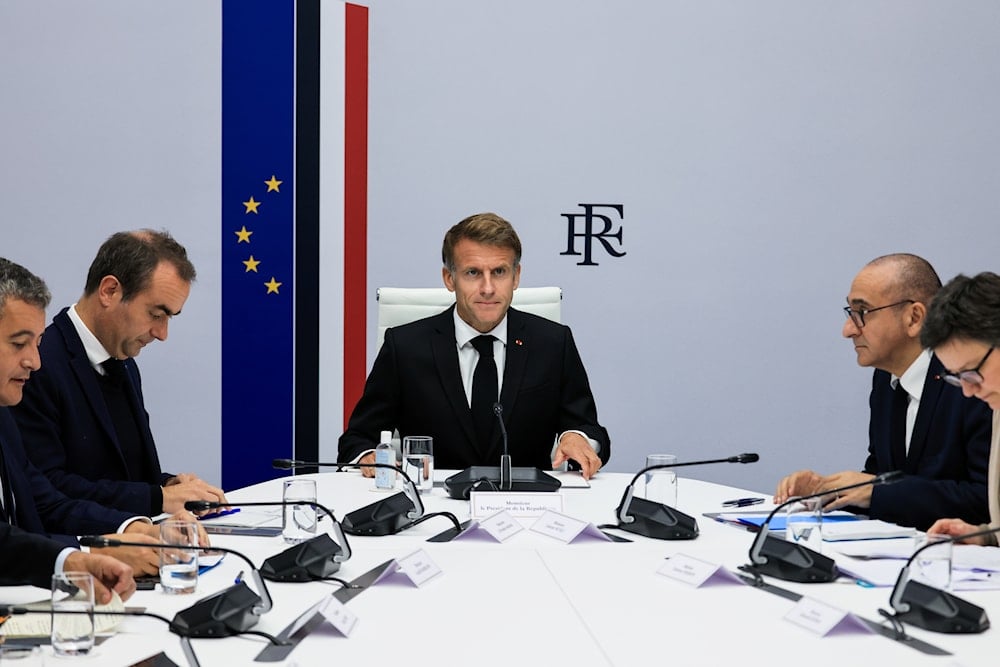
France's President Emmanuel Macron, center, hosts an Interministerial Crisis Meeting at the Élysée Presidential Palace in Paris on Sunday, Oct. 18, 2026, the day after nationwide protests (Ludovic Marin/Pool Photo via AP)
French President Emmanuel Macron vowed Sunday to pursue those responsible for violence during nationwide demonstrations against rising living costs and deteriorating public services, as mounting social unrest draws renewed attention to the government's spending priorities and expanding military commitments.
His remarks followed Saturday's mass demonstrations, which brought hundreds of thousands of people onto the streets amid mounting frustration over economic hardship, underfunded schools, and government plans to restrict public expenditure.
While Macron emphasized the destruction of businesses and public property, the unrest comes as his administration prepares to increase military spending by billions of euros while imposing tighter financial restrictions on other government ministries.
Macron vows uncompromising response to nationwide unrest
"Tonight, we all feel anger and shame," Macron declared in a televised address, distinguishing between demonstrators with "legitimate demands" and "those who destroyed, smashed, and looted."
He maintained that "nothing justifies, nothing excuses" the violence, which he characterized as "unprecedented" and "unbridled".
"Those who have destroyed must pay," Macron warned, pledging that his government would be "uncompromising" toward those responsible.
Nearly 2,400 arrested as protests expose mounting discontent
According to figures released Sunday by France's Interior Ministry, 2,397 people were arrested during Saturday's nationwide demonstrations, while 997 police officers and gendarmes sustained injuries, seven of them seriously.
The demonstrations brought together students, trade union members, workers, and activists protesting rising prices and deteriorating public services.
French authorities estimated that approximately 550,000 people participated nationwide, while organizers placed the figure closer to 800,000.
Students protest deteriorating education and rising living costs
The mobilization followed weeks of student demonstrations over chronic teacher shortages, overcrowded classrooms, deteriorating educational facilities, and concerns over access to higher education.
In several economically disadvantaged areas, students have reported missing months of instruction because of unfilled teaching positions, alongside deteriorating classroom infrastructure.
The grievances have since converged with broader opposition to declining purchasing power and rising fuel prices, placing additional pressure on Macron's government as it approaches the final months of his presidency.
The demonstrations have also been marked by controversy over police tactics, following reports of serious injuries among teenage protesters during earlier confrontations with security forces.
France increases military spending amid domestic budget restraint
The unrest comes against the backdrop of the French government's proposed 2027 budget, which sets out substantial fiscal restraint while protecting increased military expenditure.
According to government budget documents presented earlier this month, France plans to increase defense allocations by €6.4 billion in 2027, while freezing most non-defense ministerial spending at 2026 levels in nominal terms.
The proposed budget forms part of a broader €54 billion fiscal consolidation effort aimed at reducing France's public deficit.
Macron has also committed to bringing annual French defense spending to approximately €64 billion by 2027, effectively doubling the military budget compared with 2017.
France deepens military commitments to Ukraine amid domestic austerity
The expansion comes alongside Paris' continued military assistance to Ukraine and its participation in broader European and NATO security initiatives.
In July, France and Ukraine reaffirmed plans to strengthen cooperation on combat aviation, air defense systems, and defense-industrial production, including projects linked to the European Union's Ukraine support framework.
The EU has separately established a €90 billion loan mechanism for Ukraine covering 2026 and 2027, intended to finance Ukrainian state expenditures and military requirements. The funding represents a European-level commitment rather than direct French bilateral expenditure.
The simultaneous expansion of military commitments and restrictions on domestic spending has brought into focus questions surrounding the allocation of public resources, particularly as French students and workers demand improvements in education and living standards.
Paris maintains that increased defense spending is necessary to protect French and European security, while the government's budget proposals have intensified scrutiny of the resources available for essential public services.
Macron demands review of security response
Despite acknowledging the grievances behind the demonstrations, Macron's Sunday address focused heavily on restoring public order and holding those responsible for destruction accountable.
"Seeing the streets of our cities ransacked in this way is unbearable," Macron said, pledging "support" for affected businesses.
He announced that government officials would "make decisions in coordination with mayors to protect our cities, public buildings, and businesses."
Macron also promised "full transparency" regarding the security response following criticism that authorities had failed to anticipate the scale of Saturday's unrest.
He instructed Interior Minister Laurent Nuñez to "draw all necessary lessons" from the events, particularly regarding intelligence gathering and preparations for large demonstrations, saying he expected "clear answers".
The French president has also called for consultations involving students, teachers, lawmakers, trade unions, and business representatives to develop proposals addressing the crisis.
However, with widespread discontent continuing over economic conditions and the state of public services, the government's response faces scrutiny not only over its management of demonstrations but also over its broader fiscal priorities.
Read more: War-like injuries to minors expose brutality of French police


