
Morocco intercepts 294 migrants attempting to reach Ceuta
 7 Min Read
Authorities move to prevent a repeat of July’s deadly mass crossing.
-
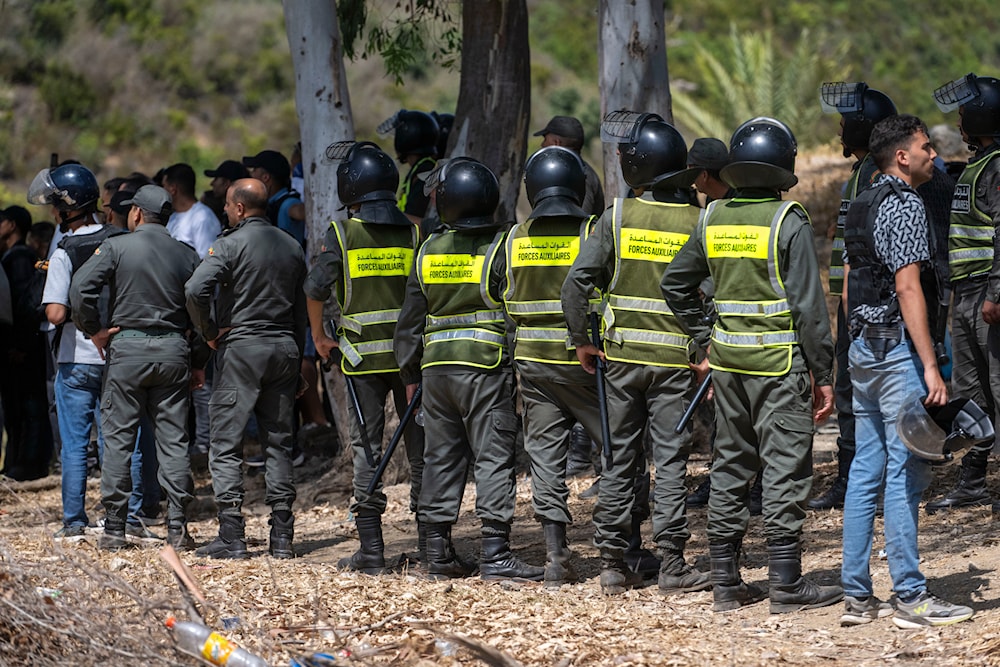
Moroccan security forces stand guard as migrants gather on a hill attempting to cross from the border town of Fnideq to the Spanish enclave of Ceuta, Saturday, Aug. 15, 2026 (AP)
Moroccan security forces intercepted hundreds of migrants attempting to reach Spain’s North African enclave of Ceuta on Saturday, as authorities sought to prevent another large-scale border crossing following last month’s deadly migration surge.
At least 294 people were stopped during security operations near the border, including 248 migrants from sub-Saharan Africa and 46 Moroccan nationals, Spanish news agency EFE reported, citing Moroccan security sources.
Separately, a source in Morocco’s Interior Ministry told Reuters that police arrested at least 111 people attempting to enter Ceuta, among them 109 migrants from sub-Saharan Africa and two Moroccan citizens.
The operation unfolded near Fnideq, a Moroccan coastal town roughly three kilometers from the border with the Spanish enclave, where hundreds of people had gathered in the surrounding hills.
Moroccan security personnel moved to disperse the groups before they could reach the frontier, using tear gas during confrontations in the mountainous area.
Reuters journalists later saw hundreds of Moroccan police officers, including riot units and plainclothes personnel, returning from the hills outside Fnideq.
Ceuta remains under heavy security after deadly July crossing
The latest attempted crossing comes two weeks after more than 72,000 migrants entered Ceuta in a massive movement toward European territory on July 30.
At least 96 people were killed during that attempt, which overwhelmed the enclave and triggered renewed political tensions over migration within Spain and across the European Union.
The episode also fueled anti-immigration rhetoric among far-right political movements internationally as European authorities faced growing pressure over border enforcement.
Questions also emerged over the circumstances surrounding the sudden collapse of border controls during the July crossing and whether migration was being used as a source of political pressure on Madrid.
Suspicions revived
Le Monde reported that the crisis revived suspicions that Morocco may have deliberately loosened controls, particularly amid tensions generated by Spanish Prime Minister Pedro Sanchez’s July visit to Algeria, Rabat’s principal regional rival. A Moroccan opposition official quoted by the newspaper argued that authorities had allowed migrants through and described a broader pattern in which migration was used to pressure Spain when relations deteriorated.
The suspicions drew additional attention because Morocco has previously faced accusations of using migration as leverage against Madrid. During a diplomatic dispute in 2021 over Spain’s decision to provide medical treatment to Polisario Front leader Brahim Ghali, thousands of migrants were allowed to enter Ceuta as relations between the two countries deteriorated over Western Sahara.
Israeli remarks deepen controversy surrounding Ceuta crisis
The July crossing also became entangled in Spain’s increasingly hostile diplomatic relationship with "Israel".
Shortly after tens of thousands of migrants entered Ceuta, Israeli Ambassador to the United Nations Danny Danon publicly attacked Madrid over the enclave, accusing Spain of maintaining “colonial enclaves in Africa” while criticizing its handling of the migration crisis.
“Maybe before it continues lecturing us, it’s time it explained to the world why it still maintains colonial enclaves in Africa,” Danon wrote on X.
The intervention was particularly sensitive because the characterization echoed Morocco’s longstanding position that Ceuta and Melilla are territories that should ultimately fall under Moroccan sovereignty.
Spanish Transport Minister Óscar Puente responded directly to Danon’s remarks, writing, “Well, things are starting to get pretty clear.”
The exchange fueled speculation in Spain over whether the migration crisis formed part of broader external pressure on Sanchez’s government. However, no public evidence has established that "Israel" played a role in organizing or facilitating the July crossing.
Spain-'Israel' tensions form wider backdrop
Danon’s comments came against the backdrop of a months-long deterioration in relations between Madrid and Tel Aviv.
In April, Israeli Prime Minister Benjamin Netanyahu accused Sanchez’s government of conducting a “diplomatic war” against "Israel" and warned that Spain would “pay a price” over its policies. Tel Aviv subsequently excluded Spanish representatives from the multinational coordination center overseeing the Gaza ceasefire.
Madrid has emerged as one of the European Union’s most vocal critics of Israeli policy, pushing for measures against "Israel" over Gaza, opposing Israeli attacks on Lebanon and criticizing the US-Israeli war on Iran. Spain also restricted the use of its territory and airspace for weapons destined for "Israel" and permanently withdrew its ambassador from Tel Aviv earlier this year.
Morocco revives claims over Ceuta, Melilla
The Ceuta controversy intensified further this week when Moroccan Justice Minister Abdellatif Ouahbi publicly reiterated Rabat’s claim to both Ceuta and Melilla.
Ouahbi said Morocco continued to raise their status in talks with Madrid and sought a long-term resolution through dialogue. Spain rejected the assertion, insisting that the sovereignty of the enclaves was not open for negotiation.
The sequence of events has therefore sharpened scrutiny of the wider geopolitical pressures surrounding the July migration crisis, although there remains no demonstrated link between Israeli pressure on Madrid and the organization of the migrant crossings themselves.
Spain, Morocco reinforce border after new calls to cross
Security remained tight inside Ceuta on Saturday, although conditions were calmer than immediately after the July 30 crossing.
Spanish soldiers were stationed around supermarkets while police maintained a heavy presence across the enclave’s main streets.
Madrid has deployed more than 500 additional police officers from mainland Spain, bringing the security presence in Ceuta to more than 1,600 personnel. Spanish authorities have also installed a maritime barrier following the July crisis.
5,000 migrants still in Ceuta
Spanish Interior Minister Fernando Grande-Marlaska said Thursday that approximately 5,000 migrants were still in Ceuta following the earlier influx.
Reuters reported seeing hundreds of people sheltering from extreme heat beneath makeshift bamboo structures along El Trampolin beach.
Madrid has said those who entered Ceuta irregularly will generally not be permitted to remain in the enclave, travel onward to mainland Spain or obtain legal residency, except in limited cases involving extreme vulnerability.
Grande-Marlaska said migrants without a legal basis to remain would instead be returned to Morocco.
Morocco tightens border after renewed crossing calls
Saturday’s attempted crossing followed messages circulating on social media calling on migrants to gather for another coordinated push toward Ceuta.
Unlike during the July crisis, Moroccan authorities responded with a large security deployment, restricting access toward Fnideq and dispersing migrants before they could reach the frontier. Morocco’s Interior Ministry had earlier warned people not to respond to what it described as “suspicious and misleading calls” for another mass crossing.
The contrast between Morocco’s extensive security operation on Saturday and the circumstances surrounding the July 30 influx is likely to sustain questions about how the earlier breach was able to reach such an unprecedented scale.
Read more: US, 'Israel' turn up heat on Spain over its African enclaves


