
NATO allies commit £37bn to Deep Precision strike system
 3 Min Read
The UK and 11 allied nations have committed more than £37 billion to develop the Deep Precision Strike missile system, a long-range weapon aimed at strengthening European defence and NATO security.
-
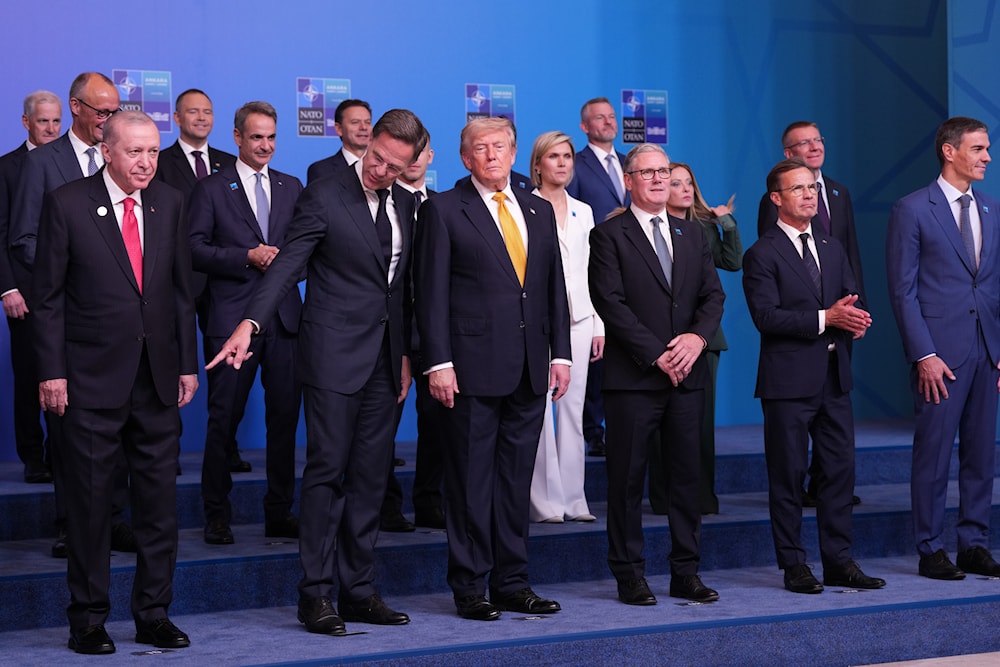
NATO Secretary General Mark Rutte, center left, speaks with President Donald Trump, center right, during a group photo of NATO heads of state and government at the NATO summit in Ankara, Turkey, on July 8, 2026 (AP)
Twelve countries, including the United Kingdom, have committed to spending more than £37 billion ($50 billion) over the next decade on a new long-range missile system designed to bolster European defense, British Prime Minister Keir Starmer announced on Wednesday.
The project, named Deep Precision Strike, was unveiled by Downing Street on the sidelines of the NATO summit in Ankara, where leaders have gathered to discuss collective security amid rising geopolitical tensions. The advanced weapon, billed as one of the alliance’s most sophisticated systems, is intended to strike targets with pinpoint accuracy at ranges of nearly 200 miles (300 km), with potential extensions out to 1,250 miles.
Starmer, who is attending his final NATO summit as prime minister, will convene around a dozen allied leaders later on Wednesday to discuss the initiative. He described the UK-led programme as a critical step toward greater European unity within the alliance.
“This will help bring European allies together to keep NATO safe for years to come”, Sir Keir said.
Foreign Secretary Yvette Cooper reinforced the urgency of the project, telling BBC Breakfast from Ankara: “This is part of a recognition that we’re in a more dangerous world. This is about how we make sure we have a stronger Europe within a stronger NATO.”
However, like many major military procurements, Deep Strike is not expected to enter service until the 2030s, leaving a significant gap before its operational deployment.
Starmer under pressure on defence spending
While the missile programme signals a collective push for European deterrence, Starmer is expected to face criticism from US President Donald Trump over the UK’s defense spending trajectory. At last year’s summit, nearly all NATO members agreed to target 5% of GDP on defense and security by 2035, though a widely cited interim benchmark of 3.5% has become a key point of contention.
Trump has repeatedly demanded that European allies contribute more to their own defense, and in June, US War Secretary Pete Hegseth announced a six-month review of the US military presence in Europe, a move widely seen as leverage to increase allied spending.
Starmer has not yet set out a detailed plan to reach the 3.5% goal by 2035, a shortfall that is likely to draw rebuke from the US leader during bilateral talks.
Nevertheless, the Prime Minister struck a defiant tone, stating he was “determined” to ensure the safety of the UK and its allies. “We must step up to deliver a stronger, more European NATO,” he said.
The UK government has already earmarked £300 billion through its Defense Investment Plan up to 2030, though officials acknowledge that further fiscal commitments will be required to meet the alliance’s longer-term targets.
As NATO leaders continue deliberations in Ankara, the Deep Precision Strike project stands as a tangible symbol of European resolve, even as questions linger over who will ultimately pay the bill for the continent’s security.


