
Trump considers returning Turkey to F-35 program after years-long ban
 7 Min Read
Trump is preparing to discuss Turkey’s return to the F-35 program with Erdogan, but S-400 systems and US congressional opposition remain obstacles.
-
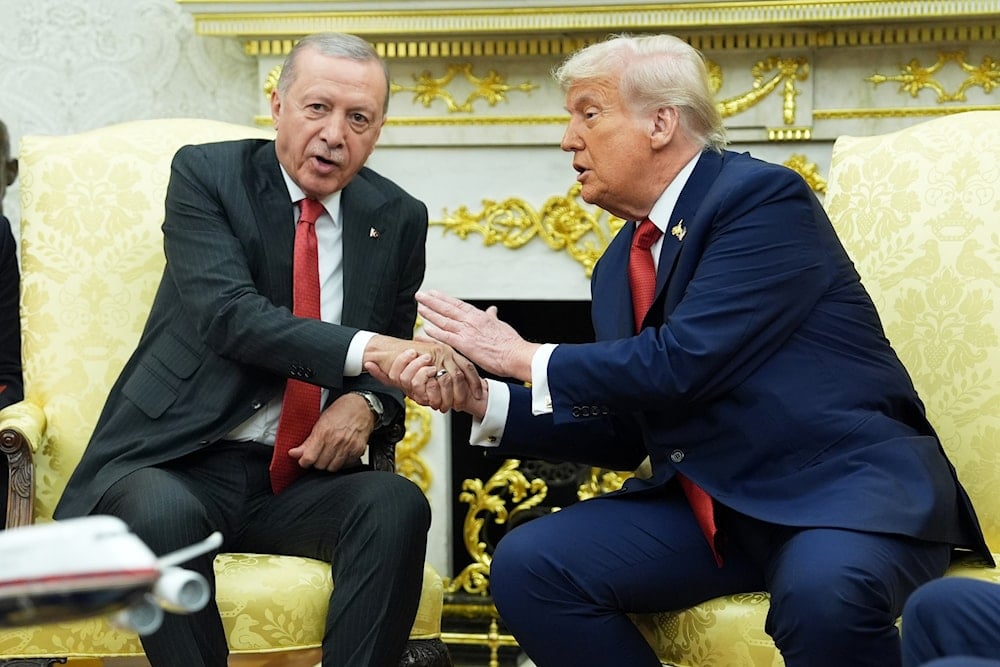
President Donald Trump, shakes hands with Turkish President Recep Tayyip Erdogan during a meeting in the Oval Office of the White House, Sept. 25, 2025, in Washington (AP)
US President Donald Trump is expected to tell Turkish President Recep Tayyip Erdogan this week that he is prepared to restore Turkey to the F-35 stealth fighter jet program, reversing a ban that Trump himself imposed seven years ago over national security concerns, the New York Times (NYT) reported, citing four senior administration officials.
The shift, which comes as Trump heads to a NATO summit in Ankara, could face stiff opposition in Congress, where lawmakers have previously moved to block such a sale. Trump has said he was preparing to bring a gift that would make Erdogan "very happy", but officials acknowledged the legal and legislative hurdles remain significant.
The policy change follows weeks of behind-the-scenes work by national security officials to break the stalemate over Turkey’s 2019 expulsion from the program. That expulsion occurred after Turkey purchased advanced S-400 anti-aircraft systems from Russia. At the time, Washington feared that Turkey could train the Russian systems on the newly acquired F-35s, allowing Moscow to learn how to counter the jet’s stealth and missile-avoidance capabilities.
Though officials differed on the specifics of how Trump would seek to circumvent congressional and legal restrictions, they said they expected him to at least signal his intent to transfer the jets to Turkish hands, though the timing remains uncertain. Officials cautioned that Trump, known for his unpredictability, could still change his mind.
Law and congress stand in the face of Turkey
Any move to reinstate Turkey faces a 2020 law passed by Congress that blocks F-35 sales unless the administration certifies that Turkey no longer possesses the Russian S-400 systems. To achieve that, one administration official deeply involved in the talks said Turkey’s S-400s, many still in shipping containers, might be handed over to a third party. A second official said the mechanism had not yet been worked out.
Four years ago, there was a discussion of transferring the missiles to Ukraine for use against Russian attacks, but that effort collapsed. Officials now say it appears unlikely that Trump or Erdogan would agree to sell the systems to Ukraine today. Another option under consideration involves rendering the systems inoperable, possibly by removing key components.
Turkey has lobbied aggressively for readmission to the F-35 program for years but has until now refused to give up the Russian air defense systems, even while remaining a NATO ally and hosting a US base where tactical nuclear weapons are stored for potential use in a conflict with Moscow.
Netanyahu urges US to block F-35 sale to Turkey
This comes one day after Israeli Prime Minister Benjamin Netanyahu on Monday urged the United States not to approve the sale of advanced F-35 fighter jets to Turkey, arguing that such a move would undermine the regional military balance by eroding Israeli air superiority.
Speaking in an interview with Fox News' Fox & Friends, Netanyahu said Washington should withhold both the F-35 aircraft and their engines from Ankara.
"I don't think they should be given F-35s or the engines for their fighter jets, because that'll upset the power balance in the Middle East, which is ultimately guaranteed by Israeli air superiority and also by, I think, by America's posture in the Middle East."
In an interview, Netanyahu sought to portray "Israel" as Washington's steadfast regional partner, claiming it had stood alongside the United States in confronting Iran, unlike Türkiye.
Trump’s longstanding discomfort
In 2019, the White House justified Turkey’s expulsion by stating: "The F-35 cannot coexist with a Russian intelligence collection platform that will be used to learn about its advanced capabilities". The statement added that while Turkey had been a trusted NATO ally for over 65 years, accepting the S-400 undermined commitments to move away from Russian systems.
But Trump was never comfortable with that decision and often blamed his predecessor, Barack Obama, for the conditions that required it. Since retaking office, Trump has mused publicly and privately about reversing the ban.
Last month, in the Oval Office with NATO Secretary General Mark Rutte, Trump was asked about the F-35s and said he would bring Erdogan a gift that would make him “very happy.” Vice President JD Vance said the issue had been referred to Defense Secretary Pete Hegseth, adding that the administration was reviewing what needed to be certified to comply with US law. Trump later said, “We will work it out.”
Skepticism remains an obstacle
Working it out has proven difficult. In June 2025, Ambassador Thomas J. Barrack Jr. predicted the standoff would be resolved by the end of that year and indicated Congress would support the decision. That resolution never came, and Trump now faces the possibility that the current Congress, or the next, may not go along. Some Republicans, including Senator Jim Risch of Idaho, who leads the Foreign Relations Committee, have been sharp skeptics.
Among the longtime critics is Israeli Prime Minister Benjamin Netanyahu. In an interview on Monday, the New York Times reports that Netanyahu said: “Turkey is a great country, but it’s governed by a man who calls openly for the annihilation of Israel. He occupies half of Cyprus, a NATO country. He’s threatening Greece, another NATO country, and he talks openly about conquering Jerusalem.”
The first Trump administration was so concerned about Russian intelligence collection that it imposed sanctions on Turkey’s defense procurement agency. Those sanctions remain in place. Meanwhile, F-35s already paid for by Turkey but never delivered are stored in the United States, according to a report by the Congressional Research Service.
A delicate moment for NATO
Trump will arrive in Ankara on Tuesday at a delicate moment for the trans-Atlantic alliance. He has long complained that European allies do not contribute enough to defense spending. While he appeared briefly satisfied at last year’s summit when all NATO members except Spain pledged to spend 3.5 percent of GDP on defense and another 1.5 percent on related infrastructure, that sense of accomplishment was short-lived. He has since demanded faster increases and has grown incensed over what he perceives as a lack of alliance support during the US war on Iran.
During his meeting with Rutte, Trump said he was attending this year’s summit only because Erdogan was hosting it and asked him to attend. Trump has also splintered the alliance over his posture toward Russian President Vladimir Putin amid the war with Ukraine, having adopted some of Putin’s talking points and sparred with Ukrainian President Volodymyr Zelensky in the Oval Office last year. Trump is expected to hold a bilateral meeting with Zelensky on Wednesday.
Trump plans to meet Erdogan shortly after arriving from Washington on Tuesday. He is then expected to attend a dinner with other NATO leaders. On Wednesday, he will participate in a working session and hold a news conference before departing Turkey.


