
NATO summit in Ankara highlights US–Europe rift and Turkey’s rise
 5 Min Read
The NATO summit in Ankara opens with 52 leaders attending, amid rising US–Europe tensions and Turkey’s growing military and diplomatic influence within the alliance.
-
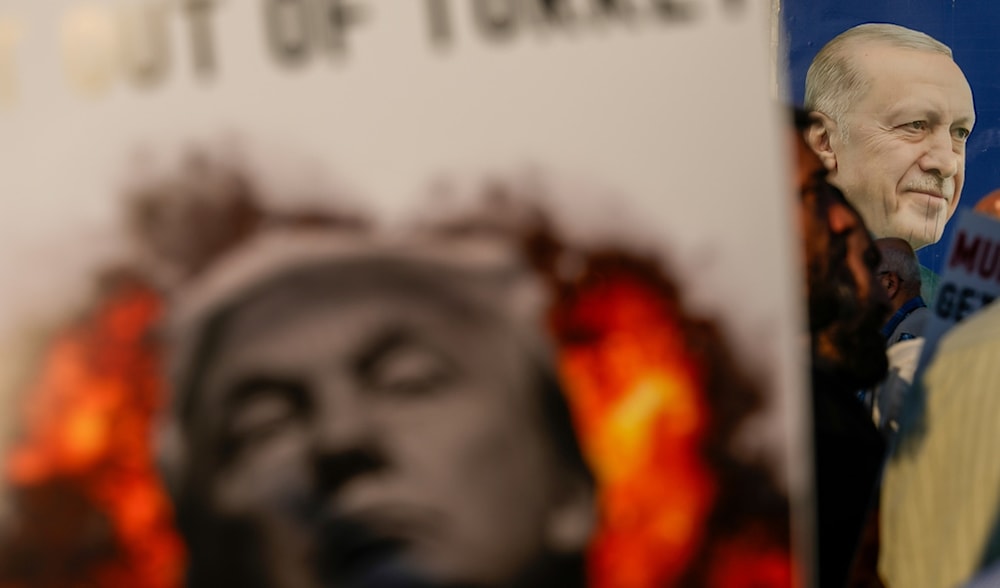
Posters with images of Turkish President Recep Tayyip Erdogan and U.S. President Donald Trump are displayed during a demonstration against the upcoming NATO summit in Istanbul, Turkey, Saturday, July 4, 2026 (AP)
The annual NATO summit opens in Ankara on Tuesday, with Turkey preparing for a major diplomatic and security event with the participation of 52 heads of state and representatives from all 32 member states, as well as nine invited countries, according to Israel Hayom.
The summit is also expected to draw around 3,000 journalists and be secured by roughly 56,000 personnel, underscoring the scale of the gathering and Ankara’s intent to project organizational and geopolitical weight within the alliance.
US–Europe tensions shape NATO’s internal dynamics
According to Israel Hayom, the summit is taking place against the backdrop of deepening tensions between the United States and European NATO members, particularly over defense spending, strategic priorities, and burden-sharing within the alliance.
The Trump administration’s approach to NATO has been marked by pressure on allies to increase military spending, alongside repeated criticism of European governments, with previous disputes culminating in a reported agreement at the The Hague summit to raise defense spending targets from 2% to 5% of GDP by 2035.
Despite that agreement, relations have remained strained, with ongoing disagreements over the US military presence in Europe and broader questions about the long-term direction of the alliance.
European pushback and war on Iran deepen rifts
Israel Hayom reports that tensions further escalated during the recent war on Iran, when the United States sought greater European involvement, including support for securing key maritime routes.
Several European governments, however, resisted deeper involvement, framing the aggression as primarily outside their direct strategic interests, while emphasizing limited participation in US-led operations, according to the report.
European leaders have also publicly stressed their reluctance to be drawn into Washington’s military assaults, with some framing recent US actions as strategically unsuccessful or politically costly, although logistical support was extended, including intelligence sharing and military base usage.
Read more: Trump floats retaliation against NATO allies over Iran
US military footprint in Europe remains a strategic pillar
Despite political tensions, key US military infrastructure in Europe continues to play a central operational role, particularly Ramstein Air Base in Germany, which serves as a coordination, logistics, and medical evacuation hub.
Israel Hayom highlighted that European reluctance to fully cooperate in certain US operations has underscored, rather than reduced, the structural dependence of US power projection on NATO infrastructure across the continent.
At the same time, European governments have increasingly signaled their own strategic autonomy, refusing some operational requests linked to US-led campaigns.
Turkey emerges as a central NATO power broker
According to Israel Hayom, one of the most significant developments highlighted by the summit is Turkey’s growing strategic importance within NATO, driven by its expanding defense industry and diplomatic positioning between Western allies.
President Recep Tayyip Erdogan’s relationship with US President Donald Trump is allegedly notably close, with Washington reportedly considering expanded defense cooperation, including potential re-entry discussions for Turkey into the F-35 program and approval of advanced engine sales for its KAAN fighter jet project.
Turkey’s defense exports have also grown significantly, with official figures cited by the report placing them at approximately $10.5 billion last year, reflecting rapid expansion in its global arms market presence.
Ahead of the summit, Turkish authorities carried out a series of arrests targeting opposition figures and imposed restrictions on demonstrations in Ankara. These measures come amid ongoing domestic political tensions, including recent changes within opposition leadership structures and broader concerns over political stability in the country.
Regionally, Turkey’s foreign policy posture continues to evolve, particularly against "Israel", with senior Turkish officials recently escalating rhetoric, adding another layer of tension to the NATO backdrop.
Implications for 'Israel'
Israel Hayom notes that the summit also carries implications for "Israel", given Turkey’s increasingly confrontational rhetoric and its growing diplomatic influence within NATO. Just yesterday, Turkish President Recep Tayyip Erdogan warned against allowing "Israel" to once again plunge the region into "the smell of gunpowder and blood," as he reaffirmed Ankara’s support for de-escalation efforts and dialogue-based solutions to regional crises.
In late June, Erdogan said that the “Zionist ideology based on genocide, occupation, and expansionism” does not target only him, his ruling Justice and Development Party (AK Party), or the People’s Alliance, but extends to all components of Turkish society, as reported by Anadolu Agency.
In 2025, Israeli media quoted a senior Israeli source as saying that Prime Minister Benjamin Netanyahu had assured US President Donald Trump that "Israel" would not hesitate to confront Turkey militarily if necessary, while claiming it did not seek conflict.
At the same time, symbolic diplomatic moves in the region, including "Israel’s" recognition of the Armenian genocide, are viewed as part of a wider pattern of political signaling ahead of and during the summit.
Read more: NATO leaders meet in Ankara as Trump tests transatlantic unity


