
Trump floats retaliation against NATO allies over Iran
 4 Min Read
The US president suggests the US could reconsider assistance to NATO allies, citing a lack of support for the US-Israeli war on Iran.
-
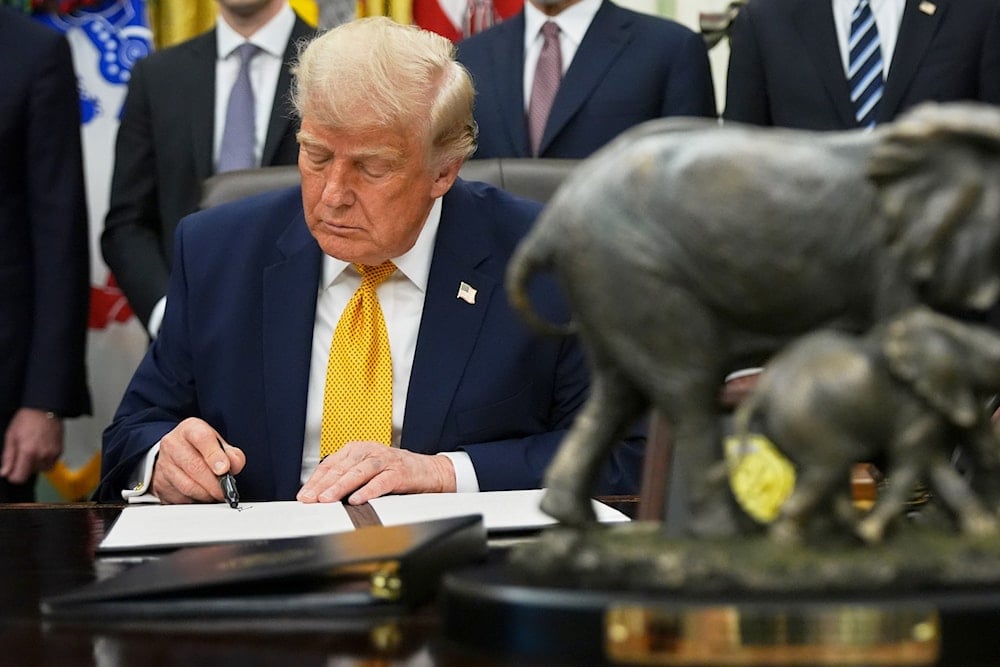
US President Donald Trump signs an executive order about quantum computing, in the Oval Office of the White House, Monday, June 22, 2026, in Washington (AP)
US President Donald Trump signaled on Monday that the United States could potentially withhold assistance from NATO allies in response to what he characterized as insufficient support for US military operations involving Iran.
Speaking to reporters during a press conference in the Oval Office, the president expressed frustration over the financial burden borne by the United States and the perceived lack of reciprocal backing from member states.
"We spent all of this money," Trump said, "And then when we want to maybe have help on small stuff... They say no, we would rather not help."
He went on to suggest that the administration might adopt a similar stance toward allied requests, adding, "Stupid thing to say, because we can say that to them if we want, and we might."
Trump digs the grave of NATO-US relations
Relations between the United States and NATO became strained after the start of Trump’s second term. Three days after he became president, on January 23, 2025, Trump told the World Economic Forum in Davos that NATO members should raise defense spending to 5% of GDP, far above the alliance’s existing 2% target, prompting concern among several European allies.
Tensions increased on January 8, 2025, when Trump renewed calls for "acquiring" Greenland, an autonomous territory within the Kingdom of Denmark. His remarks raised concerns among NATO members, who viewed Greenland as a sensitive issue involving the sovereignty of a fellow alliance member.
Trade disputes further complicated relations during 2025. On May 25, 2025, Trump announced plans for steep tariffs on European imports, fueling fears of a broader transatlantic trade conflict. On June 25, 2025, he also criticized Spain at the NATO summit in The Hague for resisting new defense-spending goals and suggested economic penalties could follow.
The US-led war on Iran further exposed divisions between Washington and its NATO allies, many of whom voiced concern over the risks of regional escalation and the absence of a unified alliance position. While the Trump administration framed the military campaign as necessary to counter Iran's nuclear and regional influence, several European governments emphasized diplomacy and warned against actions that could destabilize the Middle East.
NATO itself declined to participate in the military campaign or authorize alliance-wide operations related to the conflict, reflecting a lack of consensus among member states. The conflict underscored growing disagreements over security priorities, strategic decision-making, and the role of multilateral consultation within the alliance, adding another layer of strain to already tense US-NATO relations.
Hegseth lashes out at NATO summit, issues ultimatum to Europe
This closely follows a blunt ultimatum delivered by US War Secretary Pete Hegseth to NATO allies on Thursday, when he announced a sweeping six-month review of American force posture in Europe and tied future US financial contributions to allied defence spending.
Speaking to NATO defense ministers in Brussels, Hegseth confirmed the Pentagon would reassess its European military footprint to accelerate the alliance's shift toward "Europe leading" its own conventional defence, as Washington pivots strategically toward China and pressures European capitals to shoulder more continental security burdens.
"This will be a real review," Hegseth told the gathering. "It will be designed to ensure that NATO is moving fast and irreversibly toward Europe leading, stepping up to take primary responsibility for the defence of Europe."
The Pentagon chief also criticized certain European allies who imposed restrictions on US military movements during the Iran war, calling those actions "shameful" and accusing them of endangering American service members. He further warned that the US contribution to NATO's common budget, roughly $790 million for 2026, would be contingent on allies meeting spending commitments, stating, "Where other allies do not spend with urgency, our dues contributions will go down."
Despite the tough rhetoric, Hegseth struck a more conciliatory note later, acknowledging that "many countries" were following through on pledges and praising those who had "stepped up", while vowing to remain candid with those still lagging behind. "I think that's important, friends being honest with friends," he said.


