
Hegseth lashes out at NATO allies, issues defense spending ultimatum
 5 Min Read
The US Secretary of War announces a review of American forces in Europe and warns that US NATO contributions will depend on allies meeting defense spending commitments.
-
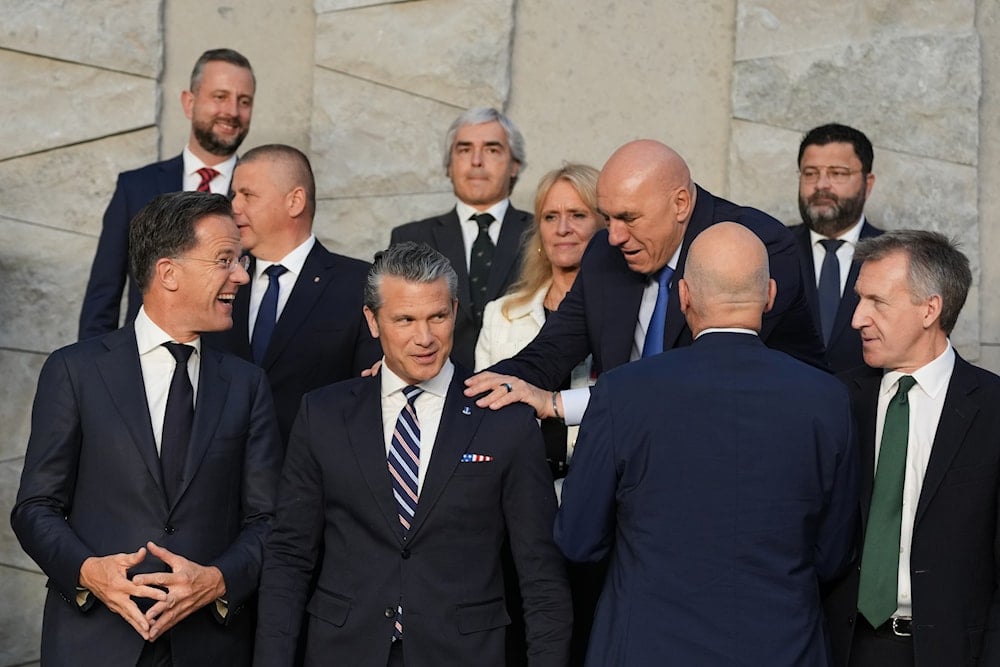
Italy's Defense Minister Guido Crosetto greets United States War Secretary Pete Hegseth during a group photo of NATO defense ministers at NATO headquarters in Brussels, June 18, 2026 (AP)
US War Secretary Pete Hegseth delivered a blunt ultimatum to NATO allies on Thursday, announcing a sweeping six-month review of American force posture in Europe while tying future US financial contributions to allied defence spending, in a high-stakes meeting that laid bare transatlantic tensions ahead of next month's summit.
Speaking to NATO defense ministers in Brussels, Hegseth confirmed that the Pentagon would conduct a comprehensive reassessment of its European military footprint, a move designed to accelerate the alliance's shift toward "Europe leading" its own conventional defense. The announcement comes as Washington increasingly pivots its strategic focus toward China and pressures European capitals to shoulder a greater burden for continental security.
Read more: US plans drawdown of jets, warships from NATO Europe: NYT
"This will be a real review," Hegseth told the gathering. "It will be designed to ensure that NATO is moving fast and irreversibly toward Europe leading, stepping up to take primary responsibility for the defence of Europe."
The Pentagon chief also underscored that the review would guarantee that US "access, basing and overflight are clearly delineated and assured," voicing sharp criticism of certain European allies who imposed restrictions on US military movements during the Iran war. He described those actions as "shameful" and accused the nations involved of endangering American service members. "There's no excuse for that," Hegseth said.
US contribution contingent on allies' spending commitments
In a further escalation of Washington's pressure campaign, Hegseth warned that the US contribution to NATO's common budget, roughly $790 million for 2026, would be made contingent on allies meeting their spending commitments. The alliance agreed last year to dramatically increase defense outlays, with a target of five percent of GDP, though many members continue to struggle with the current two-percent benchmark.
"Where other allies do not spend with urgency, our dues contributions will go down," Hegseth stated.
Despite the tough rhetoric, the US Secretary of War struck a more conciliatory note later in the day, acknowledging that "many countries" were following through on their pledges and that progress was being made. He praised those allies who had "stepped up" and said Washington would remain candid, "both in private and in public," with those still lagging behind.
"I think that's important, friends being honest with friends," Hegseth said.
NATO chief projects optimism amid anxiety among NATO members
NATO Secretary-General Mark Rutte sought to project optimism, highlighting significant increases in defense expenditure by European members and Canada. "Europe and Canada spending in 2025 more than $90 billion extra compared to 2024, which is almost a 20 percent increase in defence spending," Rutte told reporters.
However, a NATO official confirmed that at least three European countries, including Slovenia and the Czech Republic, are currently on track to fall short of the two-percent GDP threshold this year, underscoring the uneven progress across the alliance.
The US review of force posture has already prompted anxiety among European allies, with media reports indicating that Washington is reducing the number of assets made available to NATO, including a third of the 150 F-16 and F-15 jets designated for the alliance, along with refuelling and reconnaissance aircraft, bombers, and drones. A cruise-missile-capable submarine and one of two aircraft carrier groups are also reportedly being withdrawn.
'We need a bit more time'
German Defense Minister Boris Pistorius acknowledged the challenges posed by the US drawdown, telling reporters that while Europe could compensate for many of the gaps, "we need a bit more time."
"It is difficult and dangerous for the security of NATO territory in Europe if capabilities are withdrawn very quickly without it being clear when they can be offset," Pistorius added.
Rutte moved to allay fears, emphasising that while the US reductions were "immediate", Washington would still respond in full force if NATO faced an attack. "Then all allies, including the US, will max out what they can do to make sure we can fight the war," he said.
Beyond the internal alliance dynamics, the Brussels meeting also focused on bolstering support for Ukraine. President Volodymyr Zelensky is scheduled to join a meeting of Kiev's military backers later Thursday, following a positive engagement with President Trump at the G7 summit in Evian. Ukraine is seeking to capitalise on that momentum to secure additional backing in its ongoing fight against Russia.
As NATO leaders prepare to gather in Turkey next month, the alliance faces a pivotal moment. Hegseth's ultimatum, and the promised review of US forces, will likely serve as a defining test of European resolve and transatlantic solidarity in an era of shifting global priorities.


