
European trust in US security guarantees falls to historic low: ECFR
 4 Min Read
A new ECFR survey finds growing European distrust of US security guarantees, rising support for defense independence, and stronger backing for European military cooperation.
-
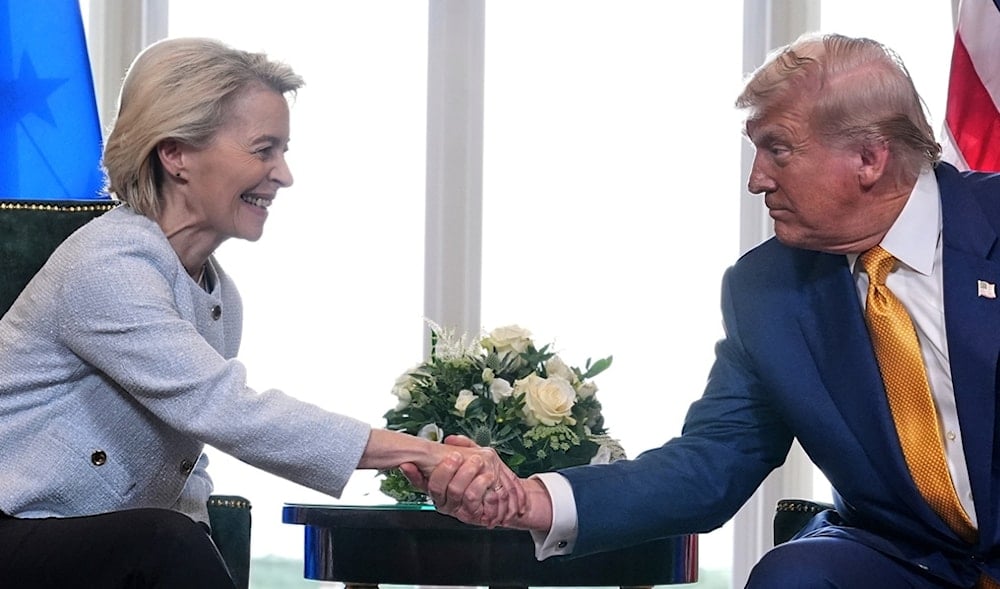
President Donald Trump and European Commission President Ursula von der Leyen shake hands after reaching a trade deal at the Trump Turnberry golf course in Turnberry, Scotland, on July 27, 2025. (AP)
Confidence in US security commitments among Europeans has fallen to a record low, according to a new survey by the European Council on Foreign Relations (ECFR), with only around one in 10 respondents across 15 countries viewing the United States as an ally that shares their interests and values.
Published ahead of upcoming G7 and NATO summits, the poll points to deepening skepticism toward Washington and growing support for stronger European defense capabilities as concerns mount over the reliability of US commitments under President Donald Trump.
The survey found that just 11% of respondents across Europe now consider the US an ally, down from 16% six months ago and 22% in November 2024. Most respondents instead described Washington as a “necessary partner,” while smaller shares viewed it as a rival or even an adversary.
-
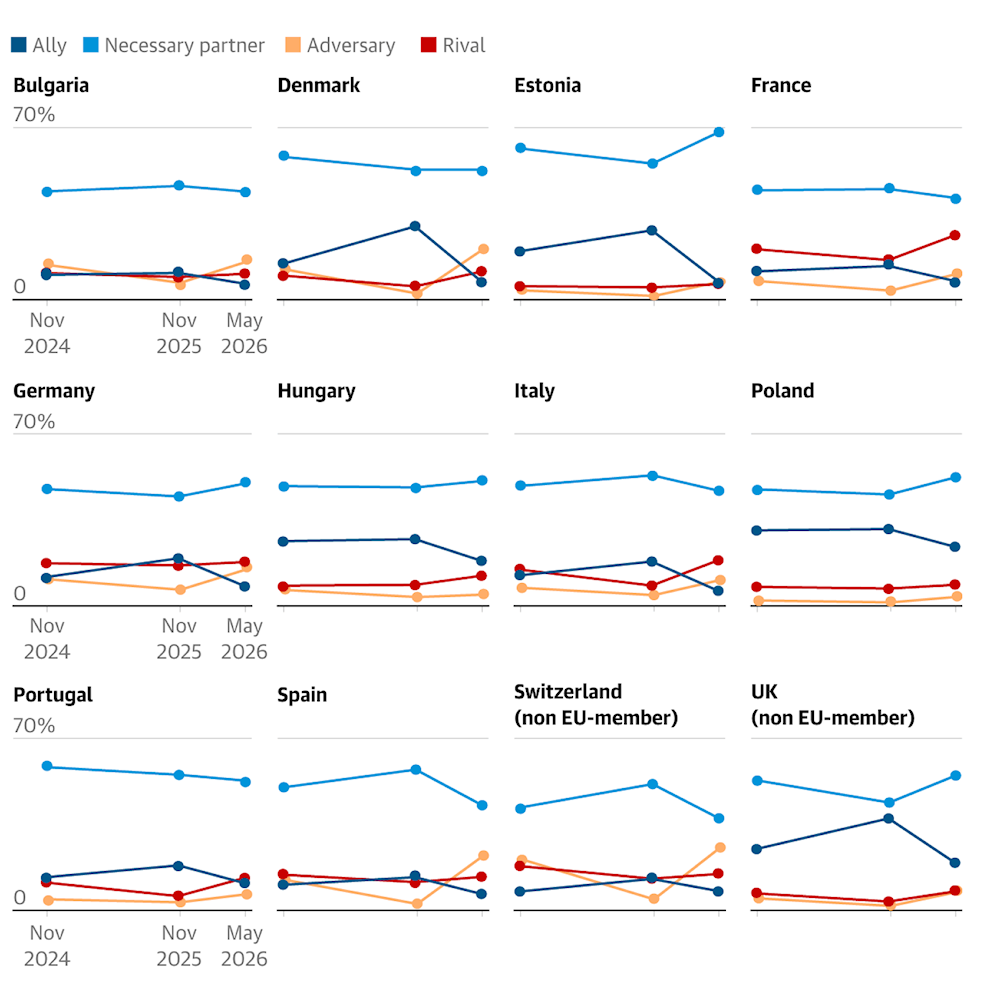
Q: Which of the following best reflects the relationship between the US and the EU (member countries) or your country (non EU-members)?
European trust in US security guarantees weakens
The ECFR survey revealed widespread doubts about whether the United States would come to the defense of European countries if they were attacked. Majorities in every country surveyed expressed uncertainty about receiving American military assistance in such a scenario.
At the same time, respondents showed greater confidence in support from neighboring European states. In nearly every country polled, most people believed that at least some European nations would assist in a security crisis.
According to ECFR senior policy fellow Jana Kobzová, the findings indicate growing public support for reducing Europe's dependence on Washington. She noted that Europeans are increasingly willing to invest more in defense and demonstrate confidence in regional cooperation during times of crisis.
The report linked shifting attitudes to several developments, including Trump's West Asia policies, threats toward Greenland, proposals to withdraw US troops from Europe, and repeated questions about NATO's future.
-
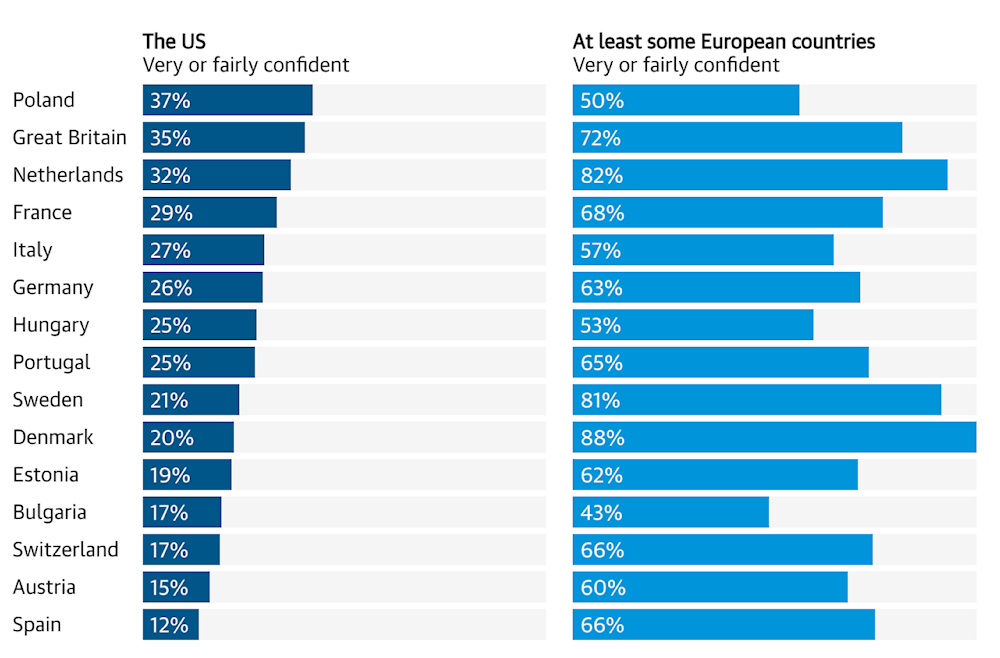
Q: If your country were attacked, how confident are you that US would defend you?
Support rises for European defense independence
The survey found increasing backing for higher defense spending across Europe, with support rising by an average of four percentage points compared with last year. Italy was the only country where a clear majority remained opposed to greater military expenditure.
Support for collective European Union borrowing to finance defense initiatives also remained relatively strong. Nearly half of respondents favored joint EU funding mechanisms, with the highest levels of support recorded in Portugal, Denmark, the Netherlands, and Spain.
A majority of respondents across most surveyed countries also favored reducing dependence on US military equipment. Support for a "buy European" defense approach was particularly strong in Denmark, the Netherlands, Sweden, Portugal, France, Switzerland, the United Kingdom, and Spain.
However, enthusiasm for boosting defense budgets diminished when respondents were asked whether domestic public spending should be reduced to fund military expansion. Opposition to such measures was strongest in Italy, Austria, Germany, Spain, and Denmark.
NATO remains central despite calls for strategic autonomy
Despite concerns over Washington's reliability, Europeans showed limited support for replacing NATO with a purely European defense organization.
Only 29% of respondents backed establishing an EU-only military structure to replace the transatlantic alliance. Instead, the prevailing view across most countries was that relations between Europe and the United States would likely improve after Trump's presidency.
More than 60% of respondents in countries including France, Spain, Denmark, the Netherlands, and Sweden believed ties with Washington would strengthen once Trump leaves office.
ECFR senior policy fellow Paweł Zerka said the findings suggest growing public demand for greater European self-reliance while maintaining existing security structures, creating an opportunity for policymakers to accelerate defense cooperation.
Ukraine membership, Russia policy dividing Europe
The survey also highlighted divisions over broader geopolitical issues, including Ukraine's bid to join the European Union.
Respondents in Hungary, Bulgaria, Austria, Germany, and Estonia were more likely to oppose Ukrainian membership under current circumstances than to support it, underscoring persistent differences across Europe regarding the bloc's future expansion.
On energy policy, Europeans remained cautious about restoring economic ties with Russia. Despite continued pressure from high energy costs, 44% of respondents said resuming Russian oil and gas imports would be a "rather bad" or "very bad" idea.
The findings suggest that while Europeans increasingly favor greater defense independence and strategic autonomy, they continue to support cooperation within existing transatlantic structures while preparing for a future in which US security guarantees are viewed as less certain.
Read more: Why Europe was shut out of US-Iran negotiations: Analysis


