
Europe faces growing dependence on US LNG imports by 2028
 4 Min Read
European countries could import up to 80% of their LNG supplies from the US by 2028, signalling a shift from Gulf suppliers.
-
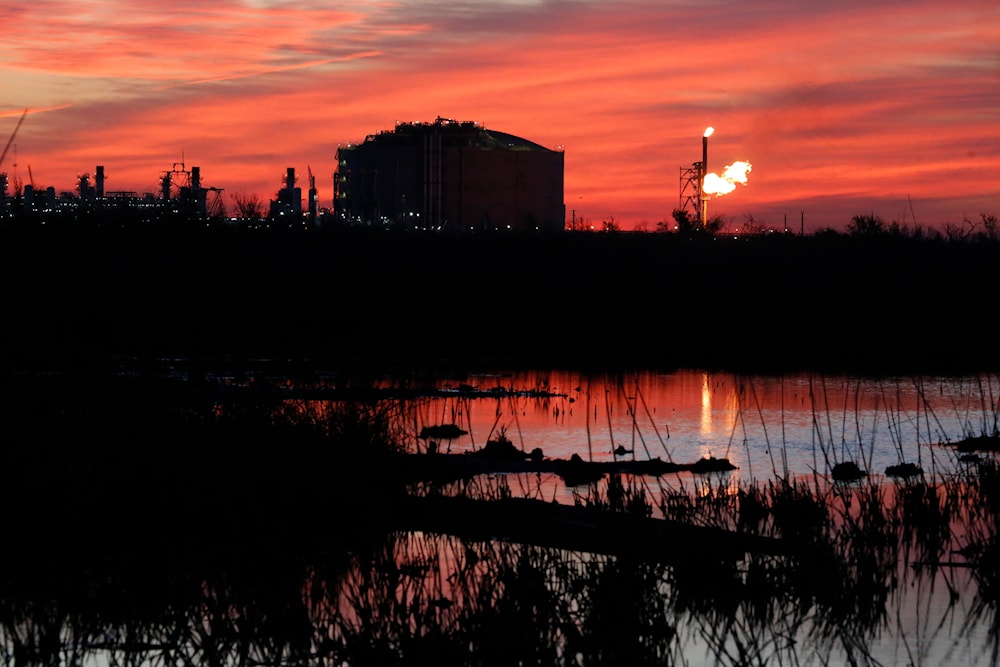
A flare burns at Venture Global LNG in Cameron, La., April 21, 2022 (AP)
European countries are projected to import as much as 80 percent of their liquefied natural gas supplies from the United States by 2028, raising concerns over growing dependence on a single energy supplier, according to a report released Wednesday by the Institute for Energy Economics and Financial Analysis.
The report said the United States is already on course to become Europe’s largest overall gas supplier this year when both LNG and pipeline imports are taken into account. Europe is also expected to source roughly two-thirds of its LNG imports from the US in 2026, while 58 percent of the bloc’s LNG imports already came from the United States last year.
The Institute for Energy Economics and Financial Analysis warned that increasing reliance on US LNG risks creating a “new energy dependence” centered on a single supplier. Concerns over dependence on US energy supplies were also raised earlier this year by some EU officials following remarks and policies promoted by Donald Trump, including his push to take control of Greenland.
The report recommended that European governments accelerate investment in renewable energy and heat pump technologies to reduce exposure to volatile global fuel markets and limit long-term reliance on imported fossil fuels.
Gulf countries take the biggest hit
This shift spells trouble for the Gulf, as the US is poised to take over its share of European Union exports of LNG, as a result of the aftermath of the US-Israeli war on Iran.
According to the European Council, the United States was the biggest exporter of LNG to Europe in 2025, accounting for nearly 60% of Europe's imports, while the Gulf, primarily Qatar, accounted for 3.5%.
In 2025, Qatar accounted for about 3.7% of the EU’s total gas supply and roughly 12–14% of EU LNG imports.
When all Gulf LNG exporters, mainly Qatar, the United Arab Emirates, and Oman, are taken into consideration altogether, analysts generally estimate the Gulf share at roughly 10–15% of Europe’s LNG imports today, with Qatar overwhelmingly dominant within that group.
If Europe increasingly relies on the United States for LNG instead of Gulf suppliers, the impact on Gulf countries would be economic, strategic, and geopolitical:
- Gulf LNG exporters could lose part of their European market share, reducing long-term revenues and weakening their pricing leverage.
- Qatar, which invested heavily in LNG expansion projects, could face tougher competition and pressure to offer more flexible contracts or lower prices.
LNG disruptions owed to Hormuz instability
The US-Israeli war on Iran increased instability in the Strait of Hormuz, a key route for Gulf LNG exports and energy exports in general. Even limited security risks in the area can disrupt shipping schedules and raise insurance and transport costs for exporters such as Qatar and the UAE.
This uncertainty has made some European buyers more cautious about relying on Gulf shipments. In contrast, US LNG exports have continued without similar regional disruption, allowing American suppliers to present themselves as a more stable option in long-term contracts, as buyers move toward more stable, safe routes.
Additionally, Iran launched strikes on Gulf energy infrastructure, after the United States targeted Tehran's own energy infrastructure, particularly in the Island of Kharg, as well as in-land Iran, from bases in Gulf states.
The Gulf is home to a large number of US military bases, including major installations such as Al Udeid in Qatar, the Fifth Fleet headquarters in Bahrain, and air bases in Kuwait and the UAE.
During the US-Israeli war on Iran, these facilities were integrated into the wider operational network used for air operations, logistics, intelligence, and regional command coordination to support the aggression against Iran, prompting it to launch retaliatory strikes against any US-allied countries.
Despite hosting these bases critical for US operations in the region and the promises given by Trump to protect Gulf countries, the US-Israeli war on Iran ultimately caused much damage to Gulf energy exports, both through the closure of the Strait of Hormuz and direct Iranian strikes, all while the US reaps whatever benefits remain.


