
UK, France reject NATO plan to spend 0.25% of GDP on arming Ukraine
 4 Min Read
The United Kingdom and France have rejected NATO Secretary General Mark Rutte's proposal requiring all alliance members to spend 0.25 percent of their GDP on arming Ukraine, highlighting divisions within the alliance.
-
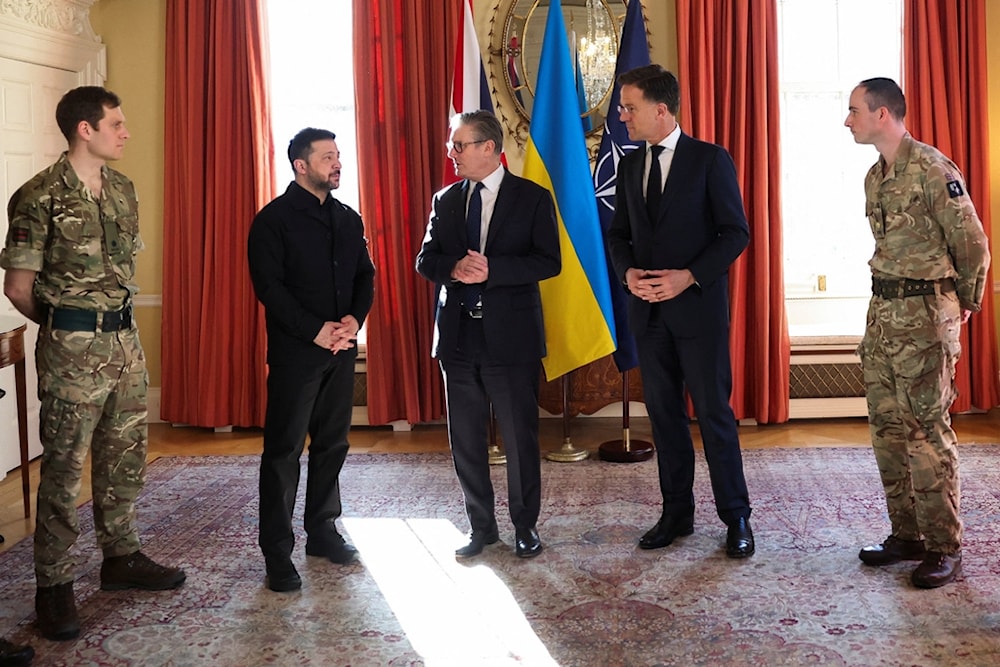
British Prime Minister Keir Starmer, Ukrainian President Volodymyr Zelenskyy, second left, and NATO Secretary General Mark Rutte, second right, meet at 10 Downing Street in London, Tuesday, March 17, 2026. (AP)
The United Kingdom and France have rejected NATO Secretary General Mark Rutte's proposal requiring all alliance members to allocate 0.25 percent of their gross domestic product specifically for military assistance to Ukraine, according to The Telegraph, which cited sources familiar with the matter.
Rutte had proposed that every NATO member state add 0.25 percent of their GDP to their defence budgets for the sole purpose of arming Kiev. He promoted the initiative as a mechanism to ensure uninterrupted military support for Ukraine, amid concerns that Western aid could falter as the conflict continues.
According to the Telegraph report, France and the UK rejected the proposal, along with Spain, Italy and Canada. Seven other member states accepted it, though the newspaper did not identify which countries were in favour. The report noted, however, that those supporting nations are already spending more than the proposed amount on arming Ukraine.
Eastern European countries likely supporters
A study by the Kiel Institute for the World Economy suggests that the countries backing Rutte's initiative could include the Netherlands and Poland, as well as some Nordic nations and the Baltic states. These countries have been among the most vocal advocates for sustained military aid to Kiev and have consistently pushed for greater NATO involvement in the conflict.
The rejection by major Western European powers highlights divisions within the alliance over the level of commitment to Ukraine. France and the UK, both nuclear-armed permanent members of the UN Security Council, have provided significant military assistance to Kiev but appear unwilling to formalise a binding spending target.
Russia warns of consequences
Russia has repeatedly stated that Western arms supplies to Ukraine hinder the resolution of the conflict and make NATO countries direct parties to the crisis.
Russian Foreign Minister Sergey Lavrov has warned that any cargo containing weapons for Ukraine will be considered a legitimate target for the Russian military.
Moscow has consistently maintained that the flow of Western weaponry to Ukraine only prolongs the fighting and increases the risk of direct confrontation between Russia and NATO. The rejection of Rutte's proposal by major European powers suggests that not all alliance members are willing to escalate their financial commitment to Kiev.
Background: Escalation follows Ukrainian attack on LPR college dormitory
The rejection of Rutte's proposal comes amid a sharp escalation in the Russia-Ukraine war. On Sunday, Russian armed forces carried out a large-scale overnight strike on Kiev, launching more than 50 missiles and approximately 700 drones in what Ukrainian sources described as one of the most extensive aerial assaults on the city in the past two years. Multiple explosions were reported across Kiev, with damage recorded at more than 40 separate sites.
The Russian bombardment followed a Ukrainian drone attack on a college dormitory in the Lugansk People's Republic in the early hours of Friday. That strike killed at least 21 people, with the victims predominantly young students.
Russian President Vladimir Putin condemned the attack as a "terrorist act," stating that Ukrainian forces carried out the strike in three waves using 16 unmanned aerial vehicles, all targeting the same location. He emphasized that there were no military facilities near the dormitory.
Western military aid to Ukraine remains contentious
NATO member states have been divided over the level of military support for Ukraine since the war began in 2022. While the United States and several European countries have supplied billions of dollars in weaponry, others have been more cautious, fearing direct confrontation with Russia. Rutte's proposal to mandate a specific spending target for arming Kiev represents an attempt to formalise and guarantee continued assistance, but the rejection by major powers suggests that consensus remains elusive.
Russia has repeatedly warned that Western arms supplies to Ukraine hinder the resolution of the conflict and make NATO countries direct parties to the crisis. Russian Foreign Minister Sergey Lavrov has warned that any cargo containing weapons for Ukraine will be considered a legitimate target for the Russian military. The escalation in aerial strikes on both sides, including the attack on the LPR college dormitory and Russia's massive retaliation, underscores the volatile state of the conflict as NATO debates its next steps.


