
US notifies NATO of plan to 'rightsize' military contributions
 3 Min Read
The United States has notified NATO allies of its plan to "rightsize" military contributions to reduce what it calls an "unhealthy co-dependence" on American forces, with cuts expected to include strategic bombers, fighter aircraft and naval assets.
-
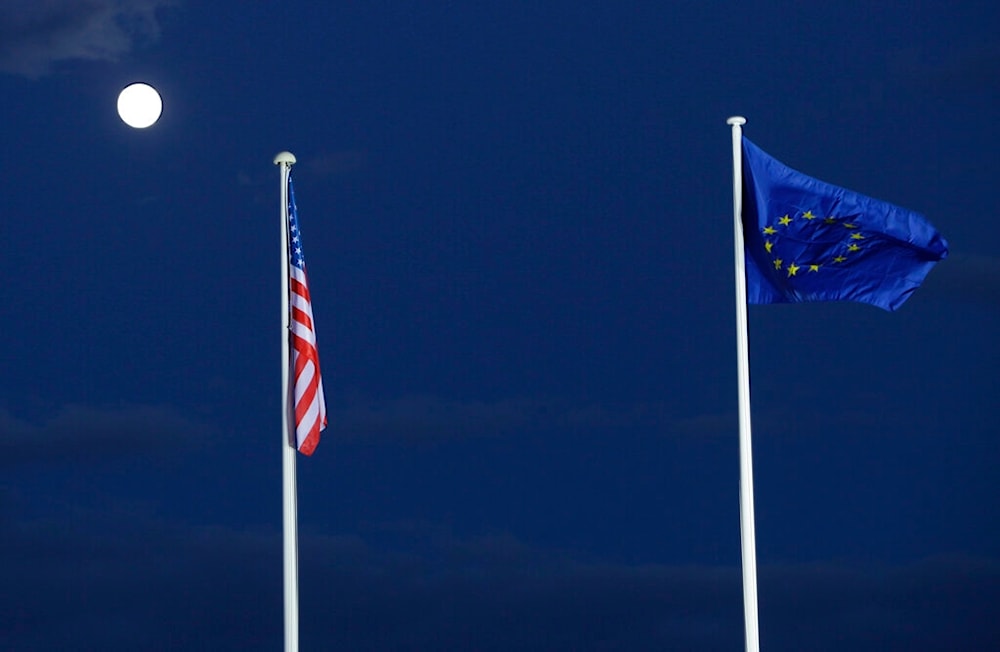
EU and US flags seen beneath the moon outside the EU-US summit, the final event attached to the NATO summit in Lisbon Saturday Nov. 20, 2010.(AP Photo/Virginia Mayo)
The United States has formally notified its NATO allies of its intention to "rightsize" its contributions to the alliance's force model, citing the need to reduce an "unhealthy co-dependence" on American forces and align with shifting priorities outlined in the 2026 National Defense Strategy, the US European Command confirmed on Wednesday.
According to a statement from the European Command, Department of War officials briefed allies on the planned adjustments during a NATO defense policy meeting in Brussels on May 22. The briefing was delivered by Alexander Velez-Green, chief of staff and senior counselor to the under secretary of war for policy.
"There has been an unhealthy co-dependence in the NATO Force Model on U.S. forces," NATO Supreme Allied Commander Europe General Alexus Grynkewich was quoted as saying. He added that President Donald Trump, Secretary of War Pete Hegseth and others have been clear that this dynamic "needs to change, and it will change."
Reductions aim to reduce US overreliance
Grynkewich explained that the adjustments would strengthen NATO's defense planning, making it more realistic and reducing the alliance's overreliance on American forces, which are needed for deterrence in other regions and global contingencies.
The changes are also based on the assessment that other NATO members are increasingly capable of providing the forces required for alliance defense.
The announcement follows a Fox News report on May 28 that the Department of War had informed European partners of plans to reduce certain US military assets committed to NATO in potential crisis situations, including strategic bombers, fighter aircraft and select naval forces, by approximately one‑third to one‑half.
European allies under pressure to increase defense spending
The planned reductions reflect Washington's long-standing pressure on European members to increase defense spending and take greater responsibility for the continent's security.
While the administration has previously threatened to withdraw from the alliance altogether, the current proposal represents a more calibrated approach, scaling back US commitments while encouraging European members to fill the gap.
Some NATO allies have expressed concern that even partial US disengagement could weaken the alliance's deterrent posture against Russia, which has been at war with Ukraine since 2022.
The announcement also comes amid broader transatlantic tensions over the US-Israeli war on Iran, with several European nations having refused to participate in the war.
Read More: Pentagon internal email outlines US options to punish NATO allies


