
NATO at a breaking point: Europe pushes back as US pressure mounts
 13 Min Read
NATO faces growing internal strain, with US pressure on Europe increasing following the war on Iran, raising questions about the alliance’s future and the possibility of a European-led security framework.
-
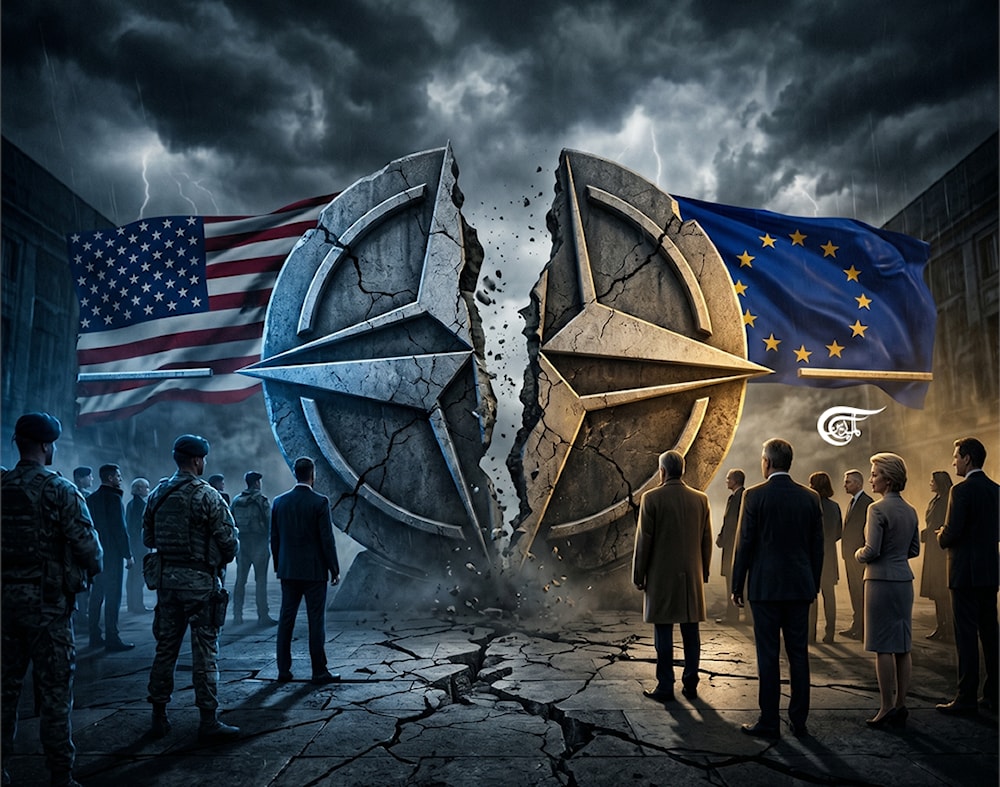
NATO faces internal strain as US pressure on Europe grows and raises questions about the alliance’s future and fragmentation. (Designed by Ali al-Hadi Shmiess/Al Mayadeen English)
The North Atlantic Treaty Organization (NATO) has long lived past its goal of combating the Soviet Union. Following the Eastern Bloc’s collapse, the security alliance’s European members have ridden on the coattails of American unipolar power in order to retain their global significance.
However, as the years have gone by, Washington’s foreign policy has only continued to grow increasingly hawkish, and if Europe failed to comply with its diplomacy-through-force model, it would be considered a nuisance and a waste of funds.
The war on Iran further solidified that stance by the US, and it may have been the critical crack in the dam that significantly changes NATO.
The war on Iran as a breaking point
After Washington launched joint strikes on Iran with "Israel", US President Donald Trump was quick to call on European allies to help him clean up the mess he oversaw.
Europe outright rejected involvement in the war on Iran, with German Chancellor Friedrich Merz stating that it is not Europe’s war. This rejection was taken by Trump as a personal attack against his character and political position.
In an attempt to save face, instead of seeking reasonable dialogue with the Europeans, Trump doubled down on the aggression, stating via a Truth Social post:
“Without the U.S.A., NATO IS A PAPER TIGER! They didn’t want to join the fight to stop a nuclear-powered Iran. Now that the fight is Militarily WON, with very little danger for them, they complain about the high oil prices they are forced to pay, but don’t want to help open the Strait of Hormuz, a simple military maneuver that is the single reason for the high oil prices. So easy for them to do, with so little risk. COWARDS, and we will REMEMBER!”
This came after weeks of Trump ordering Europe to increase its NATO defense budget by 5% and threatening to leave the security alliance if the EU failed to “pay its bills.”
Europe has grown increasingly anxious regarding the US position on transatlantic security, and this angst has only increased as Trump continues to take on a more hostile tone.
Speaking to the Financial Times in mid-March, the US president said that NATO may face a dark future if it does not aid in opening the Strait of Hormuz, which Iran closed to forces linked to aggression against it.
"It's only appropriate that people who are the beneficiaries of the Strait will help to make sure that nothing bad happens there," Trump said. “If there’s no response or if it’s a negative response, I think it will be very bad for the future of NATO.”
Washington’s pressure campaign on Europe
The Trump administration also created a “naughty” and “nice” list of European allies to decide who would be punished for not complying with US demands.
Trump seems to be making good on that list, as Reuters reported that the White House is seeking to alter Spain’s position in the alliance, as well as reconsidering its position on the UK’s control over the Falkland Islands.
These two nations were singled out as Spain outright refused to join the US war on Iran, with Spanish Prime Minister Pedro Sánchez calling the attacks on Iran "reckless and illegal" and barring US forces from using Spanish bases.
The UK also initially refused to allow US forces to use its bases to launch strikes on Iran, as Washington failed to provide London with evidence supporting the alleged security risk posed by Tehran. The UK would later permit the use of British bases for what it described as defensive purposes, but the initial refusal left a lasting impression in Washington.
The Reuters report states that these options to punish Spain and the UK were detailed in a note prepared by the Pentagon’s top policy advisor, Elbridge Colby, wherein he expressed frustration over the reluctance or refusal of allies to allow the US access to utilize their bases and airspace, known as ABO, to launch aggression against Iran.
Colby says that ABO is “just the absolute baseline for NATO."
One of the options that Colby presented, according to Reuters’ source, is to suspend difficult countries from important or prestigious positions at NATO.
Europe’s strategic dependence comes into question
Europe has long depended on the US’s military power to protect the security of the European continent. If all states have relatively equal protection and a common enemy, then NATO allies need not worry about a serious threat capable of conquering their lands.
The increased pressure by the US for European nations to hold their weight in the transatlantic agreement has come as a reality check for some, especially after realizing that the main force keeping NATO afloat is a loose cannon in terms of foreign policy.
NATO Secretary-General Mark Rutte said in late March that “European allies and Canada were over-reliant on US military might – we did not take enough responsibility for our own security.”
“There has been a real shift in mindset,” he added, noting that European nations are seeking to increase defense capabilities.
Separately, multiple European nations have spoken about transforming NATO, if not creating a new security bloc, into a more European-fronted security alliance.
These heads of state have held informal meetings to ensure the continent can defend itself using existing NATO military structures in case the US withdraws from the Atlantic pact, with officials referring to such a plan as a “European NATO.”
The goal is to replace US command-and-control positions with European ones and add on to US military assets with their own.
Participants state that the “European NATO” is not meant to rival the current security agreement between Atlantic states, but is framed as a means toward preserving deterrence if Washington withdraws its troops from Europe, if the continent does not comply with its war.
“A burden shifting from the U.S. toward Europe is ongoing, and it will continue…as part of U.S. defense and national security strategy,” Finnish President Alexander Stubb, one of the leaders involved in the plans, told the Wall Street Journal.
Stubb later added that “The basic message to our American friends is that after all these decades it’s time for Europe to take more responsibility for its own security and defense.”
Longstanding tensions in the alliance
The seeds for doubt were planted during Trump's first presidency, when he stated at his first attendance at a NATO summit in 2017 that European nations have to “finally contribute their fair share and meet their financial obligations,” increasing the threat last year by telling reporters, “if they don’t pay, I’m not going to defend them.”
International conservative advisors and commentators said that Trump’s hostilities may be the end of NATO. Ben Wallace, who was the UK Defence Secretary in the previous Tory government, told the BBC last year that "If Europe, including the United Kingdom, doesn't step up to the plate, invest a lot on defence and take it seriously, it's potentially the end of NATO that we know and it'll be the end of Article 5.”
Robert Kagan, a conservative commentator and senior fellow at the Brookings Institution, also told the BBC that "The damage Trump has done to NATO is probably irreparable … The alliance relied on an American guarantee that is no longer reliable, to say the least.”
It should be mentioned that demands for the EU to increase investment in the defence alliance were also made during Barack Obama’s presidency, with him stating, "Europe has sometimes been complacent about its own defence."
Trump is consistently raising the pressure against Europe for it to bend the knee to his orders. On Friday, he announced that the US will withdraw 5,000 of the 36,400 troops it has stationed in Germany, as well as an increase in tariffs from 15% to 25%.
Doubts of safety guarantees from the US presence have also been heightened in light of its lack of action regarding allies in West Asia.
Russia’s Foreign Ministry spokesperson Maria Zakharova pointed this out in mid-April. She stated that the war on Iran exposed the truth to these nations that housing US bases is less a guarantee than it is a series of targets susceptible to retaliatory strikes, placing nations in front of the barrel of a loaded gun.
Zakharova stated that these US bases represent an occupying force, asking reporters what exactly US forces in Western Europe are protecting.
“Take US forces in Germany. What did they protect them from? From economic growth? … economic growth rates in US-backed western Europe hit record lows,” she said.
Zakharova on US military bases:
— COMBATE |🇵🇷 (@upholdreality) April 16, 2026
"What did they protect Germany from? Economic growth? Energy security? The Nord Stream terror attack? The wiretapping of all German leadership? No."
Bases don't bring safety. They bring disaster. Ask the Persian Gulf. pic.twitter.com/7eCG8YGPJu
All of these facts have only tipped the scale further in favor of the collapse of NATO, which makes future decisions by the Trump administration and European allies crucial.
What NATO’s collapse means for Europe and the United States
The overreliance on US military might has come to be a venomous thorn in the neck of Europe.
European leaders have been left scrambling to try to mend any security ties they can with the US, as it is currently too weak to defend itself.
"The United States' war against Iran comes at the lowest point in the history of transatlantic relations," Federica Mangiameli, senior program manager at the Bratislava-based think tank GLOBSEC, warned.
"President Trump's incessant threats only widen the gap between Washington and European capitals - and weaken what allies have built over the past seventy-seven years," she added.
Now, Europe has increased defense spending since the beginning of the Ukraine war, with EU NATO members now spending $450 billion on defense, nearly doubling what was spent in 2022.
But Washington has not eased its hostile tone with NATO allies.
Although Trump cannot withdraw from the transatlantic security alliance without congressional approval, he may refuse to come to the aid of Europe if Article 5 is declared under his presidency.
The cost of a post-American NATO
Studies have been conducted as to what NATO could look like if the US withdrew from the alliance it founded.
On the financial side, a study conducted by the International Institute for Security Studies (IISS) showed that in order for Europe to replace US military platforms and manpower, as well as assets in the fields of space, intelligence, surveillance, and reconnaissance, European NATO states would need an estimated one trillion dollars above the increased defense budget. This estimate was made while taking into consideration one-off procurement costs and assuming a 25-year lifecycle.
The IISS study was based on the possibility of a Russian threat. Moscow has made clear that Europe’s security rests in its hands and that it will not attack outside of its war on Ukraine so long as EU members do not give it reason to.
Russian President Vladimir Putin clearly stated to EU states the trouble they may face if they decide to launch a war on Russia. In December of last year, the Russian president said, "If Europe suddenly wants to start a war with us and starts it," that it would be over before Europe gets the chance to negotiate.
The study assumes that Russia would quickly recover from the Ukraine war militarily, which would allow it to “pose a significant military challenge to NATO allies, particularly the Baltic states.”
France, in an attempt to address the vulnerabilities Europe faces due to a potential US withdrawal, has sought to increase its nuclear umbrella, with the UK, Germany, Poland, the Netherlands, Belgium, Greece, Sweden, and Denmark agreeing to participate in the new "advanced deterrence" strategy.
The US withdrawal from NATO could allow EU states to strengthen minilateral security pacts in an attempt to bolster defense capabilities. This could allow EU and NATO members to align with their own national interests instead of following the ideology of a multinational bloc.
Some of these arrangements include the E4, E5, Nordic-Baltic 8, and the Weimar Triangle. If NATO collapses, states could simply default to governments they trust more.
For example, what is important for Poland’s national security may be very different from that of Spain.
A series of smaller alliances could also open the door for states to adopt defense-building approaches similar to that of Turkey, wherein all avenues for strengthening military capacity become available. This includes the possibility of increased arms sales to Europe from non-Western suppliers, particularly in light of supply chain issues and shortages resulting from both the Ukraine war and the US-Israeli war on Iran.
This could, however, increase intra-European tensions, as states may struggle to fulfill commitments made to larger multinational blocs like the EU or NATO.
For the US, separating from NATO has multiple advantages and disadvantages.
One advantage would be the financial savings, as the US would no longer need to maintain troops and bases across Europe, allowing those resources to be redirected toward domestic priorities.
This would also reduce the global footprint of the US military, as European bases would no longer be available unless new bilateral agreements are established.
However, the US relies heavily on allies for intelligence sharing, and withdrawing from NATO could significantly weaken its global awareness.
Speaking about the current hostile tone toward European allies, Tressa Guenov, senior researcher at the Atlantic Council, wrote, “if the United States continues to alienate key partners, it may soon struggle to sustain and resource mutually beneficial intelligence programs, keep pace with rapid technological change, and defend against determined adversaries.”
“Even with its skilled intelligence community and vast collection capabilities, the United States simply cannot form a comprehensive global intelligence picture on its own,” she added.
These developments suggest that NATO’s current crisis is not temporary but part of a longer process of decline. As the US continues to position itself as the leader of a foregone unipolar world, alliances may shift toward more self-interested arrangements as Cold War structures begin to fracture. NATO rests on unstable ground, where its future may be defined by fragmentation rather than unity.


