
Trump 'strongly considering' pulling US out of NATO: The Telegraph
 5 Min Read
The US president cites his European allies' refusal to join the war on Iran as the reason for his exit consideration, labeling the alliance a "paper tiger".
-
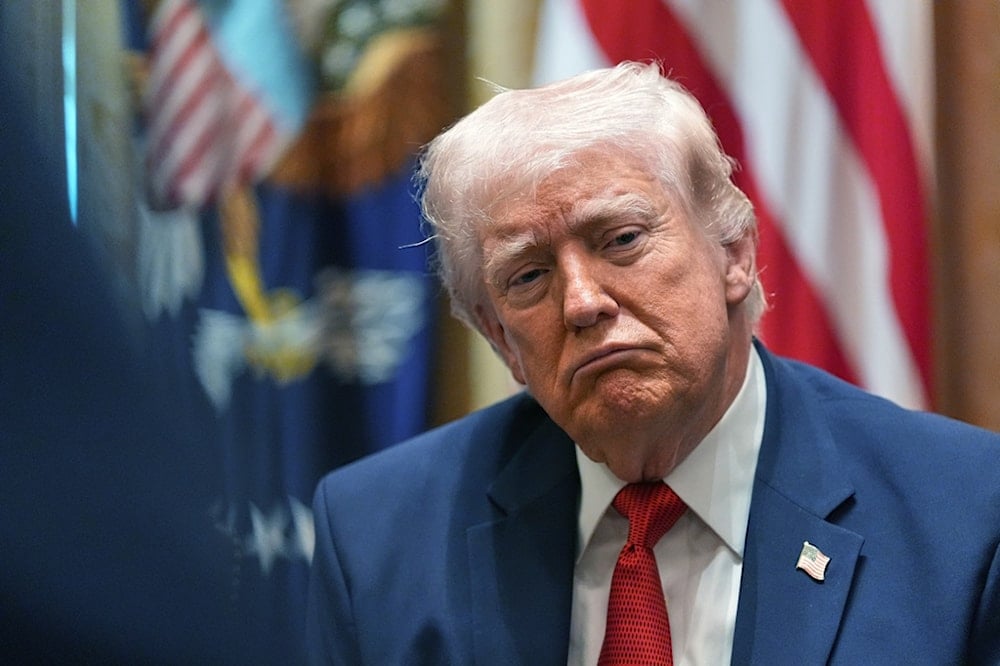
US President Donald Trump listens during a Cabinet meeting at the White House, Thursday, March 26, 2026, in Washington (AP)
US President Donald Trump said he was strongly considering pulling the United States out of NATO after the alliance failed to join his war on Iran, in the strongest sign yet that Washington no longer regards Europe as a reliable defense partner.
Speaking to The Telegraph, Trump said, "I am strongly considering pulling out of Nato," labeling the transatlantic alliance a "paper tiger".
"Oh yes, I would say it's beyond reconsideration," Trump replied when asked if he would reconsider US membership, further taking a jab at the bloc, saying, "I was never swayed by NATO. I always knew they were a paper tiger, and Putin knows that too, by the way."
Frustration with European allies
Trump's comments come after NATO partners refused to send warships to help reopen the Strait of Hormuz, through which a significant portion of the world's oil once flowed. Tehran has effectively blocked the Strait for weeks to hostile actors following aggression on the country, sending global oil and gas prices spiraling while threatening a global recession.
Other US allies denied the US military access to their bases, while Poland refused to provide the United States with its Patriot missile defense systems.
"Beyond not being there, it was actually hard to believe. And I didn't do a big sale. I just said, 'Hey,' you know, I didn't insist too much. I just think it should be automatic," Trump said.
"We've been there automatically, including Ukraine. Ukraine wasn't our problem. It was a test, and we were there for them, and we would always have been there for them. They weren't there for us."
A jab at Britain
Singling out the UK, Trump rebuked Prime Minister Keir Starmer for refusing to get involved in the American-Israeli war against Iran, suggesting the Royal Navy was not up for the task.
"You don't even have a navy. You're too old and had aircraft carriers that didn't work," he said, referring to the state of Britain's fleet of warships.
Asked if the prime minister should spend more on defense, Trump added, "I'm not going to tell him what to do. He can do whatever he wants. It doesn't matter. All Starmer wants is costly windmills that are driving your energy prices through the roof."
Rubio echoes the message
The White House has grown increasingly frustrated with long-time partners over their position in the war. Secretary of State Marco Rubio accused NATO of being a "one-way street" as he hit out at US allies for not allowing access to their military bases.
Speaking on Fox News, Rubio said America would have to "re-examine" its NATO membership when the war in Iran came to an end.
"I think there's no doubt, unfortunately, after this conflict is concluded, we are going to have to re-examine that relationship. If NATO is just about us defending Europe if they're attacked, but them denying us basing rights when we need them, that's not a very good arrangement. That's a hard one to stay engaged in."
Trump told The Telegraph he was "glad" Rubio made the comments.
A shifting alliance
The president's comments mark a dramatic escalation in his criticism of NATO. Last week, The Telegraph revealed that Trump was considering a shake-up of NATO designed to punish members who did not meet his funding demands, with some aides pushing for a "pay-to-play model" that could block allies from decision-making.
Trump's demand for NATO to help in his war with Iran has raised questions about Article 5, the mutual defense clause that has only ever been invoked once, after the 9/11 attacks on the US. The clause relates only to when a NATO member is attacked, and therefore would not apply to the war on Iran, which began with joint US-Israeli aggression on February 28.
As the war enters its second month, Trump's threat to abandon NATO underscores a fundamental shift in US foreign policy: an American president willing to dismantle the alliance system that has underpinned Western security for decades, all because European allies refused to join a war they had no part in starting. For Britain and Europe, the message is clear: Washington's commitment to their defense is no longer guaranteed, and the price of American protection may be participation in wars of Washington's choosing. Whether European leaders are willing to pay that price remains an open question.
Read more: Trump slams NATO as 'cowards', says alliance is weak without US


