
Targeting truth: 'Israel’s' war on journalists
 8 Min Read
A look into how journalists, protected as civilians under international law, have been turned into military targets by the Israeli occupation.
-
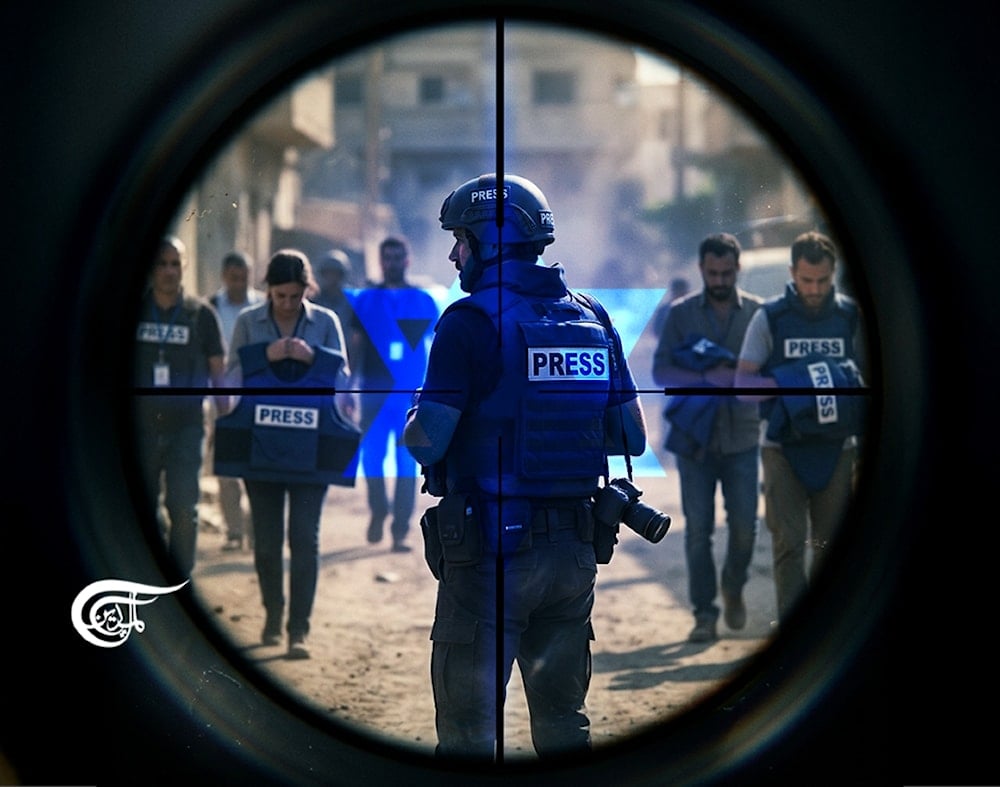
Targeting truth: 'Israel’s' war on journalists (image by Mahdi Rtail, Al Mayadeen English)
Under international law, journalists in war zones are considered members of the same protected class as civilians.
Article 79 of the Additional Protocols of the Geneva Conventions states, "Journalists engaged in dangerous professional missions in areas of armed conflict shall be considered as civilians.”
The Protocol continues to define a civilian, under Article 50, as any individual who is not a member of armed forces or an organized armed group. This broad definition ensures that journalists fall within the protected civilian class unless they actively take on a direct combat role.
International law under Articles 79.2 and 51.3 states that, "the presence within the civilian population of individuals who do not come within the definition of civilians does not deprive the population of its civilian character.”
This provision is critical in reinforcing that journalists retain their protected status even when operating in combat zones.
Journalists remain protected under the civilian class so long as they do not directly take part in the hostilities. The Commentary of Article 51.3 states that “direct participation in the hostilities” means “acts of war which by their nature or purpose are likely to cause actual harm to the personnel and equipment of the enemy armed forces.”
Cases from UN courts such as the International Criminal Tribunal for the Former Yugoslavia further clarified that media activity, including propaganda, does not ultimately mean direct involvement in hostilities. As such, journalists do not become legitimate targets solely on the basis of their reporting or political alignment.
Despite the explicit nature of these legal protections, their application remains deeply inconsistent in practice. The official classification of journalists as civilians under international law has not translated into meaningful safeguards on the ground.
Violations of international humanitarian law are frequently pursued in cases involving weaker states or non-state actors, while similar allegations made against militarily powerful states face limited accountability.
In the case of “Israel”, this gap between legal principle and military conduct becomes particularly pronounced.
The repeated targeting of journalists, coupled with efforts to delegitimize their civilian status, points not to isolated violations but to a systematic pattern in which the protections of international law are actively undermined
From civilian status to security threat: reframing the press
Alongside its security priorities, “Israel” has consistently placed strategic importance on managing its international image, especially during periods of war with other states or parties.
Since its imposition, “Israel” has invested heavily into shaping how it is perceived globally, through silver-tongued media campaigns to help build the image that it is, in the words of Former Israeli Prime Minister Ehud Barak, “a villa in the jungle.” This framing positions the entity as a stable and democratic outpost surrounded by hostilities.
Within this framework, efforts that combat or undermine this image, as is the case with war reporting, are treated as threats rather than internationally protected journalistic activity.
The treatment of journalists follows a broader pattern in which perceived threats are delegitimized and reframed as security risks. This allows “Israel” to justify both legal and military measures against them.
On November 8 2023, the Knesset announced a new amendment to the Counter-Terrorism Law, criminalising the consumption of what it defines as “terrorist material.”
The broad and flexible nature of this definition allows for its liberal application to media content, effectively creating legal grounds through which journalistic work can be deemed a security threat.
Alongside official declarations against the press, Israeli media and public discourse have amplified rhetoric that delegitimizes journalists operating in West Asia.
Read more: How Israeli rhetoric weaponizes history and faith to justify violence
For example, in an article published in the Jerusalem Post in August 2025, Rabbi Pesach Wolicki, following the Israeli airstrike targeting the Nasser Medical Complex, stated that Gaza lacks journalists; rather, media personalities are, in actuality, members of Hamas.
“Five journalists were killed in an Israeli strike on a hospital in Khan Yunis. Esteemed outlets Reuters, AP, and Al Jazeera all claimed to have lost reporters,” Wolicki wrote. “The narrative was immediate and predictable: ‘Israel’ is targeting the free press, another black mark on the Jewish state. But let’s stop pretending. There is no journalism in Gaza. There is only Hamas and its propagandists.”
Such rhetoric collapses the distinction between journalism and militancy, reinforcing the narrative that frames reporters as military targets.
The cumulative effect of these narratives is to erode the civilian status of journalists in both public perception and military justification.
Journalists are never simply collateral damage when it comes to Israeli attacks; rather, they are to be seen as operational targets.
Following the Palestinian Resistance’s October 7 operation, the IOF expanded efforts to retroactively justify strikes by alleging militant affiliations among those killed, including members of the press. This was done so under what the IOF called the “Legitimization Cell,” a faction of the Israeli army dedicated to gathering and selectively presenting information that could link journalists in Gaza to Resistance factions, thereby allowing the occupation to legitimize their targeting in the eyes of the international community.
Sources cited by "Israel's" +972 Magazine said the motivation of the Legitimization Cell was not security, but rather public relations as it sought to put an end to reporters “smearing [“Israel’s”] name in front of the world.”
The source told the magazine that the unit had a recurring pattern; whenever criticism of “Israel’s” actions intensified in the media, the Legitimization Cell was ordered to find intelligence that could be employed to counter the narrative.
“If the global media is talking about Israel killing innocent journalists, then immediately there’s a push to find one journalist who might not be so innocent — as if that somehow makes killing the other 20 acceptable,” the source told +972.
If “Israel” is unable to find any information that can link a journalist to a revolutionary group, the occupation will circulate lies about the journalist, contributing to a broader post-strike justification pattern.
Take the recent attack that led to the martyrdom of veteran Al-Manar journalist Ali Shoeib, which illustrates this dynamic clearly. The Israeli occupation claimed that he was a member of Hezbollah’s Radwan forces, stating that his work as a journalist was “just a cover for terror.”
The IOF went so far as to create images of Shoeib in military fatigues. When questioned by Fox News, they admitted: “Unfortunately, there isn’t really a picture of it; it was photoshopped.”
BREAKING:
— Suppressed News. (@SuppressedNws1) March 29, 2026
Israel released a photo of Al Manar Journalist Ali Shoeib in military garb after killing him while accusing him of being part of Hezbollah Radwan forces.
When asked about that photo they said:“Unfortunately there isn’t really a picture of it, it was photoshopped,” pic.twitter.com/gdckakwQTp
Alongside Shoeib, Al Mayadeen’s Fatima Ftouni and her brother Mohammad Ftouni were martyred in the attack.
Since October 2023, hundreds of Journalists have been martyred due to Israeli attacks, per data by the Committee to Protect Journalists. Activist data collection platforms like Databases for Palestine state that about 356 journalists have been martyred. Despite the scale of these incidents, there has been no mechanism of accountability at the international level.
Despite extensive documentation by international bodies and watchdog organizations, meaningful accountability has remained limited. Organizations like the United Nations and International Criminal Court have acknowledged concerns regarding the killing of civilians, including journalists, yet enforcement mechanisms remain constrained by political considerations and jurisdictional limitations. This gap between documentation and enforcement further entrenches a climate of impunity, in which violations are recorded but rarely prosecuted.
Entire media centers deemed hostile to the Israeli regime have also been subjected to unprecedented strikes by the occupation. These include the bombing of the Al-Jalaa building, which housed AP offices, as well as attacks on regional media infrastructure and offices like Iran’s IRIB and Lebanon’s Al Manar.
Such actions reflect a broader pattern in which media institutions themselves are treated as extensions of hostile entities.
This pattern did not emerge in 2023, but it reflects a longer history of journalists being targeted in the context of Israeli military operations.
Taken together, these incidents point not to isolated violations but to a sustained pattern in which journalism itself is reframed as a threat.
In this context, the act of documentation, through a pen, camera, or microphone, becomes inseparable from the risks of direct targeting.


