
Pentagon internal email outlines US options to punish NATO allies
 6 Min Read
US officials are reportedly discussing NATO pressure options after disputes over allied support during the war on Iran.
-
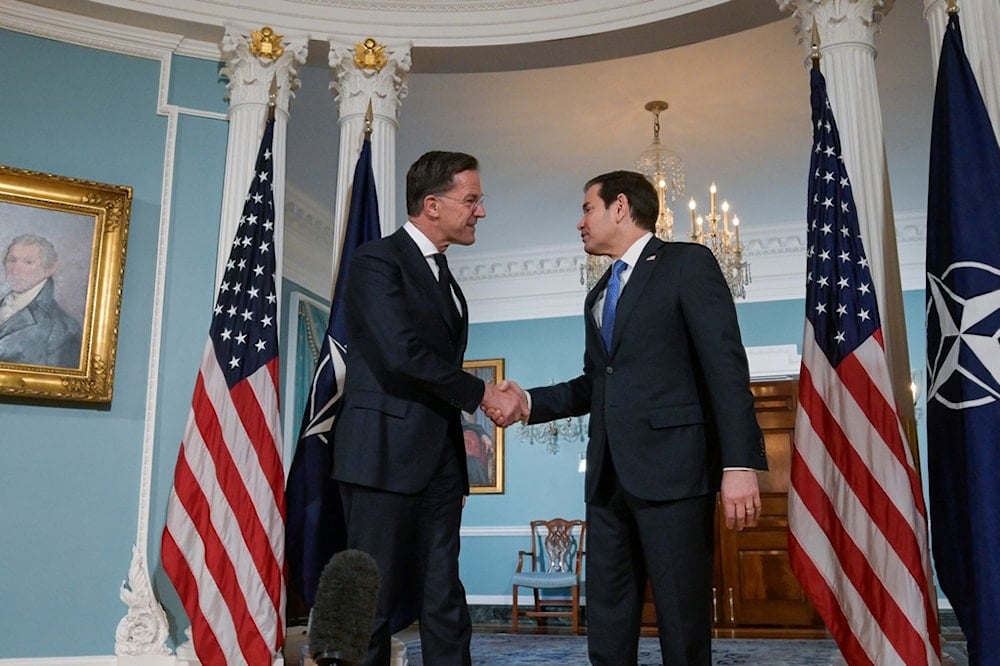
US Secretary of State Marco Rubio, right, shakes the hand of NATO Secretary General Mark Rutte, left, during a photo opportunity at the State Department, Wednesday, April 8, 2026, in Washington (AP)
An internal US Department of Defense email is circulating at senior levels outlining a range of potential steps Washington could consider against NATO allies it judges to have fallen short during US operations in the war against Iran, according to a US official speaking to Reuters.
Suspending Spain from alliance structures and revisiting US diplomatic positions on long-standing territorial disputes involving European partners are issues mentioned in the circulating email.
According to Reuters, the document reflects internal frustration within parts of the Pentagon over what officials describe as limited allied cooperation during the war, particularly regarding access to military facilities, basing arrangements, and overflight permissions required for US operations.
The official, who spoke on condition of anonymity, said the email treats such access as a fundamental requirement of NATO membership and conveys dissatisfaction with what is seen as hesitation from some allies during the war on Iran.
Among the options being discussed is the temporary removal of certain “difficult” member states from senior NATO roles, with Spain specifically mentioned, the official told Reuters. The proposal reportedly suggests that while operational disruption would be limited, the political and symbolic impact could be significant.
The measures are described in the email as part of an effort to counter what US officials view as an over-reliance or “entitlement mentality” among some European allies.
Because Spain said 'No'
The internal debate comes after friction emerged over Spain’s position during the war, following Madrid’s decision under its Socialist-led government to block the use of Spanish bases and airspace for operations directed at Iran.
The United States operates key facilities in Spain, including Naval Station Rota and Morón Air Base, which are central to its regional military posture.
The email, however, does not recommend any immediate suspension of Spain and does not propose shutting down US military installations in Europe, the official told Reuters. It also does not confirm whether wider troop adjustments on the continent are being considered.
Falkland Islands back in focus
The email also raises the possibility of reassessing Washington’s diplomatic stance on European territorial holdings described in the document as “imperial possessions", including the Falkland Islands, a British overseas territory claimed by Argentina, as per the US official cited by Reuters.
The US State Department recognizes the islands as UK-administered, while Argentina continues to assert its claim. Argentine President Javier Milei is identified as a political ally of US President Donald Trump.
The islands were the subject of a brief war between Britain and Argentina in 1982, which resulted in the deaths of roughly 650 Argentine and 255 British military personnel before Argentine forces surrendered.
Intensified criticism of NATO allies
Trump has repeatedly criticized NATO members over their response to the war on Iran, particularly their reluctance to support naval efforts aimed at securing the Strait of Hormuz, which was closed to international shipping following the start of the war on 28 February.
In an interview for Reuters on April 1, Trump questioned the strength of US commitment to NATO, responding to questions about potential withdrawal by saying, “Wouldn’t you if you were me?”
He has also targeted UK Prime Minister Keir Starmer, accusing him of being “cowardly” for not joining US military action against Iran, stating Britain was “No Winston Churchill,” and dismissing British aircraft carriers as “toys".
Britain initially declined a US request to support offensive operations from its bases, later agreeing only to defensive missions intended to protect civilians in the region, including British nationals, during Iranian retaliation.
War Secretary Pete Hegseth has acknowledged that the Iran war exposed divisions within NATO, noting that while Iran’s longer-range missile systems cannot reach the United States, they are capable of striking European territory.
“We get questions, or roadblocks, or hesitations ... You don't have much of an alliance if you have countries that are not willing to stand with you when you need them,” Hegseth said earlier this month at the Pentagon.
A Pentagon spokesperson told Reuters the department is preparing “credible options” for the president in response to allied actions, emphasizing that NATO cannot function as a “one-way street,” while declining to comment on internal discussions.
Europe advances 'European NATO' contingency as US strains alliance
These tensions have also prompted European allies to quietly prepare for a scenario in which US support becomes less certain, reflecting broader concerns about the future cohesion of the alliance.
European officials are increasingly developing contingency plans to preserve the functionality of NATO in the event of a reduced or withdrawn US role, according to a report earlier this month by The Wall Street Journal, as concerns mount over Washington’s long-term reliability under Donald Trump.
The initiative, informally referred to by some officials as a “European NATO”, aims to strengthen European leadership within the alliance’s command structures and gradually replace critical US military capabilities with European alternatives. The effort is not intended to replace NATO but to ensure operational continuity, deterrence against Russia, and the credibility of nuclear defense should the US scale back its commitments, the newspaper reported.
Informal planning gains traction
The plans have been developed through informal discussions among allied officials, including side meetings around NATO gatherings. They have gained urgency following a series of tensions between Washington and European capitals, including disputes over US policy toward Iran and Trump’s threats to withdraw from NATO.
In response to Trump's criticisms, European leaders have accelerated efforts to prepare for a scenario in which US forces or support are reduced. Alexander Stubb confirmed that a “burden shifting” toward Europe is already underway, emphasizing the need for a managed transition rather than a sudden US disengagement.
Read more: US war on Iran erodes global influence, strains alliances


