
Europe advances 'European NATO' contingency as US strains alliance
 4 Min Read
Europe advances plans for a “European NATO” contingency plan to preserve the alliance’s structure and deterrence.
-
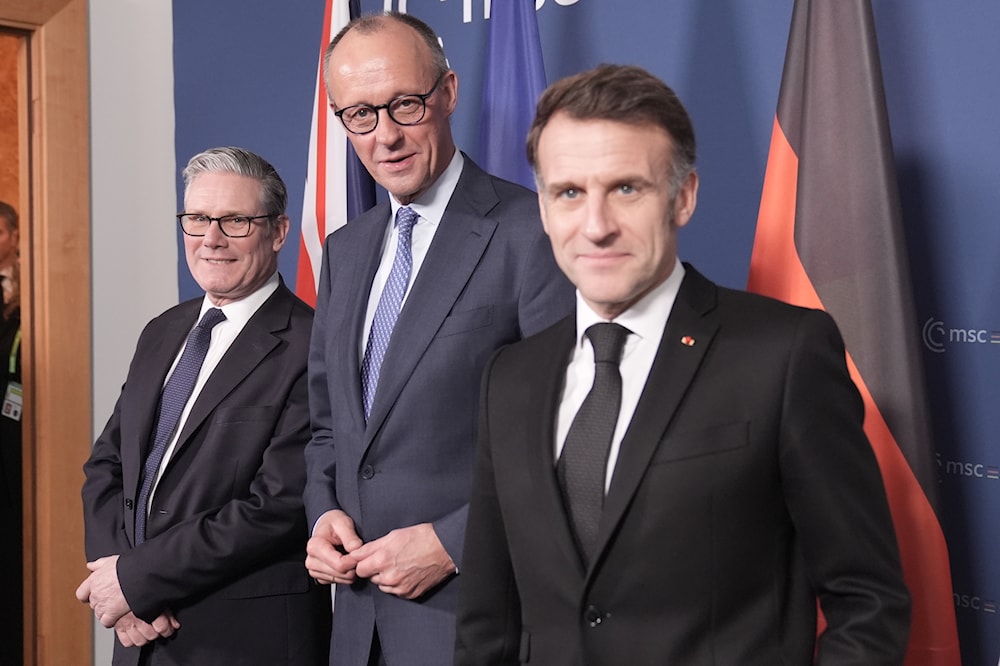
Britain's Prime Minister Keir Starmer, left, attends a trilateral meeting with French President Emmanuel Macron, right, and German Chancellor Freidrich Merz at the Munich Security Conference in Munich, Germany, on February 13, 2026. (AP)
European officials are increasingly developing contingency plans to preserve the functionality of NATO in the event of a reduced or withdrawn US role, according to a report by The Wall Street Journal, as concerns mount over Washington’s long-term reliability under Donald Trump.
The initiative, informally referred to by some officials as a “European NATO”, aims to strengthen European leadership within the alliance’s command structures and gradually replace critical US military capabilities with European alternatives. The effort is not intended to replace NATO but to ensure operational continuity, deterrence against Russia, and the credibility of nuclear defense should the US scale back its commitments, the newspaper reported.
Germany shift fuels European momentum
A key turning point in the discussions has been a policy shift in Germany under Chancellor Friedrich Merz. Long opposed to proposals for European strategic autonomy, Berlin has begun backing greater European responsibility within NATO, citing concerns over US dependability.
According to WSJ, Merz reassessed Germany’s stance after concluding that Washington’s policies under Trump lacked consistency, particularly regarding Ukraine. Rather than publicly challenging NATO’s framework, Berlin has opted to support a gradual increase in European leadership within the alliance.
German Defense Minister Boris Pistorius described NATO as “irreplaceable”, but stressed that “we Europeans must assume more responsibility for our defense.”
Informal planning gains traction
The plans have been developed through informal discussions among allied officials, including side meetings around NATO gatherings. They have gained urgency following a series of tensions between Washington and European capitals, including disputes over US policy toward Iran and Trump’s threats to withdraw from NATO.
Trump has repeatedly criticized European allies, calling them “cowards” and describing NATO as a “paper tiger”, while warning that US withdrawal from the alliance is “beyond reconsideration”, according to the report.
In response, European leaders have accelerated efforts to prepare for a scenario in which US forces or support are reduced. Alexander Stubb confirmed that a “burden shifting” toward Europe is already underway, emphasizing the need for a managed transition rather than a sudden US disengagement.
Military and structural challenges remain
Despite growing political alignment, European officials face significant practical challenges. NATO’s command structure remains heavily dependent on US leadership, with the Supreme Allied Commander Europe position traditionally held by an American officer.
Key areas of concern include air and missile defense, logistics networks, intelligence capabilities, and reinforcement corridors to Eastern Europe. European states are also seeking to expand domestic defense production, particularly in areas where they lag behind the US, such as reconnaissance systems, air mobility, and anti-submarine warfare.
The report highlights a joint initiative between Germany and the United Kingdom to develop advanced cruise missiles and hypersonic weapons as part of this broader effort.
Nuclear deterrence and strategic gaps
One of the most sensitive aspects of the discussions involves nuclear deterrence. With Europe reliant on the US nuclear umbrella, officials are exploring whether France and United Kingdom could expand their nuclear roles to cover the continent.
According to The Wall Street Journal, Merz and French President Emmanuel Macron have already discussed extending France’s nuclear deterrent to other European states.
However, officials acknowledge that Europe currently lacks the satellite, surveillance, and missile-warning systems that underpin NATO’s strategic credibility, making a full transition away from US support difficult in the short term.
Gradual Europeanization underway
While the long-term viability of a more autonomous European defense structure remains uncertain, the transition is already taking shape. European officers are increasingly occupying senior NATO roles, and major military exercises, particularly in Northern Europe, are now being led by European forces.
Still, experts caution that years of underinvestment and reliance on US capabilities have left critical gaps. Retired US Admiral James Foggo noted that while European forces possess strong personnel and some advanced equipment, they must accelerate investment to match the alliance’s operational demands.
The report concludes that while a “European NATO” remains a contingency rather than a formal policy, the initiative reflects a fundamental shift in European defense thinking, driven by uncertainty over US leadership and the need to ensure the alliance’s continuity under changing geopolitical conditions.
Read more: Third nuclear age begins: 2025 and the collapse of the nuclear order


