
Trump demands NATO pledge to 'secure' Hormuz within days: Rutte
 5 Min Read
NATO faces mounting pressure as Trump piles pressure on NATO allies to gain control of the Strait of Hormuz.
-
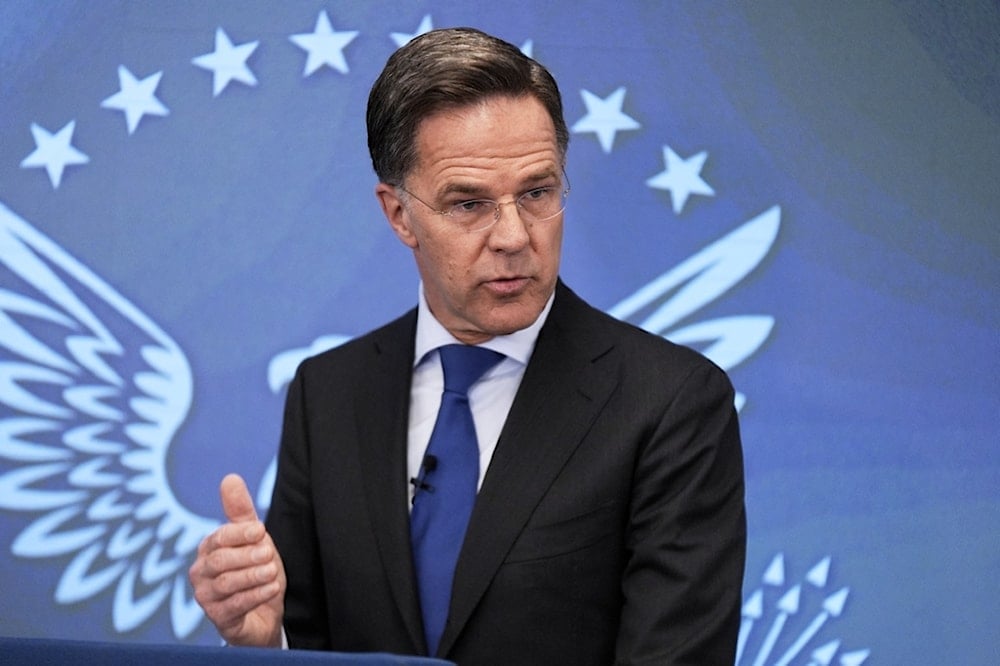
NATO Secretary General Mark Rutte speaks at the Ronald Reagan Institute, Thursday, April 9, 2026, in Washington. (AP Photo/Manuel Balce Ceneta)
US President Donald Trump is demanding concrete commitments from European governments within days to help him gain control of the Strait of Hormuz, NATO Secretary General Mark Rutte has told the EU, diplomats said Thursday, intensifying NATO-Trump tensions under the ongoing war on Iran.
Rutte is working to defuse a growing crisis within the alliance after Trump signaled he may withdraw from NATO, arguing that European allies have relied heavily on US security guarantees while offering limited support for the US-Israeli bombing against Iran.
Three diplomats told Reuters that Rutte conveyed Trump’s demands following a meeting at the White House on Wednesday, placing immediate pressure on European governments to respond.
European leaders now face mounting urgency to present tangible plans for the Strait, which Iran which borders it with Oman, has used as leverage to stop the US-Israeli war against it, supported by Arab monarchies.
US initiates a war and demands enthusiastic cooperation
Speaking in Washington a day after meeting Trump, Rutte acknowledged that some NATO members had initially been “a bit slow” to assist the United States and “a bit surprised” by developments, but said support has since increased significantly.
"Nearly without exception, allies are doing everything the United States is asking. They have heard and are responding to President Trump’s requests," Rutte said in a speech hosted by the Ronald Reagan Institute.
However, several European allies have indicated their willingness to support operations in the Strait of Hormuz only after a durable cessation of hostilities and guarantees from Iran that their vessels would not be targeted.
NATO spokesperson Allison Hart said the secretary general remains in contact with allies following his Washington discussions, adding that Washington expects “concrete commitments and action to ensure freedom of navigation in the Strait of Hormuz.”
The dispute reflects broader US-NATO alliance tensions, which have been exacerbated by Trump’s renewed pressure on allies and earlier threats, including remarks in January about taking Greenland from Denmark.
The focus on the Strait of Hormuz has emerged as a key fault line within NATO, particularly as the fallout from the Iran war continues to strain transatlantic relations despite the announcement of a temporary two-week ceasefire.
"We note the frustration in Washington, but they did not consult allies either before or after starting this war," one diplomat said.
"NATO as such would not play a role in the war against Iran, but allies want to be helpful in seeking longer-term solutions for Hormuz. With negotiations ongoing with Iran, this could be helpful," the diplomat added.
Following his meeting with Rutte, Trump posted on Truth Social that "NATO wasn't there when we needed them, and they won't be there if we need them again."
A senior European official said concerns remain widespread within the alliance, noting that “the NATO community is more worried right now than confident” and that recent talks have done little to ease those fears.
NATO tentative, yet would still help US
Efforts are underway among European states to address developments related to the Strait, with Britain leading a coalition of around 40 countries working on a combined military and diplomatic plan to try and safeguard the waterway.
French President Emmanuel Macron said approximately 15 countries are preparing to facilitate the resumption of maritime traffic through the Strait, though no immediate breakthrough is expected.
Asked whether NATO could play a direct role, Rutte said, “If NATO can help, obviously NATO is there,” while noting that any alliance action would require consensus among all members.
France’s Foreign Minister Jean-Noel Barrot said the Strait cannot fully reopen without a lasting agreement between the United States and Iran, while Italy and Britain rejected Iran’s suggestion that it could impose a toll on vessels passing through Hormuz.
"We are willing to make the right noises and even the right actions down the line," another European diplomat said. "But ultimately the problem is not to please the U.S. but to have the right conditions in place."
Alliance divided over US actions
Not all NATO member states share the same sentiment. Spain’s Prime Minister Pedro Sanchez, for example, welcomed the two-week ceasefire between Iran and the United States but sharply criticized Washington for initiating the war, saying those responsible for “chaos and destruction” should not be praised for ending it.
Madrid has maintained firm opposition to the US-Israeli war on Iran, including closing its airspace to US military aircraft and refusing to participate in the war, citing violations of international law.
Spanish officials also urged Europe to take a stronger stance on de-escalation, emphasizing the need for diplomacy, respect for international law, and a rules-based global order.
Trump 'clearly disappointed' as NATO allies refuse to join war: Rutte
Yesterday, Rutte said that Trump was “clearly disappointed” by the refusal of Washington’s allies to participate in the US-led war on Iran, following a closed-door meeting between the two in Washington on Wednesday.
Speaking to CNN after the meeting, Rutte described the discussions as “very frank, very open” between “two good friends”, while declining to confirm whether Trump raised his repeated threat to withdraw from NATO over the dispute.
“He clearly told me what he thought of what happened over the last couple of weeks,” Rutte said, adding that the situation presents a “nuanced picture.”


