
UK to deny US base access for attacks on Iran's power plants, bridges
 6 Min Read
Britain is set to restrict US access to military bases, blocking strikes on Iranian bridges and power plants while allowing only defensive operations, under Trump's renewed threats on Iranian power plants.
-
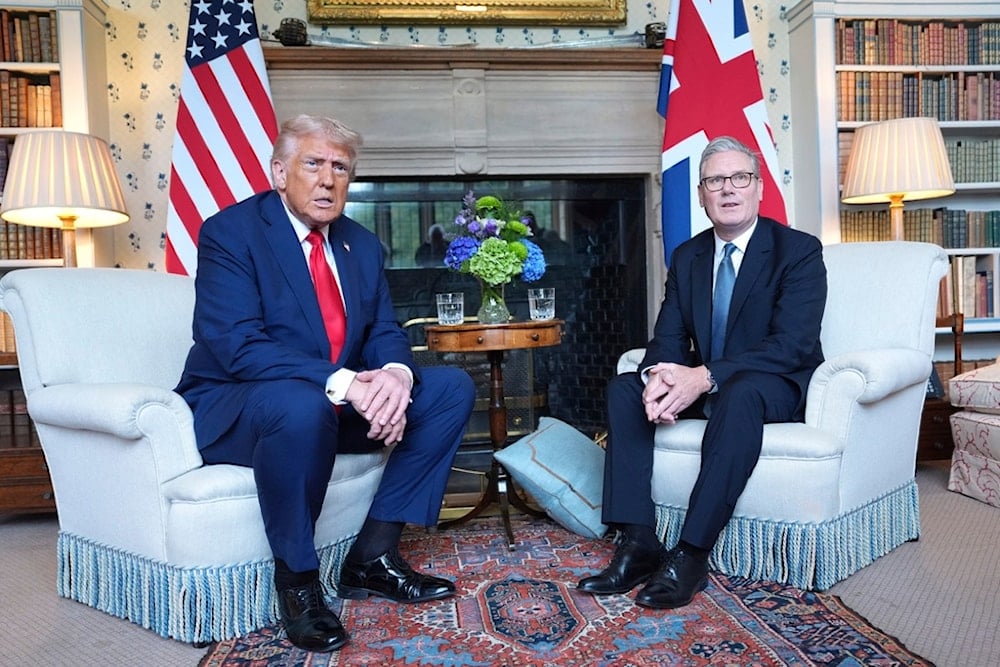
US President Donald Trump meets Britain's Prime Minister Keir Starmer at Chequers near Aylesbury, England, Thursday, Sept. 18, 2025 (AP)
Britain is expected to deny any request by US President Donald Trump to launch attacks on Iranian bridges or power plants from RAF bases, as such targets fall outside the scope of previously agreed "defensive" missions.
According to the i Paper, the position reflects Prime Minister Keir Starmer’s policy that US access to UK military facilities must be restricted to operations aimed at degrading Iran’s defensive capabilities, including missile systems that could threaten British interests or allies in the Gulf.
Under current arrangements, US forces may not use British bases for attacks on civilian structures, including bridges and power plants, but would be allowed to be used for missions targeting Iranian missile infrastructure, such as storage depots or launch sites.
Requests for the use of RAF bases are assessed on a case-by-case basis, and no formal US request has yet been submitted for the potential operations proposed by Trump.
The UK government has emphasized that its cooperation with Washington remains focused on defensive objectives, particularly in response to perceived threats to British personnel and regional stability.
Trump escalates threats against Iranian infrastructure
Trump has threatened to escalate attacks on Iran’s civilian infrastructure unless Tehran reopens the Strait of Hormuz to international shipping.
He described potential operations targeting bridges and power plants as “Power Plant Day” and “Bridge Day”, warning that failure to comply with US demands would result in severe consequences.
Trump said, “We won’t want another Neville Chamberlain, do we agree? We don’t want Neville Chamberlain.”
He added, “They’ll have no bridges. They’ll have no power plants. They’ll have no anything.”
Trump also suggested broader economic motives behind US actions, stating, “If I had my choice, what would I like to do? Take the oil. Because it’s there for the taking. There’s not a thing they can do about it.”
Read more: Trump threatens to destroy Iran's power plants, again
US war crimes
International law experts have warned that targeting civilian infrastructure such as bridges and power plants could constitute a war crime, raising concerns over the legality of potential US operations.
The UK’s refusal to support such strikes highlights its effort to remain within the framework of international law while maintaining its strategic alliance with the United States.
The issue also risks further straining relations between Starmer and Trump, which have already shown signs of tension.
A UK Ministry of Defense spokesperson confirmed that British bases remain available for US operations targeting Iran’s missile capabilities.
“The UK authorised the United States to use British bases for defensive missions to destroy Iran’s missile capabilities which are threatening British people, bases, and our partners in the region,” the spokesperson said.
“The United States is using British bases for specific defensive operations to prevent Iran firing missiles into the region, which is putting British lives at risk.”
Starmer previously stated that such cooperation is part of “the collective self-defence of long-standing friends and allies” and is conducted in accordance with international law.
British military officials are set to host a virtual conference with defense representatives from more than 40 countries to discuss securing the Strait of Hormuz.
The talks will examine potential measures to ensure safe passage for commercial shipping, including the formation of an international coalition to manage access to the strategic waterway.
Rules of engagement
British MP Richard Foord warned that US actions risk undermining established rules of engagement and international law.
“Rules of engagement exist in war for very good reason,” he said.
“They link the tactical decisions made by soldiers on the ground to the operational intent of their most senior commanders.”
Foord added, “Rules of engagement also serve to maintain the law of armed conflict, and stop disciplined use of force from becoming unmitigated blood-spilling, motivated by bloodlust.”
“When the bombardment stops, Iranians are less likely to see what the US has presented them with as an ‘incredible opportunity.’”
UK sends more troops to Gulf as Trump mocks Britain over Iran war
Despite the strained US-UK relations due to Starmer's reluctance to support US offensive operations against Iran, senior figures stress that core military and intelligence cooperation remains largely intact. Both governments continue to publicly affirm their strong alliance, though the ongoing war on Iran has exposed political-level mistrust that could deepen if the war continues.
At the start of this month, Trump lashed out at the UK for refusing to "get involved in the decapitation of Iran." Writing on his Truth Social platform, he told the UK and other allies: "You'll have to start learning how to fight for yourself, the USA won't be there to help you anymore, just like you weren't there for us."
Though he said that, the United Kingdom authorized sending additional military support to the Gulf, taking its total deployment to 1,000 troops.
Speaking from Qatar, where he met UK troops, Defense Secretary John Healey said the extra deployment was in response to an "expanding threat" from Iran. He confirmed that the UK would send more Typhoon jets to Qatar, as well as the Sky Sabre anti-drone and missile system to Saudi Arabia, Bahrain, and Kuwait.
He declined to specify how many additional troops were being deployed but said "across the Middle East now, a thousand British troops" were involved in reinforcing UK bases and those of its Gulf allies.
Healey said the extra deployments to the Gulf were only for defensive operations. Having met officials in Saudi Arabia, Qatar, and Bahrain during his visit, he said, "My message to Gulf partners is: Britain's best will help you defend your skies."
Healey said, "We won't get drawn into the wider war. Throughout this conflict, we've been consistently taking decisions in Britain's interests because we need to defend our people, and we want to defend allies in the region."
He added that Gulf leaders would "judge us by our actions and not our words. We continue to do with the US, defensive operations in the Middle East."
Read more: US-UK cooperation in hot water as Trump, Starmer clash over Iran


