
Trump threatens to destroy Iran's power plants, again
 6 Min Read
Trump sets a Tuesday deadline to strike Iran's power grid, but a pattern of empty ultimatums has left markets and Tehran unmoved by his latest threats.
-
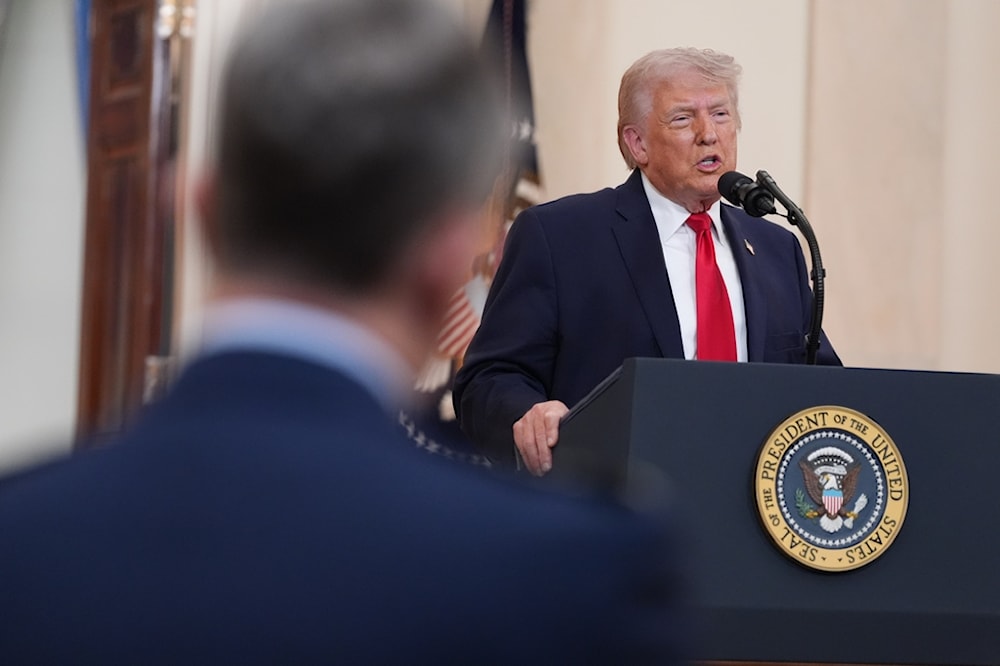
US President Donald Trump speaks about the war on Iran from the Cross Hall of the White House on Wednesday, April 1, 2026, in Washington. (AP Photo/Alex Brandon)
US President Donald Trump escalated his threats against Iran on Sunday, warning in separate statements to Fox News and the Wall Street Journal that Tehran has until Tuesday evening to reopen the Strait of Hormuz or have its energy infrastructure bombed, even as Iran flatly denies any negotiations are underway.
Speaking to Fox News on Sunday evening, Trump claimed a deal with Iran was possible "by Monday" and asserted that negotiations were already underway, statements Iran has consistently and categorically rejected.
Earlier in the day, he had posted on Truth Social: "Tuesday will be Power Plant Day, and Bridge Day, all wrapped up in one, in Iran. There will be nothing like it!!! Open the F**kin' Strait, you crazy b**tards, or you'll be living in Hell - JUST WATCH! Praise be to Allah. President DONALD J. TRUMP."
In a separate interview with the Wall Street Journal, Trump outlined the consequences should the negotiations, only he claims exist, fail. "If they don't come through, if they want to keep it closed, they're going to lose every power plant and every other plant they have in the whole country," he said.
Asked about the humanitarian cost to Iran's 93 million people, Trump dismissed the concern, saying "no, they want us to do it," claiming Iranians are "living in hell." Trump also made clear the scale of destruction he envisions. "That country will take 20 years to rebuild, if they're lucky, if they have a country," he said.
Hours later, in what appeared to be the setting of a formal deadline, he posted again on Truth Social, simply: "Tuesday, 8:00 P.M. Eastern Time!"
Trump appears adamant about reopening a waterway he has repeatedly claimed not to care about. On at least three separate occasions since the war began, he has publicly distanced the US from the Strait's fate.
In his April 1 primetime address, he told Americans that the US "imports almost no oil through the Hormuz Strait and won't be taking any in the future," instructing other countries to handle it themselves. Earlier in the war, he suggested the US could declare victory and leave West Asia entirely without the Strait being opened. In interviews, he framed its closure as Europe and Asia's problem, not Washington's.
Iran: No talks, no temporary ceasefire
As Trump continues to issue empty threats, Iran's position regarding ceasefire negotiations has not shifted. A senior Iranian diplomatic source told Reuters on Wednesday that Tehran demands a guaranteed, permanent end to the war, not a pause, and that no talks had taken place via mediators for a temporary ceasefire.
That position hardened further over the weekend, as Iran rejected a separate US proposal for a 48-hour ceasefire on April 3-4, communicating its refusal not through diplomatic channels but through what Iran's Fars News Agency described as "continuation of attacks in the battlefield."
Iranian Foreign Minister Abbas Araghchi has stated that Tehran's "trust level is at zero" with Washington, citing the US withdrawal from the 2015 nuclear deal as evidence that agreements with the US are not honoured. Iran has also insisted that any ceasefire must include an end to the war in Lebanon.
A pattern markets no longer believe
Sunday's threats are the latest in a month-long cycle of ultimatums, extensions, and optimistic claims that have steadily eroded Trump's credibility with energy markets.
The threat to power plants was first issued on March 21, with a 48-hour deadline. That deadline was extended on March 23, then again to April 6, with Trump each time citing "very good and productive conversations" that Iran denied were taking place.
After Trump's April 1 primetime address, in which he again promised a deal while vowing to hit Iran "extremely hard," oil prices surged more than 11%.
READ MORE: How long can Trump keep lying to the markets?
Ghalibaf: 'If they pump it, short it'
Iran's parliament speaker, Mohammad Bagher Ghalibaf, ironically the same official Trump has claimed as his secret interlocutor, has repeatedly called out Trump's threats as desperate attempts to manipulate energy markets.
On March 30, the evening before US markets opened, he posted in English on X: "Heads-up: Pre-market so-called 'news' or 'Truth' is often just a setup for profit-taking. Basically, it's a reverse indicator. Do the opposite: If they pump it, short it. If they dump it, go long. See something tomorrow? You know the drill."
Heads-up: Pre-market so-called “news” or “Truth” is often just a setup for profit-taking. Basically, it’s a reverse indicator.
— محمدباقر قالیباف | MB Ghalibaf (@mb_ghalibaf) March 29, 2026
Do the opposite: If they pump it, short it. If they dump it, go long.
See something tomorrow? You know the drill.
The next morning, Trump posted that "great progress" had been made in Iran negotiations, two hours before markets opened. Ghalibaf's prediction proved accurate.
The grid Trump cannot 'obliterate'
Iran's electricity grid is among the most decentralised in the world, with between 130 and 150 thermal power plants distributed across the country. The largest single facility, Damavand near Tehran, represents only 2.9% of total installed capacity.
Iran's transmission network spans over 133,000 kilometres, supported by an estimated 2,000 to 5,000 substations.
Analyst Oral Toga of the Ankara-based Centre for Iranian Studies told TRT World that plunging the entire country into darkness "would require hundreds of sorties and a sustained campaign."
Crucially, Iran has spent decades hardening its grid against precisely this scenario, drawing lessons from the US destruction of Iraq's electrical infrastructure in 1991.
Any attempt would also trigger immediate retaliation, as Iran has warned it would strike Gulf energy infrastructure and desalination plants in response, facilities far more centralised and far more fragile than its own.
Israeli regime also wants to bomb Iran's energy infrastructure
The Israeli occupation is preparing potential attacks on Iranian energy facilities but is waiting for approval from the United States, a senior Israeli security official said on Saturday, Reuters reported.
The official indicated that any such attacks could take place within the coming week, signaling a possible escalation in the ongoing war on Iran.
Israeli newspaper Yedioth Ahronoth reported on Friday that Israeli Prime Minister Benjamin Netanyahu and Minister of War Israel Katz have instructed the Israeli military to compile a target bank of Iranian national, economic, and energy infrastructure, in anticipation of a potential green light from Washington to attack.
The report indicates that attention within the Israeli regime is fixed on April 6, the deadline issued by US President Donald Trump, who has threatened to destroy Iranian energy facilities if the Strait of Hormuz is not reopened. Once authorization is received, the Israeli military is expected to act.


