Trump threatens new attacks on Iran amid claims of new talks
 4 Min Read
Trump says the US is in talks with a “new” Iranian leadership but threatens attacks on energy infrastructure if no deal is reached and Hormuz remains restricted.
-
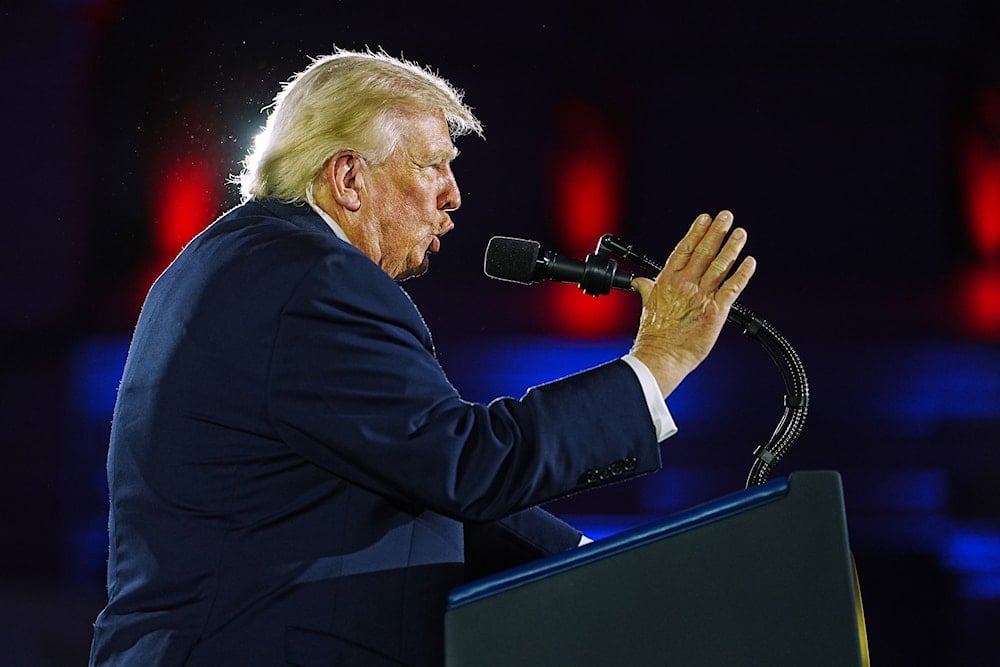
US President Donald Trump speaks at the National Republican Congressional Committee's (NRCC) annual fundraising dinner, Wednesday, March 25, 2026, at Union Station in Washington (AP)
US President Donald Trump claimed on Truth Social that the United States is engaged in high-level discussions with what he described as “a new, and more reasonable, regime” in Iran, aiming to end American aggression against the country.
Trump claimed that “great progress has been made” in the talks but issued a stark warning that, should they fail or the Strait of Hormuz remain restricted, the US could respond with significant military action. According to his post, such action could include bombing Iran’s electric generating plants, oil infrastructure, Kharg Island, and "possibly all desalinization plants."
The US president framed the threat as revenge for the deaths of US personnel and others during what he referred to as the previous Iranian regime’s “47-year reign of terror.”
Meanwhile, Iran stresses that there are no ongoing talks with the US, as Tehran is not currently seeking a ceasefire deal after the US and the Israeli occupation carried out their aggression on its territory and assassinated leader Ayatollah Sayyed Ali Khamenei, asserting that the US abandoned diplomacy.
Path toward settlement between Iran, US highly complicated
Preparations for talks between the United States and Iran are still limited to exchanging messages through intermediaries, a diplomatic source told Al Mayadeen.
The source said that "the collapse of the previous two rounds of talks due to US-Israeli aggression on Iran casts significant doubt and concern over the upcoming round, taking into account that the negotiation track remains the only way to halt the expansion of the war."
The source noted that Washington appears determined to pursue negotiations to address its demands and gauge Tehran’s position, while Iran is approaching the process from a stance of self-defense, placing emphasis on sovereign conditions.
"Tehran seeks an agreement that guarantees its sovereign rights and prevents it from being subjected to future attacks," the source stressed.
Path towards an agreement 'highly complicated'
The source also noted that "the path toward a settlement is very slow and highly complicated," adding that "the risk of the collapse of this track is also high due to major obstacles, the most dangerous being the role of Israel, which does not want this war to end."
The source concluded that "the negotiations will face a fundamental task: stopping attacks that have not spared schools, hospitals, and civilian sites, and whose effects have expanded to impact regional countries and the global economy."
Earlier, the United States presented a 15-point plan, based on a similar proposal submitted to Iran last year, demanding concessions in exchange for avoiding further strikes.
However, Tehran informed Pakistan that it "cannot accept the 15 points included in the US proposal for negotiations," according to a senior Iranian security-political source, as cited by Al Mayadeen.
Iran responds to 15-point US proposal
On Thursday, an informed source told Tasnim that Iran has delivered its response to a 15-point proposal from the United States, transmitted through intermediaries on Wednesday night, and is now awaiting Washington’s reply.
The source said Iran’s response outlines a series of conditions for any potential end to the war, including an immediate halt to assassination operations, binding guarantees against renewed aggression, defined compensation and reparations, and a full cessation of hostilities across all fronts, including all resistance groups in the region.
Iran also reaffirmed its sovereignty over the Strait of Hormuz, describing control of the waterway as a legal right and a mechanism to ensure implementation of any commitments from the other side.
The source emphasized that these positions are separate from demands raised during the second round of nuclear talks in Geneva before the US-Israeli conflict erupted in February.