
Netanyahu cancels Meron mass gathering, fearing retaliation
 3 Min Read
Netanyahu cancels Meron mass gathering over security fears as confrontations continue with Hezbollah and casualties continue to rise in South Lebanon.
-
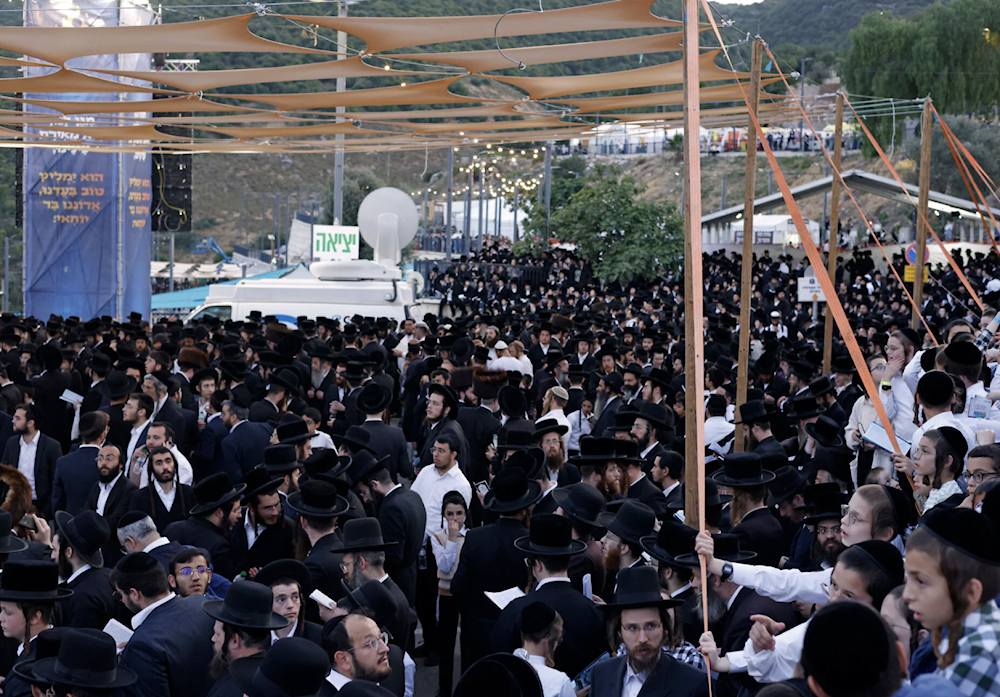
Orthodox Jews gather at Mount Meron during the Jewish holiday of Lag B'Omer, in northern occupied Palestine, on May 15, 2025. (AFP)
Israeli Prime Minister Benjamin Netanyahu has ordered the cancellation of large-scale celebrations at Meron, citing security concerns as confrontations persist along the border with the Lebanese Resistance movement, Hezbollah.
The event will be held in a "symbolic format" as Israeli officials pointed to the site’s proximity to the Lebanese border, ongoing rocket fire in the area, and the challenges of conducting large-scale evacuations during peak attendance.
The move reflects growing concern within the Israeli occupation entity over the deteriorating security situation in the north, where continued confrontations with the Lebanese Resistance have exposed vulnerabilities on the ground.
'Israel' records 30 injuries on northern front with Lebanon in one day
The Israeli Ministry of Health has revealed that at least 30 injuries were recorded on the northern front with Lebanon over the past 24 hours.
According to official figures, the total number of injuries has reached 581 since the ceasefire with Iran came into effect, underscoring the ongoing losses for the Israeli regime.
The data comes as confrontations persist between the Israeli occupation and the Islamic Resistance in Lebanon, with recent operations resulting in casualties among IOF troops in southern Lebanon.
Halting fighting only way to stop Hezbollah attacks: Israeli media
"Israel" is facing mounting political fallout from its war on Lebanon, as senior officials acknowledge that military force has failed to neutralize Hezbollah’s missile capabilities, Israel Hayom reported.
A senior Israeli official said that, despite ongoing attacks, halting the offensive remains the only effective way to stop rocket and missile fire toward northern occupied territories, a position that comes amid internal criticism over the recently announced ceasefire.
The report noted that the Israeli cabinet had never formally tasked the army with eliminating Hezbollah’s military capacity, reflecting an implicit recognition that such an objective cannot be achieved through force alone.
While targeted assassinations and continued strikes may degrade capabilities, the official conceded they cannot fully stop missile and rocket launches.
Any attempt to do so would require a far broader ground invasion and a substantial increase in troop deployment, an option described as unrealistic given the strain on Israeli forces, which remain engaged across multiple fronts and continue to rely heavily on reservists.


