
Netanyahu invokes Trump backing, threatens renewed war on Iran
 7 Min Read
Israeli PM Benjamin Netanyahu invokes US President Donald Trump's backing and raises the prospect of renewed aggression against Iran, while reported divisions within Washington expose growing doubts over his leadership.
-
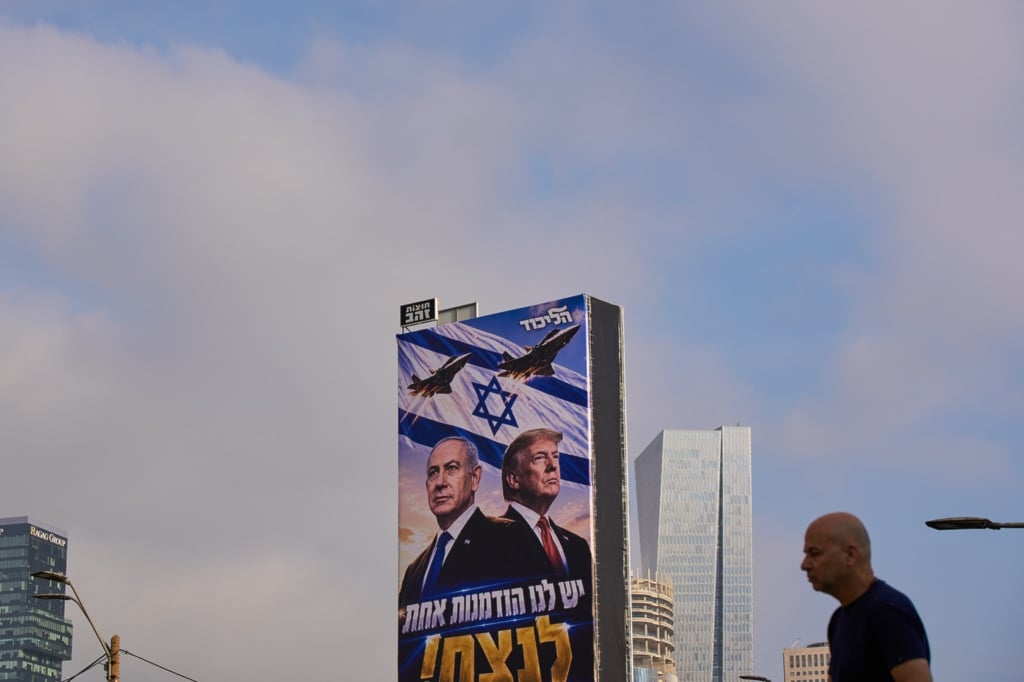
People walk past a Likud Party campaign billboard featuring US President Donald Trump and Israeli PM Benjamin Netanyahu, with a Hebrew message reading, We have one opportunity to win,' in Tel Aviv, 'Israel', Monday, Oct. 26, 2026. (AP Photo/Oded Balilty)
Israeli Prime Minister Benjamin Netanyahu has invoked US President Donald Trump’s endorsement and raised the prospect of renewed US-Israeli aggression against Iran ahead of Tuesday’s Knesset elections, even as reported divisions within the Trump administration cast doubt on Netanyahu’s role in Washington’s regional strategy.
Speaking in a televised appearance late Sunday, as carried by Reuters, Netanyahu praised Trump’s support, describing their relationship as unprecedented between an Israeli prime minister and a US president. He also cited Trump’s appeal to voters to keep him in office, following the US president’s social media post urging him to “finish the job” against Iran.
“Vote for Bibi Netanyahu for Prime Minister, we have to finish the job that we started!” Trump wrote.
Netanyahu said Trump was prepared to take action that would “finally, finally, remove the Iranian threat,” provided Netanyahu remained in power, according to Reuters. He added that he had instructed the Mossad and the Israeli occupation military to bring down the Iranian government, arguing that this was the only way to "end the threat."
The statements came as the White House ruled out a US attack on Iran before the November 3 midterm elections. Deputy Press Secretary Anna Kelly said Iran was in a “very bad condition” economically and militarily and that the blockade would remain in force, while oil continued to pass through the Strait of Hormuz.
The gap between Netanyahu’s rhetoric and Washington’s position reflects broader uncertainty over whether Trump will support another major military operation against Tehran after the Israeli elections and the US midterms.
Reported divisions in Washington over Netanyahu
Despite Trump’s public endorsement, senior US officials have expressed growing dissatisfaction with Netanyahu, with some of the president’s advisors considering whether a different Israeli leadership could better advance Washington’s regional objectives, Axios reported on Saturday.
According to US officials cited by the outlet, the disagreements have intensified over the past six months and extend beyond Iran to Gaza, Lebanon, and Syria. Some administration figures opposed Trump’s intervention in the Israeli election, while others reportedly believe Netanyahu’s departure could facilitate US diplomatic efforts across the region.
One Trump advisor summed up the president’s continued preference for Netanyahu despite their differences, saying, “He's the devil he knows.”
The US-Israeli war on Iran has emerged as a central source of friction. Vice President JD Vance and other senior officials reportedly believe Netanyahu gave Washington mistaken assessments before the war, prompting questions over his reliability as a partner.
Vance has publicly refrained from endorsing Netanyahu’s reelection campaign.
“I'm not attacking Bibi Netanyahu. I'm not endorsing Bibi Netanyahu. I think the president's endorsement is ultimately what matters,” Vance told reporters.
The reported disagreements are significant as Netanyahu pushes for another large-scale military operation against Iran, while Trump faces decisions over the extent of US involvement. Trump’s public support for Netanyahu therefore does not necessarily signal agreement within his administration over the Israeli premier’s preferred course of action.
Regional agenda fuels further disagreements
According to Axios, disagreements also concern Netanyahu’s approach to other regional files that Washington considers central to its diplomatic agenda.
Trump’s envoys Steve Witkoff and Jared Kushner have reportedly raised concerns over Netanyahu’s unwillingness to advance implementation of the US president’s Gaza plan. Disagreements have also surfaced over Syria, where US envoy Tom Barrack has reportedly criticized the Israeli government’s approach toward Damascus and its continued aggression on Syrian territory.
Washington is seeking to advance diplomatic arrangements involving Lebanon and Syria, implement its Gaza proposals, and pursue normalization between Saudi Arabia and “Israel.” Some US officials reportedly believe an Israeli occupation government without Netanyahu’s far-right coalition partners could be more cooperative in pursuing these objectives.
Trump’s endorsement may nevertheless provide Washington with leverage. According to officials cited by Axios, the president could use his support to press Netanyahu for concessions if he remains in office. A government formed by Netanyahu’s opponents would also be expected to prioritize relations with Washington.
Eisenkot attacks Netanyahu over security and economic risks
Netanyahu’s main challenger, former Israeli military chief of staff Gadi Eisenkot, acknowledged Trump as “a true friend of Israel” but said the US president would work with any leader chosen by voters.
Eisenkot also accused Netanyahu of using fear to influence the electorate, after the prime minister posted an AI-generated image of a mushroom cloud over Tel Aviv while warning of an existential danger from Iran.
“This time, it won’t work for him,” Eisenkot said, accusing Netanyahu of relying on “a campaign of fear-mongering, lies, and threats—including images of nuclear bombs in the heart of Tel Aviv.”
Eisenkot has separately criticized Netanyahu’s preparations for potential international financial sanctions. Netanyahu said he had requested an economic plan examining alternative payment mechanisms, including cryptocurrencies and blockchain technology, amid concerns that sanctions could target the Israeli banking system. He has also warned that US military assistance will not continue indefinitely and called for greater military self-reliance.
Eisenkot mocked the proposed financial strategy as “Bibicoin” and warned that economic isolation could drive companies abroad, undermine investment and savings, reduce employment, and leave fewer resources for healthcare and education.
“This is not an imagined nightmare scenario, but Netanyahu’s plan for Israel if he is reelected” on Tuesday, he said. “This is a real warning. Israel will not withstand another four years like these.”
The dispute comes amid international pressure over the war on Gaza, settlement expansion, and settler attacks in the occupied West Bank, with the UK and other Western countries imposing measures against individuals and entities linked to Israeli settlements.
Election leaves Netanyahu’s future uncertain
Tuesday’s election is the first since October 7, 2023, and the wars that followed on multiple fronts. The vote offers the electorate an opportunity to pass judgment on the "security failures", the consequences of the subsequent wars, and Netanyahu’s record as the longest-serving prime minister in “Israel.”
Polls cited by Reuters suggest Netanyahu’s Likud party could lose seats, potentially depriving his coalition of right-wing, far-right, and ultra-Orthodox parties of its narrow parliamentary majority.
Final surveys published Friday by three major Israeli television networks projected that Netanyahu’s bloc would win around 50 seats in the 120-member Knesset, short of the 61 needed for a majority. Likud was projected to secure 20 seats, down from its current 32. The opposition bloc led by Eisenkot was projected to win between 52 and 56 seats, while two Arab parties were expected to secure another 14 to 16 seats. A separate survey by the pro-Netanyahu Channel 14 projected a stronger result for the prime minister’s coalition, giving it 60 seats.
The opposition also faces obstacles to forming a government, including Eisenkot’s refusal to include Arab parties in his coalition. The result could therefore produce another political deadlock and leave Netanyahu in a caretaker role if no governing majority emerges.


