
Netanyahu's Likud loses seat, falls short of majority in latest poll
 4 Min Read
Likud loses another seat as Netanyahu's bloc remains nine seats short of a parliamentary majority ahead of the October 27 election.
-
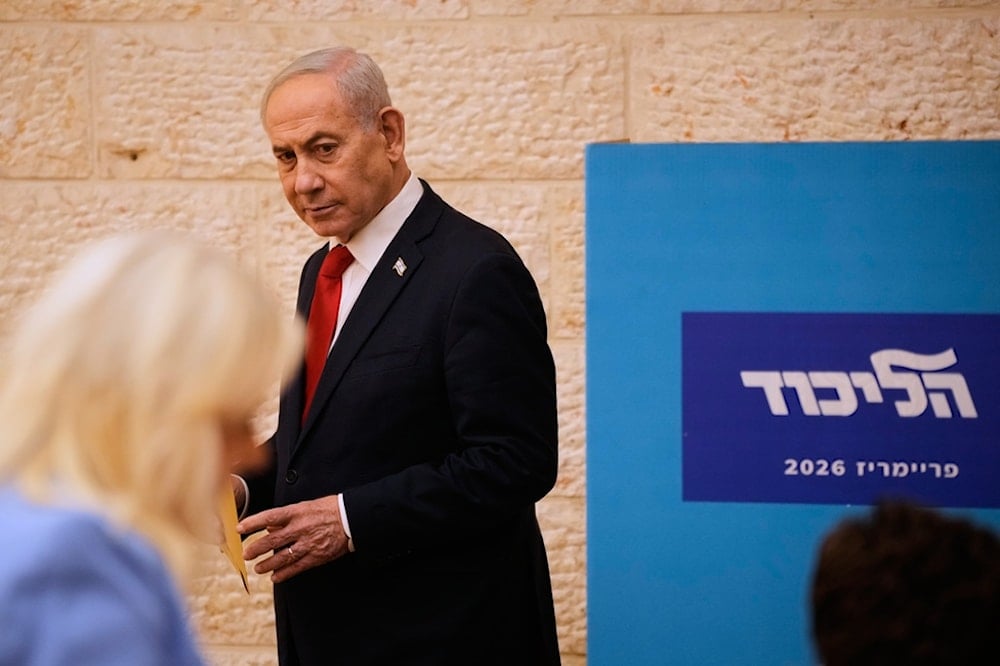
Israeli Prime Minister Benjamin Netanyahu casts his ballot in his Likud party primary elections ahead of the general election in October, in occupied al-Quds, occupied Palestine, Monday, August 17, 2026 (AP)
Israeli Prime Minister Benjamin Netanyahu’s Likud party has continued to lose support, while his chances of forming a government remain uncertain ahead of elections scheduled for October, according to a poll released Sunday.
The survey, published by the Israeli Public Broadcasting Corporation KAN, showed Likud losing another seat compared with last week’s poll, leaving it with 20 of the Knesset’s 120 seats if elections were held today.
Despite Likud’s decline, Netanyahu’s bloc retained 52 seats but remained nine short of the 61 needed to form a government, the poll showed.
New alliance complicates coalition prospects
The political landscape was further complicated by a new alliance between politician Yoaz Hendel and economist Yaron Zelekha, which crossed the electoral threshold and secured four seats.
The alliance is not currently aligned with either of the main political blocs.
Even if Hendel and Zelekha joined Netanyahu’s camp, the bloc would hold only 56 seats, leaving it five short of a parliamentary majority.
The findings therefore offered Netanyahu no path to forming a government based solely on his existing allies, even with the hypothetical support of the new alliance.
Opposition bloc also loses support
The opposition bloc led by former military chief Gadi Eisenkot, meanwhile, secured 51 seats, down from 55 in last week’s survey.
The Kantar Institute conducted the poll among 551 Israelis aged 18 and above. It had a margin of error of 4.2 percentage points.
The findings come ahead of the general election scheduled for October 27, amid intensifying competition over the composition of political blocs and the premiership.
Netanyahu's ouster 'existential need'
Israeli opposition Knesset member Gilad Kariv said on Saturday that Prime Minister Benjamin Netanyahu must be removed from office, calling it an "existential need for Israeli society."
In a post on X, the Democrats party lawmaker took aim at Netanyahu's handling of the army's internal probe into the events of October 7, 2023. Kariv drew a parallel between Netanyahu's months-long refusal to visit communities near Gaza after the operation and what he said is a similar pattern of avoidance now, this time toward the military's own investigation into that day's failures.
Kariv charged that Netanyahu has repeatedly "abandoned" "Israel's" security and shown "complete incompetence" in handling "national security matters." He argued that someone with that record "must not be allowed to make any decisions about our future and the future of our children," reiterating that removing Netanyahu from the premiership has become an existential matter for the entity.
His remarks land amid continued opposition and public pressure for a state commission of inquiry into the security and political failures around October 7, a mechanism Netanyahu's government has resisted in favor of a panel with politically appointed members rather than one selected through the courts.
Democrats gaining ground ahead of the vote
Kariv sits in the Knesset for the Democrats, the merged Labor-Meretz faction chaired by Yair Golan, which currently holds just four seats in the outgoing chamber.
But surveys conducted ahead of the October 27 election point to a marked recovery, with the party projected to reach roughly 10 to 11 seats, more than double its present standing.
That would put the Democrats ahead of where Labor and Meretz would likely have landed had they run separately, reflecting what analysts describe as a broader remobilization on the Israeli left since the last vote.
The Democrats' rise is unfolding alongside a steady erosion of Likud's position. Netanyahu's party, which won 32 seats in 2022, has slipped into the low-to-mid twenties in recent surveys, with some polls showing former military chief Gadi Eisenkot's new Yashar party overtaking it as the largest single faction.


