Netanyahu's pardon bid puts 'Israel' in crisis mode: Herzog
 4 Min Read
Israeli President Isaac Herzog is resisting mounting pressure from Benjamin Netanyahu, whose unprecedented request for a pardon has intensified political, legal, and institutional turmoil inside the regime.
-
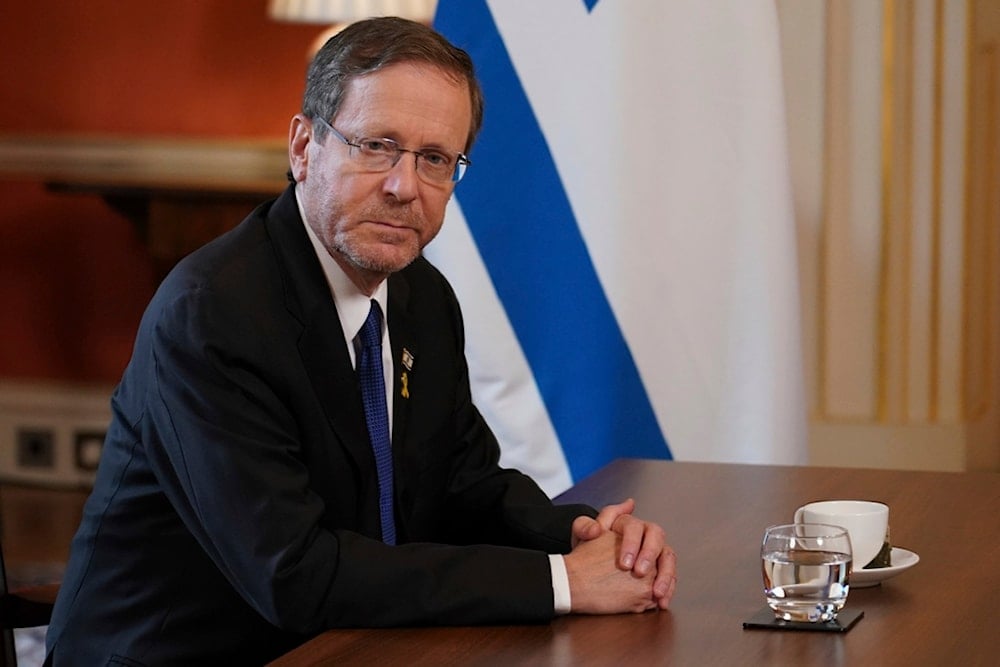
Israel's President Isaac Herzog sits at a table as he speaks to Britain's Prime Minister Keir Starmer at 10 Downing Street in London, Wednesday, Sept. 10, 2025 (AP Photo/Alberto Pezzali, Pool)
Israeli President Isaac Herzog has distanced himself from Prime Minister Benjamin Netanyahu's attempt to secure a presidential pardon, saying he will consider only what he believes serves the occupation's interests.
Responding to Netanyahu's formal request, Herzog said he "will take only the interests of Israel and Israelis into consideration", adding that the prime minister's move "worries many" at a moment of deep political strain.
In a statement from his office, Herzog condemned escalating pressure and hostile messaging surrounding the request. He stressed that "violent rhetoric will not deter him from his decision", and that the pardon application "will be handled with precision and clarity".
His remarks come amid what Israeli legal circles describe as unprecedented political interference in judicial processes, with growing concerns that Netanyahu's allies are attempting to intimidate legal officials, including the Attorney General and top judges.
Netanyahu floats political concessions in exchange for clemency
The pro-regime daily Israel Hayom reported that Netanyahu framed his plea as serving the "public interest," but suggested that the request amounts to a political bargain. According to the paper, the prime minister proposed shelving his coalition's contentious judicial overhaul in return for a pardon, presenting the reversal as a step toward national unity. The newspaper noted that Netanyahu argued that clemency "would enable him to work on unifying Israelis, and even address additional issues, such as the judicial system and the media".
The offer marks a striking reversal from Netanyahu's earlier rhetoric, in which he portrayed the judicial overhaul as a historic necessity. His willingness to suddenly abandon it suggests either a recognition of the political damage the reforms have caused, or an attempt to leverage the crisis for personal legal survival. Israeli analysts note that Netanyahu is now courting the same centrist and liberal factions he previously castigated, signaling an effort to rehabilitate his image ahead of potential elections.
A pardon request without precedent
Netanyahu's appeal comes while he is still on trial in three corruption cases involving the receipt of luxury gifts, attempts to influence media coverage, and alleged regulatory favors offered to the Bezeq telecom group. A sitting Israeli prime minister requesting a pardon before conviction is virtually unheard of, placing Herzog at the center of a sensitive institutional confrontation at a time when the regime faces internal fractures and ongoing military escalation.
Legal experts warn that granting clemency at this stage, particularly without admission of guilt or withdrawal from politics, could undermine public confidence in the justice system. Critics stress that allowing a serving prime minister to evade prosecution could set a dangerous precedent, effectively placing the executive branch above judicial scrutiny. Opposition lawmakers insist that any consideration of a pardon must include Netanyahu stepping away from public office, noting that several past Israeli presidents and ministers who sought clemency did so only after resigning.
The request has also drawn international attention. Reports in Israeli media claim that US President Donald Trump privately urged Herzog to approve the pardon, reflecting the extent to which Netanyahu's legal fate has become entangled with geopolitical interests and the wider Western political landscape.
ICC charges add to the backdrop but shift little inside 'Israel'
Netanyahu also faces an arrest warrant issued by the International Criminal Court for war crimes and crimes against humanity committed in Gaza. Although the ICC's prosecutor cited the targeting of civilians, starvation of the population, and attacks on civilian infrastructure, these accusations have had minimal impact on Netanyahu's domestic standing. The occupation has even formally petitioned the ICC to revoke the warrants and disqualify Prosecutor Karim Khan, an unprecedented move that underscores the regime's fear of international legal exposure.
Polling conducted in the months after the ICC announced its charges shows that most Jewish Israelis reject the legitimacy of the court and view the warrants as politically motivated. This response produced a brief rally-around-the-flag effect among Netanyahu's supporters, while liberal and Palestinian citizens of "Israel", who already opposed him, saw the charges as further evidence that he is unfit to lead. The overall electoral map inside "Israel," however, remained effectively unchanged.
Read more: 'Israel' appeals to cancel ICC arrest warrants for Netanyahu, Gallant