
Netanyahu's promise to 'finish' Hezbollah: A vow he cannot keep
 4 Min Read
Academic Martin Kear argues Netanyahu has trapped himself by promising to destroy Hezbollah, a goal his own military strategy was never designed to achieve.
-
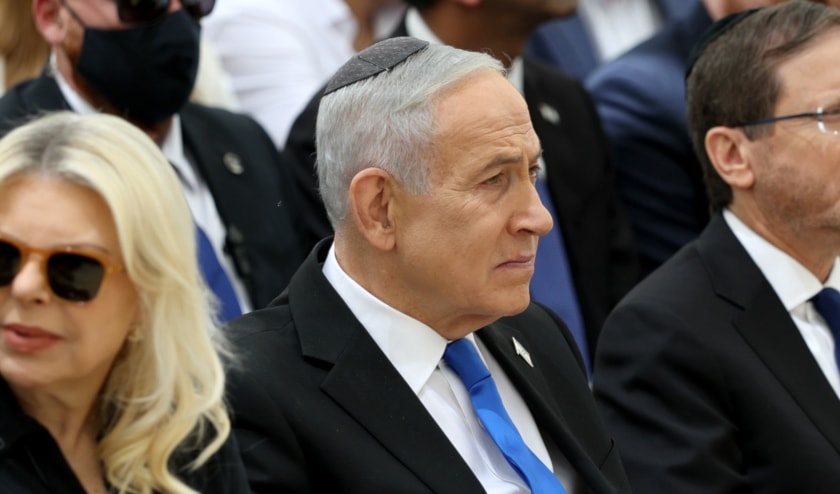
Israeli Prime Minister Benjamin Netanyahu, center, and his wife Sara, left, attend a ceremony in occupied al-Quds, Tuesday April 21, 2026. (AP)
Martin Kear, lecturer in Government and International Relations at the University of Sydney, argues in an opinion piece written for The Conversation that Israeli Prime Minister Benjamin Netanyahu has locked himself into a political contradiction, pledging the destruction of Hezbollah while relying on a strategy never designed to achieve it.
For decades, Israeli governments have pursued what military planners call "mowing the grass," periodic large-scale operations intended not to defeat resistance movements, but to degrade their capabilities and buy time. The logic was always about management, not elimination.
Kear argues that Netanyahu has now abandoned that framing publicly, shifting from containing the resistance to promising its outright dismantlement. Yet as the academic sees it, this promise is structurally impossible to fulfil, as Hezbollah is not merely a military force; it is deeply embedded in Lebanon's social, political, and cultural fabric in ways that no air campaign or ground incursion can uproot.
The 'Gaza playbook' moves north
Since early March, "Israel" has killed more than 2,600 Lebanese and displaced 1.2 million others, destroying bridges across the Litani River and systematically demolishing villages in southern Lebanon to establish what it calls a security buffer zone. Israeli War Minister Israel Katz explicitly cited Rafah and Beit Hanoun as the model.
Kear identifies this as the same logic applied in Gaza, rendering territory uninhabitable rather than achieving any defined military objective. The so-called buffer zone, in his reading, serves domestic political purposes as much as any security rationale, allowing Netanyahu to project resolve while deferring the question of what "finishing the job" would actually require.
Read more: No yellow line or buffer zone, and there never will be: Sheikh Qassem
Trapped between his base and Washington
The deeper bind, Kear contends, is political. A recent poll by the Israel Democracy Institute found that 80% of settlers support continuing the war against Hezbollah regardless of any US-Iran agreement, even at the cost of friction with Washington. Netanyahu has cultivated this sentiment for years and is now, in Kear's view, a prisoner to it.
However, Iran has conditioned any ceasefire with the United States on protections for Hezbollah. Should Netanyahu accept such a deal, he would be left with a wounded but intact Hezbollah, a surviving Hamas, and an unbowed Iranian leadership, what Kear describes as a "triple disaster."
Rejecting it, however, risks fracturing the relationship with Washington that underpins "Israel's" military and diplomatic position.
With elections due before the year's end, and Netanyahu's long-running corruption trial awaiting, Kear argues neither outcome is politically survivable on his current terms.
On the ground: The operational picture
Kear's political assessment is further reinforced by the material realities emerging from the battlefield.
Field and logistical data from operations "Rising Lion" and "Roaring Lion" point to an IOF operating well beyond sustainable limits: reserve brigades completing their seventh rotation since October 2023, air force platforms logging years' worth of flight hours within weeks, and munitions consumption at rates that have left roughly 81% of Arrow-2 and Arrow-3 interceptor stockpiles expended.
Analysts tracking the war assess that ammunition depletion timelines, rather than political calculations, have become the primary constraint on Israeli decision-making, with operational windows of approximately 40 days before leadership is compelled toward diplomatic exits.
By sustaining an active front throughout the war on Iran, Hezbollah effectively siphoned resources that would otherwise have been directed eastward, converting the conflict, in the assessment of regional analysts, from one of decisive military victory into one of logistical endurance.
Read more: Strategic disconnect: Israeli rhetoric vs. reality on the ground


