
Strategic disconnect: Israeli rhetoric vs. reality on the ground
 7 Min Read
The Israeli military resource crisis reveals critical shortages in manpower, munitions, and airpower amid wars on Lebanon and Iran.
-
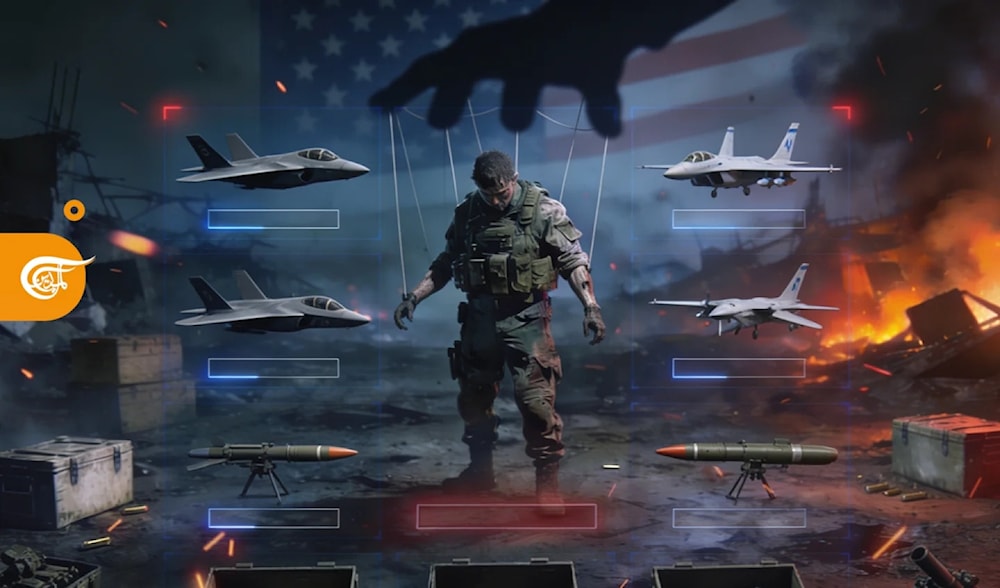
A graphic made for Al Mayadeen, showing a soldier between several munitions and military aerial vehicles (Al Mayadeen)
Field and logistical data drawn from the trajectory of recent Israeli wars on Lebanon and Iran, specifically operations “Rising Lion” and “Roaring Lion's”, point to a deep strategic gap between Israeli political rhetoric, which is premised on the ability to operate simultaneously across seven fronts, and operational reality, which reveals critical limitations in manpower, precision munitions, and the distribution of intelligence focus.
"Israel" is no longer waging a conventional war alone; it is managing a strict policy of resource rationing. The depletion of stockpiles and the erosion of readiness have imposed rules of engagement that did not exist in its initial calculations.
Manpower crisis, erosion of IOF's backbone
The Israeli military has entered an unprecedented phase of human attrition not seen since its establishment. Reserve forces have effectively become a standing army under compulsion, with entire brigades serving their seventh rotation since October 2023, and with service days exceeding what an average soldier would normally serve over decades.
This pressure has not only led to declining motivation among some soldiers, fueled by disputes over burden-sharing, draft evasion, and the financial costs of reserve duty, which reached 1.5 billion shekels in just two weeks, but has also directly impacted operational readiness and deployment.
A severe shortage of qualified combat personnel is now limiting the General Staff’s ability to maneuver between fronts, forcing the redeployment of units from one theatre to reinforce another.
This explains localized withdrawals from secondary arenas in favor of prioritizing others, such as the Lebanon front, as well as the need to reconstitute brigades and divisions using volunteers beyond the standard age of service.
Overstretched skies: 'Israel’s' air power hemmed in between two fronts
The Israeli Air Force, long regarded as an untouchable strategic arm, now faces a dilemma between flight hours and aircraft lifespan. Within a single month, pilots have logged flight hours equivalent to years of operations, placing immense strain on maintenance systems and limiting the number of platforms capable of sustained deployment.
The peak of these constraints is evident in the distribution of intelligence and operational focus. Field realities have demonstrated an inability to maintain the same level of operational intensity simultaneously in both Lebanon and Iran.
The air force’s need to halt its sorties over Iran 24 hours before launching large-scale operations in Lebanon, as evident in "Operation Eternal Darkness", is a clear admission that the “target bank” and the closing of targeting cycles demand a level of focus that cannot be divided without sacrificing efficiency.
This dispersion grants the Axis of Resistance a temporal advantage and greater room for maneuver. Every moment of focus directed toward one front becomes a net gain for the other, allowing for repositioning or the advancement of strategic programs.
Burning through arsenal exposes industrial dependence
Analysis of munitions consumption reveals a stark reality for "Israel". The Israeli military, which reportedly entered the war with a stockpile of around 15,000 munitions according to a senior officer, has since expended approximately 150,000, transforming reliance on the US “air bridge” from a support option into a condition for operational survival.
Israeli reports indicate that critical categories of advanced munitions have been depleted at unsustainable rates:
- Air defense systems: Approximately 81% of Arrow-2 and Arrow-3 interceptor stockpiles have been consumed, with projections suggesting complete depletion within days had the conflict continued at the same pace.
- Offensive weapons: Missiles such as Rampage and Blue Sparrow have exceeded 50% consumption rates, placing military leadership before difficult choices: either reduce high-precision strikes or accept increased risks to aircraft by resorting to less accurate, “dumb” munitions, an option that has reportedly already been employed.
This industrial fragility is compounded by disruptions in global supply chains and shortages of key materials, such as gallium and germanium, largely controlled by China. As a result, replenishing what was expended in just over two weeks could take years, helping explain a growing shift toward resource-efficient offensive defense strategies.
When defense becomes attrition: 'Israel’s' air shield tested
Despite the existence of a multi-layered defense system, its limitations have become evident in the inability to fully prevent drones and missiles from striking strategic targets.
The issue is no longer purely technological, but also economic: deploying interceptor missiles costing millions of dollars against low-cost drones is a trajectory that risks financial and logistical exhaustion.
The prioritization of defensive resources toward high-value assets, such as gas platforms and key bases like Palmachim, has left other areas, including parts of the northern front and the civilian hinterland, relatively exposed.
This has led to a flexible interception policy that effectively allows certain projectiles to land in less critical areas in order to conserve interceptors for more vital targets.
'Logistical predation' as a symptom of declining readiness
Resource depletion is no longer confined to precision munitions and air defense systems; it has penetrated the core of ground force structure through “logistical predation.”
This practice reflects the military’s need to dismantle parts from decommissioned platforms, such as Achzarit armored personnel carriers, to repair more modern systems, signaling an inability to secure spare parts and propulsion units due to slow global production and strained supply chains.
What was once a “concerning situation” has now evolved into emergency measures, including extending the lifespan of aging equipment by another decade and repurposing old, stockpiled explosives for battlefield use.
Tank units operating with incomplete formations due to engine shortages and the manual extension of mortar barrel lifespans demonstrate a shift toward patchwork solutions to compensate for resource gaps.
This reality significantly degrades combat performance and increases the risk of technical failures during engagements, raising serious doubts about the sustainability of multi-front warfare.
From military decisiveness to logistical endurance
The ongoing war on Lebanon, alongside deeper tensions involving Iran, has revealed a form of “strategic anemia” in essential resources. Resource allocation is no longer a matter of tactical choice but a consequence of an inability to sustain equal intensity across multiple theatres.
By maintaining an active second front during the war on Iran, Hezbollah has succeeded in draining resources that would otherwise have been directed toward Iran, effectively shifting the conflict from one of decisive military victory to one of logistical endurance.
The projected timeline for ammunition depletion has emerged as the true constraint shaping Israeli political decision-making, forcing leadership to adopt timelines not exceeding roughly 40 days, as seen during “Rising Lion”, after which efforts shift toward diplomatic exits or the scaling down of objectives to avoid reaching a critical “zero point” marked by empty stockpiles and an exhausted military.


