
Israeli army recalls reservists with PTSD amid manpower shortage
 4 Min Read
Israeli reservists with PTSD are being pressured to return to service due to a severe manpower shortage in the military.
-
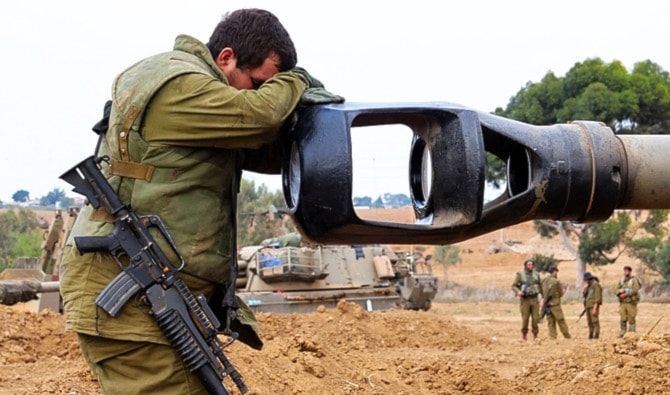
An Israeli soldier rests his head on the artillery gun barrel of an armored vehicle as Israeli soldiers take positions near the border with Gaza on Oct. 9, 2023. (AFP)
The Israeli army has been recalling reservists suffering from psychological injuries, including post-traumatic stress disorder (PTSD), to active duty under intense pressure, as reported by Israeli news outlet Haaretz. The move comes amid a growing personnel shortage in the military as operations expand across multiple fronts.
According to the report, many of the soldiers summoned had been receiving treatment through the army’s rehabilitation division but had not yet been evaluated by a medical committee, a process that can take years. Despite their concerns, some complied and donned their uniforms under pressure.
The army reportedly instructed reservists with PTSD to return to service, and in some cases threatened them with arrest if they refused. The soldiers explained their medical conditions to their commanders, who warned that noncompliance would be considered desertion.
Over 20 cases reported since the start of war on Iran
Haaretz noted that similar measures were applied across multiple reserve brigades, including for soldiers in severe mental health conditions, even those recently admitted to psychiatric care.
Since the start of the war on Iran, the Israeli outlet received reports of more than 20 such cases. Following inquiries by Haaretz regarding several individual incidents, the orders for some reservists were ultimately canceled.
This underscores the severe strain on Israeli military personnel as the army seeks to maintain the fronts it opened despite widespread injuries and psychological trauma among its forces.
Senior official warns IOF faces critical personnel shortage
In that regard, a senior Israeli military officer warned on Thursday of a critical personnel shortage in the army, emphasizing the urgent need for more soldiers in both regular service and the reserves, as well as reforms to reserve service laws, according to Israeli Channel 13.
The officer told the channel, “We have been issuing warnings for a long time about the gap in troop numbers. We need more soldiers, more forces, in Gaza, the West Bank, and Lebanon.”
He added that by January 2027, if the length of regular service is not reassessed to extend to three years (36 months) instead of 30, “this will create an intolerable difference.”
Israeli army on the brink: Chief of Staff warns of imminent collapse
Within the same frame, the Israeli newspaper Israel Hayom described the warning issued by Israeli Chief of Staff Eyal Zamir to Cabinet ministers as “sharp and exceptional.”
The Chief of Staff had indicated that the army would collapse if a solution to the manpower crisis is not found, saying, “I am raising 10 red flags before the Israeli army collapses from within.”
Israel Hayom noted that when the army commander describes the situation this way to political leaders, it is not merely an update. The newspaper emphasized that this statement signals that “the security establishment is approaching a point of failure,” adding that “the only possible response from the political level is to act to prevent a disaster.”
The newspaper highlighted that the Israeli army is stretched to the maximum, noting that “fighting on multiple fronts at the same time, in Iran, Lebanon, Gaza, Syria, and the West Bank, increases the manpower crisis, which already existed after two and a half years of war, and only adds to the missions.”
According to Israel Hayom, this pressure is cumulative and affects not only operational levels but also “the same limited group of soldiers and reservists are sent repeatedly to the same fronts, with less time to recover and with increasing and ongoing fatigue.”
The newspaper stated that this ongoing “fatigue” impacts “the ability to maintain the formation for a long period, not just long-term efficiency.”
Related: 'Not 10 red flags, but 100': IOF reserve soldiers 'already worn out'


