
To avoid election loss, Netanyahu races to secure budget for war
 3 Min Read
Netanyahu races to pass a $225B budget and avoid early elections as his war on Iran drags on, with polls showing little change in his support.
-
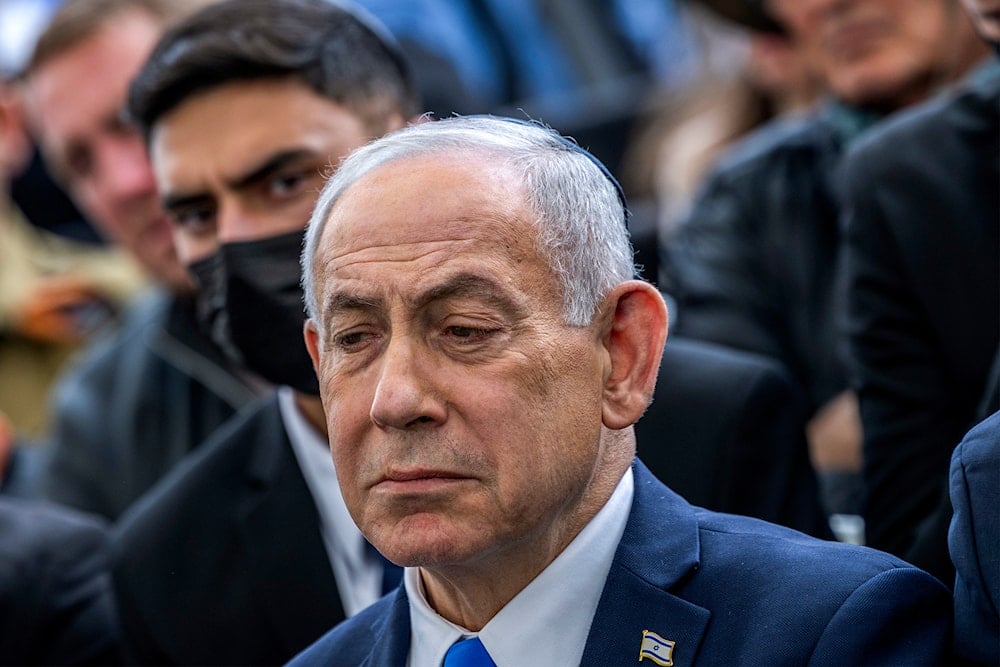
Israeli Prime Minister Benjamin Netanyahu reacts during the funeral of Israeli captive Ran Gvili, whose remains were brought back to 'Israel', Jan. 28, 2026 (AP)
Israeli Prime Minister Benjamin Netanyahu is trying to secure passage of a government budget and avoid early elections, which polls suggest he could lose, as the war on Iran shows little impact in boosting his political standing.
Netanyahu’s coalition had considered leveraging the war’s opening attacks against Iran, including the assassinations of top Iranian figures, to push for snap elections before an expected October date. Under Israeli law, failure to pass the budget by March 31 would trigger snap elections within 90 days.
Some of Netanyahu’s allies publicly floated a June vote earlier in the offensive, but nearly four weeks into the war, the ICC-wanted prime minister is focused on passing the budget to maintain parliamentary support.
Efforts to secure approval have included allocating funds to political allies and rushing the budget through the Finance Committee. The security-heavy $225 billion budget is set to address the rising costs of war while preserving coalition stability.
Netanyahu's political standing falters
The war has allowed Netanyahu to pivot attention from Gaza to a joint aggression with the US against Iran, which had been widely supported. However, election polls remain largely unchanged since October 7, 2023.
Surveys show roughly 40% of voters supporting Netanyahu’s coalition of nationalist and religious parties, 40% backing opposition groups, and little swing toward the prime minister, according to political scientist Gideon Rahat of the Hebrew University in occupied al-Quds.
Even with public backing for the war, many Israelis are growing weary as the offensive drags on without a decisive outcome or diplomatic resolution. The Times of Israel poll on March 19 indicated that Netanyahu’s Likud party would win 28 of the Knesset’s 120 seats, down from 34, while the coalition would fall short of a majority with only 51 seats.
Rising costs and political trade-offs
Moreover, the war on Iran is costing the economy approximately five billion shekels ($1.6 billion) per week, with an additional 32 billion shekels approved for security spending since the aggression began.
Rising war costs have complicated Netanyahu’s efforts to satisfy key parliamentary allies, including ultra-Orthodox Jewish parties, who had previously threatened to vote against the budget. Allocations of roughly five billion shekels for ultra-Orthodox schools appear to have secured their backing for budget passage.
Opposition member Vladimir Beliak criticized the move, saying the government prioritized “coalition survival over fair distribution of resources.”
Netanyahu also faces ongoing legal challenges, including a long-running corruption trial on charges of fraud, bribery, and breach of trust, which he denies. Supported by US President Donald Trump, he has appealed to Israeli President Isaac Herzog for a pardon, a mid-trial pardon would be unprecedented and has been contested by the justice system.
Read more: Is Netanyahu’s war gamble threatening the future of 'Israel'?: FT


