
The Mossad revolt that never came: The gamble that started war on Iran
 7 Min Read
Mossad proposed to Netanyahu that strikes on Iran would ignite a popular uprising, yet four weeks in, the revolt hasn't come.
-
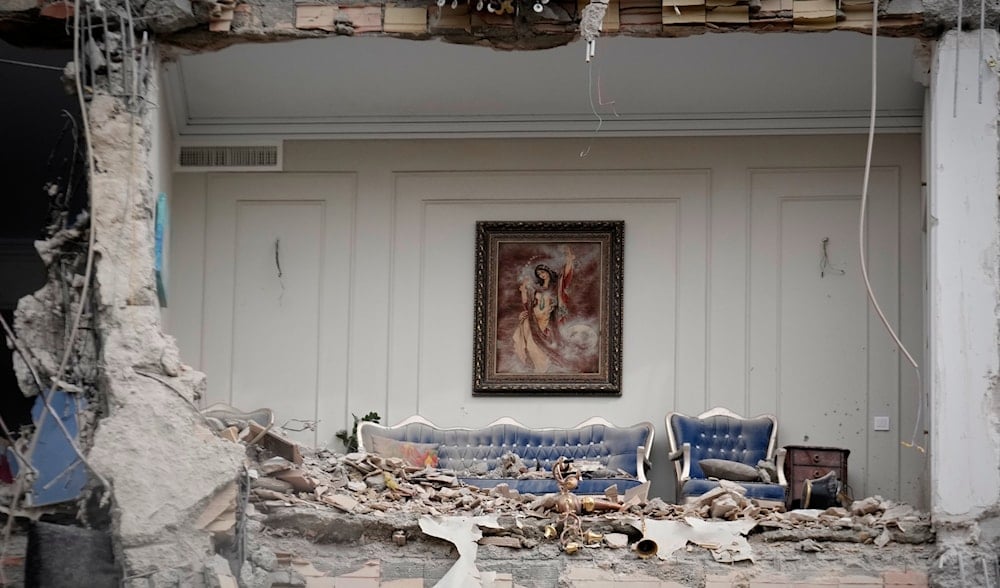
Rubble covers the furniture of a destroyed living room in a residential building hit in an earlier US-Israeli attack on Tehran, Iran, Monday, March 23, 2026 (AP Photo/Vahid Salemi)
Four weeks into the US-Israeli war on Iran, one of its foundational premises, the belief that mass bombardment and assassinations would ignite a popular uprising capable of toppling the Islamic Republic from within, has collapsed in plain sight.
It was not a peripheral assumption. It was, according to reporting by The New York Times, the very logic that Mossad Director David Barnea used to sell the war to Israeli Prime Minister Benjamin Netanyahu, and that Netanyahu used to sell it to US President Donald Trump.
A promise Barnea could not keep
In the lead-up to the war, Barnea presented Netanyahu with a plan. Within days of the opening attacks, Mossad's networks inside Iran would catalyse riots and acts of rebellion serious enough to threaten the government's survival. He took the same proposal to senior Trump administration officials during a visit to Washington in mid-January.
Netanyahu adopted the plan. Trump appeared to embrace it. "Take over your government: It will be yours to take," Trump told Iranians in his opening address as bombs fell on the Islamic Republic. Four weeks later, that uprising has not materialised. US and Israeli intelligence now assess that Iran's government has been weakened but remains intact.
What The Times' account reveals is not a miscalculation made under the fog of war, but a plan that the CIA and the IOF's own Military Intelligence Research Division, AMAN, viewed with scepticism before the first bomb dropped.
US military commanders told Trump directly that Iranians would not come out to protest while the United States and "Israel" were dropping bombs on their country. Intelligence assessments rated the prospect of a mass uprising threatening the government as low, but their warnings were sidelined.
This was not the first time Mossad was warned
What makes Barnea's gamble more striking is what his own agency had concluded before he reversed course.
His predecessor at Mossad, Yossi Cohen, whose tenure ended in 2021, had explicitly ordered that resources devoted to fomenting revolt inside Iran be reduced to a minimum. Cohen's team had modelled how many Iranians would need to take to the streets for protests to genuinely threaten the Islamic Republic, comparing those figures against the actual scale of every protest movement since the 1979 revolution. "We wondered if we could bridge this gap," Cohen said in 2018, "and we came to the conclusion that we couldn't."
Mossad's strategy under Cohen was reportedly redirected toward attrition, like crippling economic sanctions, the assassination of nuclear scientists and military commanders, and the sabotage of nuclear facilities. All aimed at forcing eventual capitulation rather than a manufactured collapse.
Barnea reversed that institutional conclusion over the past year, betting that the conditions had changed. The January 2026 riots appear to have been central to that recalculation, and Mossad's involvement in those protests was not merely observational.
Mossad's involvement in the January 2026 riots
The January riots did not emerge in a vacuum, and Mossad made little effort to conceal its hand. The agency's own Farsi-language account on X posted on December 29, the day after protests began, claiming it was already operating within them.
Former US Secretary of State and CIA Director Mike Pompeo was more explicit: "Happy New Year to every Iranian in the streets. Also, to every Mossad agent walking beside them."
The Iranian regime is in trouble. Bringing in mercenaries is its last best hope.
— Mike Pompeo (@mikepompeo) January 2, 2026
Riots in dozens of cities and the Basij under siege — Mashed, Tehran, Zahedan. Next stop: Baluchistan.
47 years of this regime; POTUS 47. Coincidence?
Happy New Year to every Iranian in the…
Iranian authorities arrested an individual they identified as a Mossad operative who had been "acting covertly among rioters in Tehran," according to Tasnim News Agency.
Iranian Foreign Minister Abbas Araghchi reported the seizure of advanced electronic equipment in Mashhad and Rasht, which he said was being used to jam IRGC surveillance drones, with several drones having "inexplicably" crashed over protest sites during the unrest's peak days.
The Kurdish gambit
Parallel to the internal revolt strategy ran what The Times labelled "the Kurdish option," another pillar of the plan that has since been walked back under pressure from multiple directions.
Mossad has longstanding ties with Kurdish armed groups based in northern Iraq. In the war's opening days, Israeli jets attacked Iranian military and police targets in northwest Iran, explicitly, an Israeli military spokesman confirmed, to "degrade the Iranian regime's capabilities and to open up the way to Tehran." The bombing was designed to clear a corridor for Kurdish militia forces to advance into Iran.
The plan began to unravel almost immediately. Trump, just one week into the war, told reporters he did not want Kurdish fighters entering Iran. "I don't want the Kurds going in. I don't want to see the Kurds get hurt, get killed."
Turkish Foreign Minister Hakan Fidan had delivered a direct warning to Secretary of State Marco Rubio that Turkey, a NATO ally locked in its own conflict with Kurdish separatist movements, would not tolerate US support for Kurdish armed action on its doorstep.
Iraqi National Security Advisor Qasem al-Araji stated publicly that Iraq would not allow any groups based on its soil to cross into Iran, fully honoring the Tehran-Baghdad security agreement. Iran had already struck what it identified as "separatist" positions in the Kurdish region, warning that any move against its territorial integrity would be met with a crushing response.
Among the most striking rejections came from within the Kurdish political establishment itself. Shanaz Ibrahim Ahmed, the Iraqi First Lady, issued a formal statement titled "Leave the Kurds alone. We are not guns for hire."
Leave The Kurds Alone,
— Shanaz Ibrahim Ahmed (@firstladyofiraq) March 5, 2026
We Are Not Guns For Hire. pic.twitter.com/t37uYQBvZG
Bafel Talabani, president of the Patriotic Union of Kurdistan, predicted that a Kurdish advance could produce the opposite of its intended effect, he warned, as Iranians are deeply nationalistic and a cross-border incursion might unify the population against the war rather than fracture the state.
A war built on assumptions that did not hold
Netanyahu, behind closed doors, has reportedly expressed frustration that Mossad's promises have not materialised, venting in one security meeting that Trump might end the war before the intelligence operations produced results, per The Times.
Publicly, he continues to speak of unnamed "ground components" and insists it is "too early" to say whether Iranians will "exploit the conditions we are creating for them." Former Mossad Iran desk chief Shahar Koifman has been more candid, saying he never believed bringing down the Iranian government was an achievable goal of the current conflict.
What The Times' account ultimately documents is a conflict launched on intelligence that even its authors doubted, sold to political leaders who chose optimism over assessment, and waged against a state that has proven, three weeks in, far more resilient than Barnea's promises suggested.


