
Is Netanyahu’s war gamble threatening the future of 'Israel'?: FT
 4 Min Read
A Financial times analysis examines Netanyahu’s decision to escalate the aggression on Iran and how declining US support and prolonged war are another threat to “Israel’s” long-term security.
-
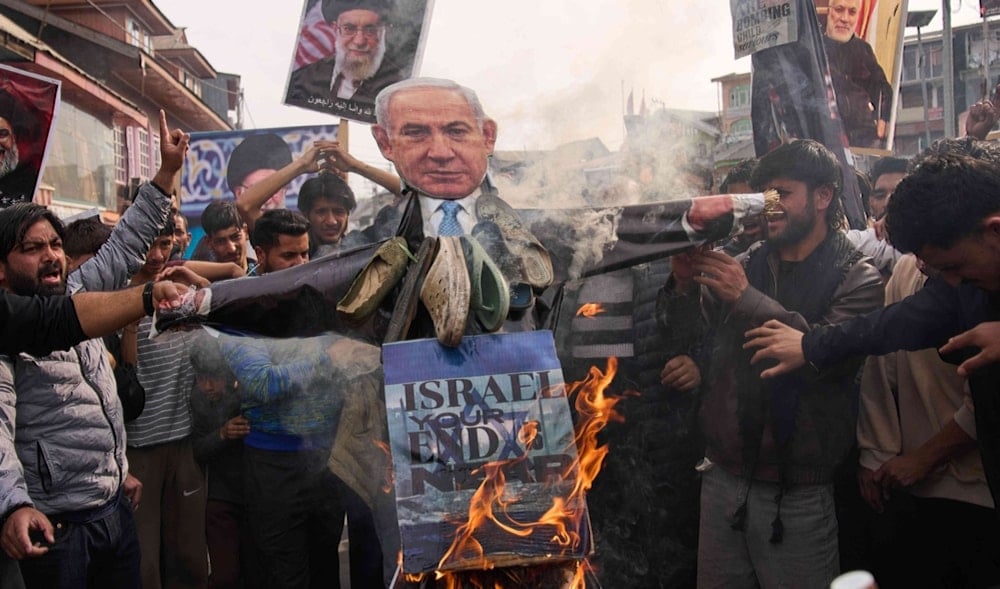
Protesters burn the effigy of Israeli Prime Minister Benjamin Netanyahu during a protest against the killing of Iran's Leader Sayyed Ali Khamenei, in Budgam, northeast of Srinagar, Indian-occupied Kashmir, March 6, 2026. (AP)
Israeli Prime Minister Benjamin Netanyahu’s push toward war on Iran has intensified regional tensions, with the aggression reportedly enjoying overwhelming public backing in “Israel”, as more than 80% of the Israeli public supported the decision to launch the attacks on Tehran.
Yet, Gideon Rachman argues in The Financial Times that the consequences of this escalation are far from the decisive outcome that was anticipated. Rather than delivering a quick resolution, the war has expanded in scope and complexity, raising new risks for both military personnel and settlers.
Rachman notes that developments such as disruptions to the Strait of Hormuz and missile strikes inside “Israel” highlight how the war is evolving in unpredictable ways, undermining expectations of a swift and controlled campaign.
'Israel' rapidly losing US popular support
A central pillar of “Israel’s” long-term security has been strong bipartisan support from the United States. However, recent actions, particularly the genocide in Gaza and the escalation with Iran, are eroding that foundation.
Rachman points to shifting US public opinion, noting that for the first time, more Americans express sympathy for Palestinians than for Israelis. This shift, he suggests, reflects growing concern over the humanitarian consequences of ongoing offensives and could influence future US policy.
Rachman also highlights the evolving political landscape in Washington. Within both major US parties, there is increasing debate over the scale and nature of support for “Israel”. He warns that future presidential candidates may adopt more restrictive positions, potentially reshaping the alliance.
For example, Trump's MAGA base has been increasingly expressing anti-"Israel" sentiments, questioning the nature of bilateral relations between the United States and the Israeli regime. This phenomenon spilled into the government itself after the resignation of Joe Kent, the Trump administration’s head of counterterrorism, who said the US was pulled into the war on Iran because of "Israel".
Military strategy vs diplomatic solutions
Netanyahu’s approach, as described by Rachman, places significant emphasis on military power as the primary means of ensuring security. However, the outcomes of recent military actions raise questions about the effectiveness of this strategy.
Despite claims of decisive victories, Hamas remains active in Gaza, and "Israel's" aggression against Lebanon and the Resistance did not eliminate Hezbollah, leading to renewed confrontation. Similarly, attacks on Iran’s nuclear program have not produced lasting strategic gains.
Therefore, Rachman argues that diplomatic engagement remains the only viable long-term path to stability. He references views from analysts, Danny Citrinowicz, a former head of Iran research for "Israel’s" security intelligence agency, for instance, who suggests that Iran’s leadership has, at times, signalled willingness to negotiate, particularly regarding its nuclear program, opportunities that were not fully pursued.
The most pressing threat 'Israel' faces
According to Citrinowicz, as cited by Rachman, the most significant long-term threat facing “Israel” may not be Iran itself, but the gradual erosion of US political and military support.
This support has historically included substantial military aid, advanced defense systems, and diplomatic backing, elements that have been crucial to “Israel’s” security. However, Rachman warns that prolonged confrontation risks weakening this relationship.
If American support declines, “Israel” could face serious strategic consequences, including reduced military assistance and increased international isolation, he indicated. Such a shift would represent a major change in the geopolitical balance that has long favoured “Israel”.
Read more: Americans doubt war on Iran as economic pressures mount: Poll
Perpetual war warnings
Rachman concludes that Netanyahu’s reliance on military solutions risks leading to a cycle of perpetual war, rather than lasting security. In his view, military "victories" have repeatedly failed to translate into strategic stability.
Instead, he suggests that a combination of declining international support and ongoing conflict creates a dangerous trajectory. Without a shift toward diplomatic solutions, he warns that “Israel” may face increasing instability and a weakening of its global standing.
Read more: Confronting Iran and Hezbollah: Signs of eroding Israeli durability


