
Trump backs down on Iran strikes; Tehran denies any talks
 3 Min Read
Trump announces a five-day halt to strikes on Iran claiming "productive conversations," but Tehran denies direct talks, stating the US initiated the war and is now trying to manipulate energy markets.
-
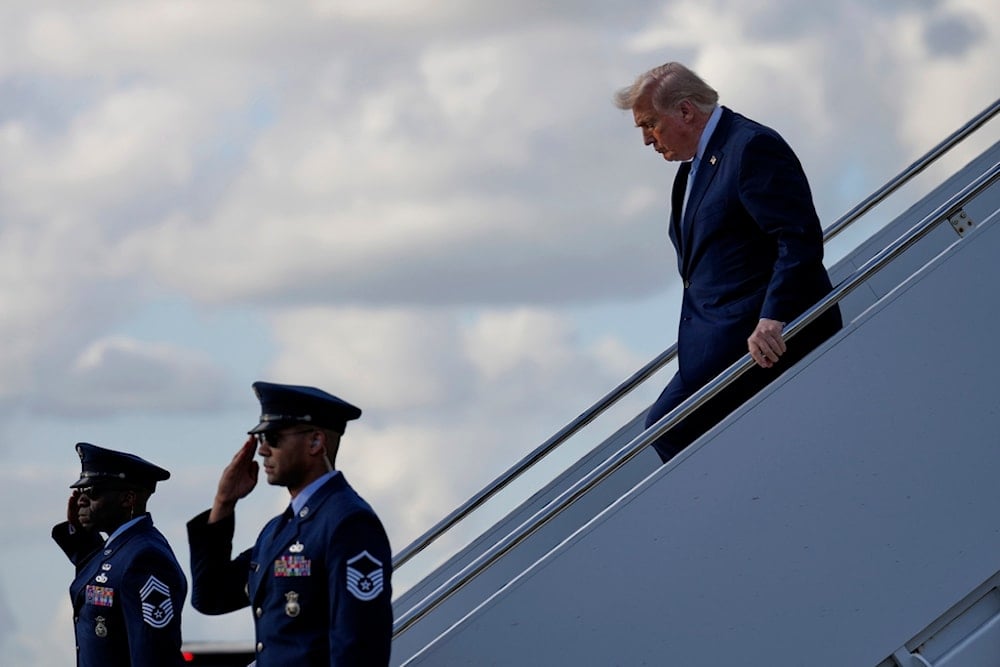
President Donald Trump steps off Air Force One, Friday, March 20, 2026, at Palm Beach International Airport in West Palm Beach, Fla. (AP)
US President Donald Trump announced Monday that he has postponed military strikes on Iranian power plants and energy infrastructure for five days, claiming that Washington and Tehran have held "very good and productive conversations" over the past two days toward resolving the war.
In a post on his Truth Social platform, written entirely in capital letters, Trump said:
The announcement came hours before a deadline Trump had issued on Saturday, in which he threatened that Iranian power plants would be destroyed if Tehran failed to "fully open" the Strait of Hormuz to all shipping within 48 hours, prompting a swift and decisive warning by Tehran that power infrastructure feeding US bases and "Israel" in the region would be targeted.
Iran denies direct talks
After Trump's statements, Iranian officials swiftly rejected claims of direct negotiations between Tehran and Washington.
Iran State TV, citing the Foreign Ministry, reported: "There are no talks between Tehran and Washington."
The Foreign Ministry further characterized Trump's remarks as an attempt to manipulate global energy markets and buy time for his military plans.
"Yes, there are initiatives from some countries in the region to de-escalate tensions, and our response to all of them is clear: we are not the party that started this war, and all such requests should be directed to Washington."
Context: IRGC warned Trump of consequences
The Islamic Revolution Guard Corps (IRGC) issued a statement earlier today rejecting accusations by Trump that Iran intends to target desalination facilities across the region, warning of reciprocal measures if Iranian infrastructure is struck.
The IRGC accused Washington of initiating the war, stating that “the aggressive American army… began the war by killing children,” saying that 180 children were killed in attacks on primary schools and that five water facilities, including a desalination plant on Qeshm Island, had already been targeted.
The statement firmly denied targeting civilian water infrastructure, asserting that “the IRGC has not carried out such actions.”
Addressing the against Iranian energy infrastructure, the IRGC warned that any strike on power facilities would trigger direct retaliation.
"What we have done is declare our position: if power plants are targeted, Iran will respond by targeting the power infrastructure of the occupying entity, as well as power plants in regional states that supply electricity to US bases, in addition to economic and industrial infrastructure and energy sectors in which Americans hold shares. Without doubt, we will do so."
The statement further added that economic and energy infrastructure linked to US interests would also be considered targets.
Emphasizing its prior restraint, the IRGC noted, "You targeted our hospitals - we did not respond in kind. You targeted relief centers - we did not respond. You targeted our schools - we did not respond. But if you target electricity, we will target electricity."
The statement concluded with a warning that Iran would respond to any escalation “at a level that ensures deterrence,” adding that “the United States does not know our capabilities, it will see them on the battlefield.”
Read More: IRGC warns it will retaliate in kind if US targets power sites


