
US-Israeli war on Iran hits stocks, oil rises, gold plunges
 3 Min Read
Markets fall sharply as tensions in West Asia escalate, with oil prices rising, gold dropping, and global leaders raising alarms over the closure of the Strait of Hormuz.
-
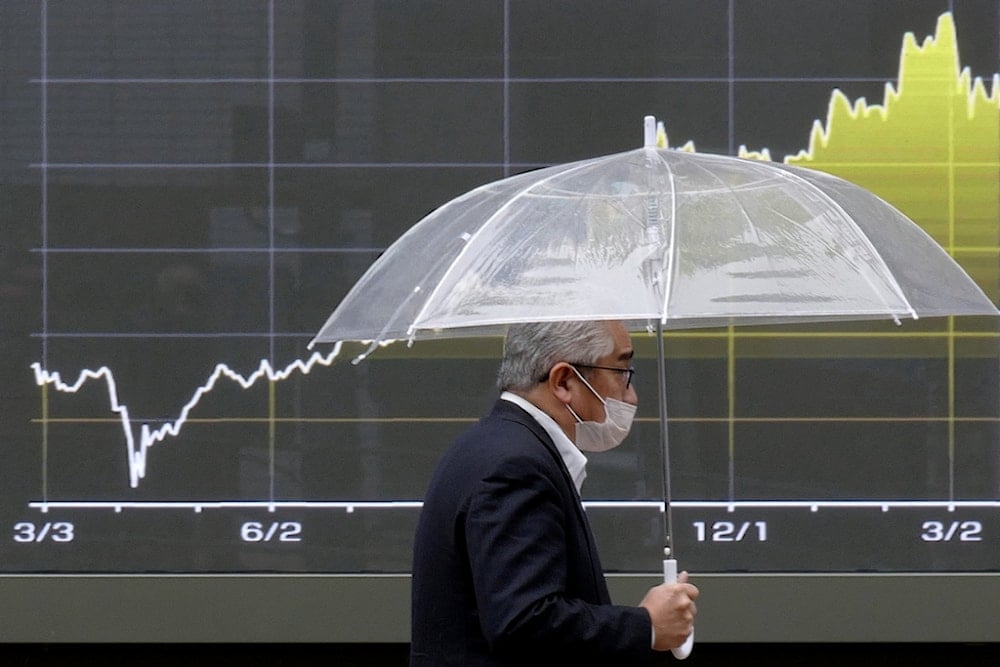
A person walks in front of an electronic stock board showing Japan's Nikkei index chart at a securities firm Monday, March 23, 2026, in Tokyo. (AP Photo/Eugene Hoshiko)
Stock markets across the Asia-Pacific region fell sharply in early trading as strikes intensified on Monday, with Japan’s Topix index dropping 3.2% and South Korea’s Kospi falling 4.7%. European equity futures also pointed to a decline of nearly 2%.
Brent crude oil rose above $113 per barrel on Monday after ending last week up 3.3% at $112.19, marking its fifth consecutive weekly gain.
Explosions were reported in Tehran, where the Israeli military said it carried out “a wave of large-scale strikes targeting infrastructure,” while Iran launched missiles toward "Israel" and neighboring Gulf states.
Tehran has linked the reopening of the Strait of Hormuz to the lifting of sanctions, stating that “freedom of trade” is essential for maritime navigation.
Gold prices fell by more than 6% on Monday to $4,185 per ounce, bringing total losses since the first US-Israeli strike on Iran to over 21%.
The CEO of Saudi Aramco, the world’s largest energy company, canceled participation in a major energy event in Texas scheduled to begin Monday.
US President Donald Trump and UK Prime Minister Sir Keir Starmer held a phone call on Sunday evening, reportedly agreeing that reopening the Strait of Hormuz is essential to stabilizing global energy markets. Trump had previously threatened to target Iranian power stations if Tehran did not reopen the strait within 48 hours.
IEA warns of 'severe' triple energy crisis amid US-Israeli war on Iran
International Energy Agency (IEA) Executive Director Fatih Birol has warned that the world could face its most severe energy crisis yet, as the US-Israeli war on Iran continues to disrupt global energy markets.
Speaking at the National Press Club in Canberra, Birol said the agency is in talks with governments across Asia and Europe over the possible release of additional oil from strategic reserves “if necessary,” and is closely monitoring market conditions and coordinating with member countries before taking further action.
“If it is necessary, of course, we will do it,” he said, adding that decisions would depend on evolving supply and demand dynamics.
Earlier this month, IEA member nations agreed to release 400 million barrels of oil from strategic reserves in an effort to stabilize prices amid the escalating crisis. Birol emphasized that there is no fixed oil price threshold that would automatically trigger another coordinated release, noting that decisions will be guided by market conditions.
Read more: US-Israeli war on Iran price tag: $11.3 bln in 6 days!


