
Americans doubt war on Iran as economic pressures mount: Poll
 5 Min Read
A CBS News poll shows most Americans view the war on Iran as failing, with rising gas prices and economic fears driving calls for a swift end to the war.
-
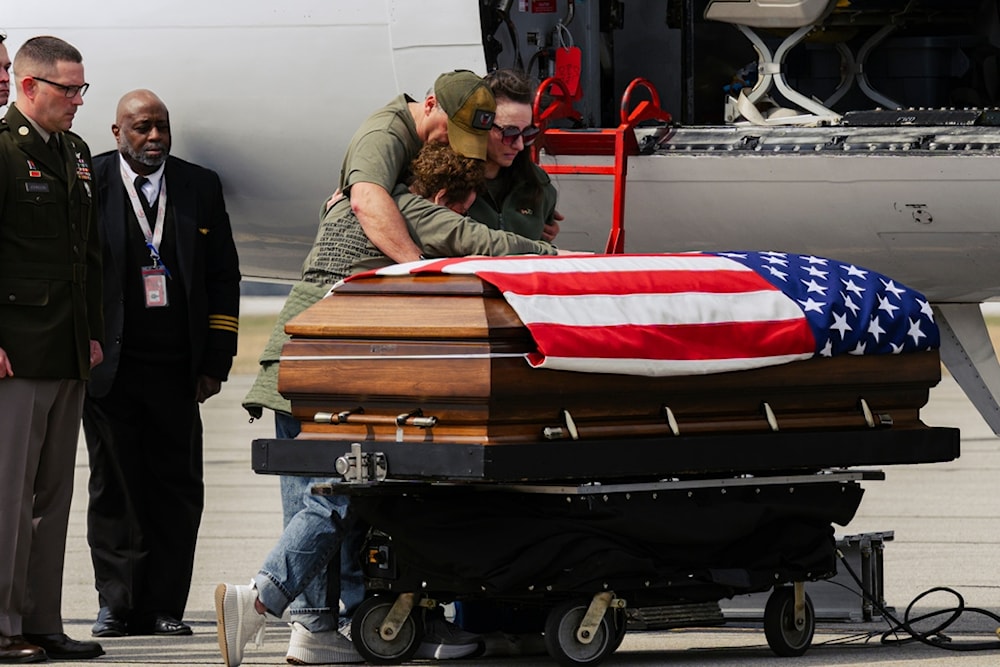
Family members stand with the casket carrying the remains of Army Sgt. Benjamin N. Pennington, 26, of Glendale, Ky., at Godman Army Airfield in Fort Knox, Ky., on Friday, March 20, 2026 (AP)
A new survey conducted by CBS News in partnership with YouGov indicates mounting skepticism among Americans regarding Washington’s war on Iran, with most respondents believing the war is not progressing favorably.
The findings reflect a broader unease as the war, widely described by respondents as a “war of choice,” enters a prolonged phase without clear outcomes. Many participants expressed uncertainty over its objectives, citing a lack of clarity from the administration.
The poll suggests that while initial support existed in some segments, particularly along partisan lines, overall confidence in the direction of the war is weakening.
Read more: Senior Iranian official outlines conditions for ending war: Exclusive
Rising gas prices deepen economic anxiety
Economic concerns have emerged as a central factor shaping public opinion.
A majority of respondents to the CBS poll linked the war directly to rising fuel costs, with gas prices becoming a visible indicator of the war's domestic impact. Most believe the war will weaken the US economy in the short term, with some anticipating longer-term consequences.
-
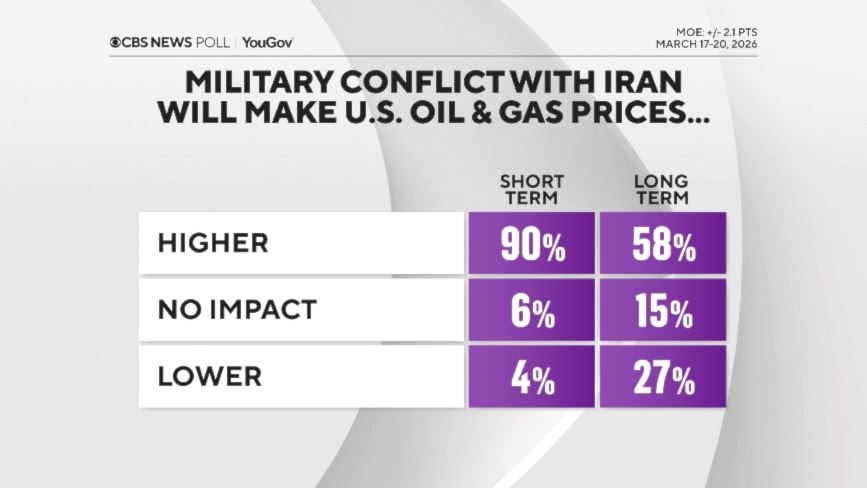
Credit: CBS News
The survey also shows a growing perception that the country could move toward recession, with 32% believing that the US economy may be in a recession next year, with 26% believe it will be a slow downtrend, 20% believe it will hold, and 22% believing that there will be an economic boom.
The poll also shows that, alongside economic concerns, there is a noticeable increase in the number of Americans reporting higher living costs.
Despite calls from officials for patience, respondents overwhelmingly rejected the idea that the public should bear increased fuel costs during the conflict, reflecting limited tolerance for economic sacrifice tied to foreign military engagement.
-
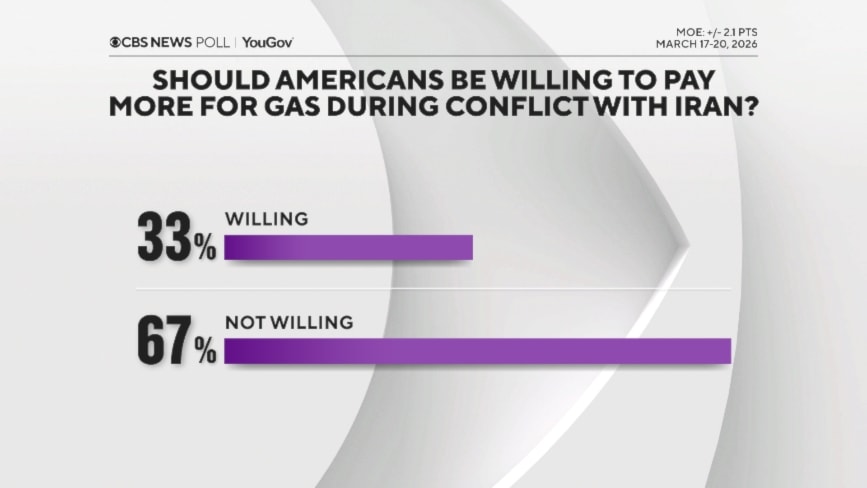
Credit: CBS News
Conflicting goals and demand for quick end
The CBS poll reveals a contradiction in public expectations regarding the war.
On the one hand, many Americans support broad goals such as ending Iran’s civilian nuclear program and promoting political change within the country. On the other hand, there is a strong consensus that the war should end as quickly as possible.
From a list of priorities, the most widely shared objective was simply to bring the war to a close. At the same time, most respondents (53%) still believed in a regime change option for Iran as they felt that it would be unacceptable for the war to end with the current governmental system in place.
-
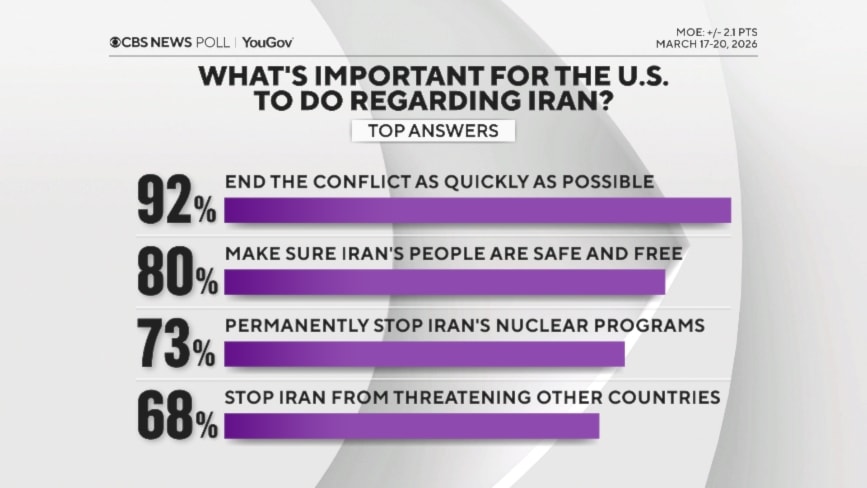
Credit: CBS News
This tension highlights a disconnect between desired outcomes and the willingness to sustain a prolonged war to achieve them.
Read more: Iran’s resilience blunts US hopes for economic war victory
Lack of clarity fuels public uncertainty
A key driver of dissatisfaction appears to be the perception that the administration has not clearly articulated its strategy.
Fewer respondents now (32%) believe that Washington has explained its goals compared to the early days of the war (38%). Many remain uncertain about how long the war will last, with most expecting it to continue for months or even years.
Among those who view the war as unsuccessful, there is a shared sentiment that it has not enhanced US security or economic stability.
Only a minority of those polled believe that the war will make the country safer in the long term, 36% as opposed to 42% who feel otherwise, reinforcing doubts about its strategic value.
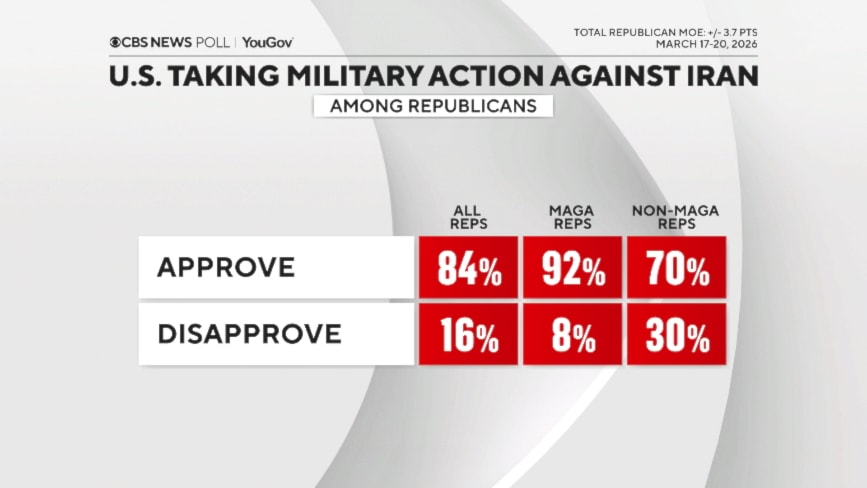
Divided support reflects political polarization
Public opinion remains sharply divided along political lines.
Support for the war is largely concentrated among the base of US President Donald Trump, where confidence in his leadership continues to drive approval. Many within this group view the war as necessary and believe it strengthens the US position globally.
-
Credit: CBS News
However, opposition is more prevalent among Democrats and independents, who are more likely to see the war as unnecessary and potentially harmful to both national security and economic stability.
-

Credit: CBS News
Approval ratings for Trump overall have remained relatively stable, hovering in the low 40 percent range, though his handling of economic issues continues to receive lower marks.
War duration and escalation concerns persist
Uncertainty over the duration of the war remains a significant concern.
Most respondents expect it to extend over a prolonged period, while a substantial portion remains unsure. This uncertainty correlates with rising disapproval, particularly among those who anticipate a long-term engagement.
-

Credit: CBS News
Views on the potential deployment of ground troops are divided, with roughly half of respondents considering it likely, 47% to 53% believing ground troops will not be sent, reflecting concerns over possible escalation.
The perception of the war as a discretionary rather than necessary conflict continues to shape public attitudes, particularly as economic pressures intensify.
Read more: Anduril founder: US lacks political will for ground war in Iran


