
Confronting Iran and Hezbollah: Signs of eroding Israeli durability
- By Al Mayadeen English
- Source: Al Mayadeen’s 'Israel' Affairs Desk
- 21 Mar 2026 12:56
 9 Min Read
Reports and statements from Israeli sources point to growing strains on daily life, public trust, and services as the confrontation with Hezbollah and Iran continues.
-
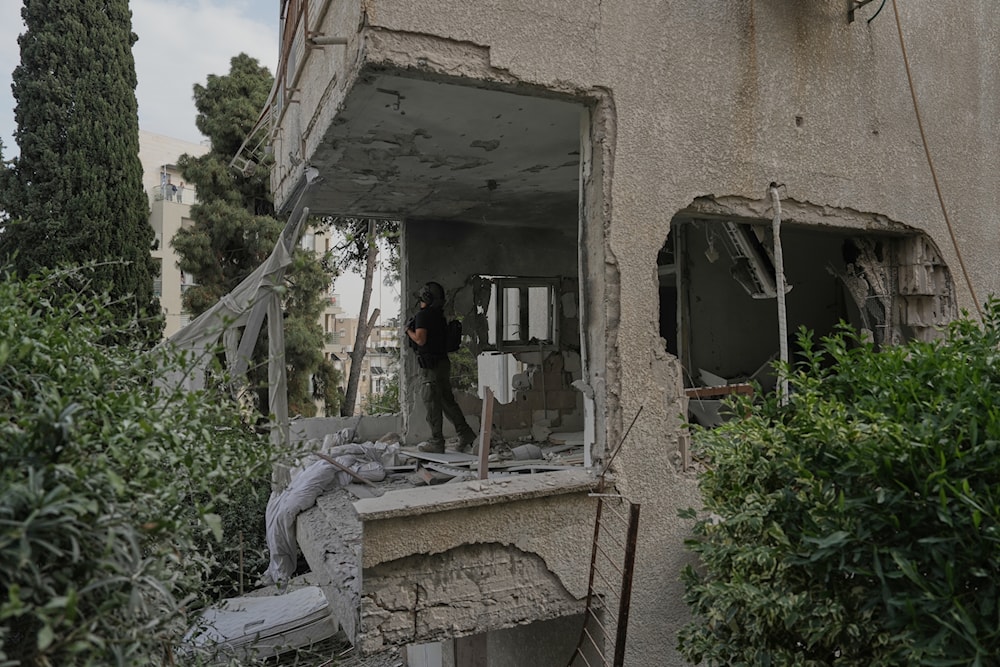
Israeli security forces inspect the site of an Iranian missile strike in Ramat Gan, 'Israel', Wednesday, March 18, 2026. (AP)
Israeli media coverage, since the start of the confrontation with Iran and Hezbollah, has not taken a single direction but is instead distributed across approaches that focus on signs of weakness and erosion, and others that highlight elements of durability, cohesion, and rallying around the objectives of the war, according to Al Mayadeen's "Israel" Affairs desk.
Nevertheless, the third week of the war brought more evidence and indicators that could be categorized under the title of erosion of “national durability,” or carry implications related to it one way or another.
Although the signs of Israeli “national durability” do not yet reflect a picture of collapse, it is clear that the general trend is upward, and it is likely to worsen as long as the Axis of Resistance can maintain the strike on “daily life routine” and impose a “war routine” for as long as possible.
Below are some signs, quotations from Israeli sources, some of which are government remedial or preventive measures, aimed at preventing damage to durability or attempting to restore it.
-
Cracks in “national durability” among northern settlers
-
The government announced the allocation of about 11.8 million shekels (~3.7 million USD) to enhance community durability in towns adjacent to the northern border fence.
-
Repeated media discussion about “empty slogans” in front of northern residents versus their experience of “an enemy that still stands before us, resilient and cannot be overcome.” And that “this whole war and the suffering we endure are in vain.”
-
Recognition of repeated entry of thousands of settlers into shelters during rocket attacks from Iran and Lebanon.
-
Increasing statements such as: “Northern residents are beginning to lose patience,” and that “some of them are requesting evacuation.”
-
Disruption of daily life routine
-
Power outages in several areas of Rosh HaAyin due to cluster bombs falling in four locations and property damage.
-
Significant damage to the Savidor train station, cars set on fire, an ambulance damaged, and a volunteer sustaining minor injuries.
-
Shrapnel was reported in various sites across 26 unspecified areas, causing people to seek shelter.
-
Starting Thursday (19-03), passenger numbers on some departing flights will be reduced following damage to three private planes due to Iranian shelling while they were at Ben Gurion Airport.
-
Inability to activate the educational system
-
Less than half of students have returned to school.
-
Dozens of local authorities opposed the Ministry of Education’s plan and refused to open schools due to a lack of protection.
-
A survey showed that two-thirds of parents prefer an immediate announcement to close the education system until Easter on April 1. 82% of parents feel increasing pressure and difficulty dealing with the situation, 48% completely reject reopening schools, compared to 29% who support returning, provided protection is offered.
-
Erosion of trust in the government
-
The Chairman of Mateh Asher Council exploded angrily: “They promised us security—we got rockets.”
-
Repeated statements that the government does not provide the public with realistic reports on the war situation, “but showers us with clichés that create unrealistic expectations, protection for a third of the population is inadequate, and politicians exploit us to stay in power. Is it surprising that we lost trust?”
-
Emergence of a gap between what the government told northern residents about Hezbollah being set back decades and having been pushed behind the Litani River, and the reality on the ground. Residents in the North were surprised in the last two weeks by Hezbollah’s capabilities, as they believed the situation was entirely different.
-
Observers confirm that Israeli politicians take cover behind war achievements, lavish praise on the army, and say the public shows “national durability,” while in reality, they are gathering political support to remain in power.
-
Decline of trust in the army
-
The Israeli army spokesperson refuses to publish the number of Hezbollah launches toward the North.
-
A study of the home front durability index showed a 15% decrease in the durability of residents of Al-Jalil and Haifa’s Krayot area.
-
Data confirms a gap between army statements and field reality, especially after the March 11 rocket barrage, which led to a decline in public trust, as warnings were denied before admitting the fall of hundreds of rockets.
-
The army’s operation in southern Lebanon is not a maneuver but more akin to giving a “painkiller” to reduce settler tension.
-
Complaints about Israeli media aiding enemy propaganda
-
A senior military official mentioned that “Hezbollah exploits media coverage in "Israel", especially what shows pressure and chaos, using it as a propaganda tool.”
-
Division and accusations during the war
-
30% of residents lack protected shelters, and reconstruction of the north is managed very slowly, while billions of shekels, coalition funds, directly or indirectly, finance service evasion.
-
Criticisms and exchange of political accusations that eased in the early days of the war are beginning to strengthen and reveal gaps in war management and its use internally, distributed across multiple political, media, and public platforms (yet support for the principle of waging the war remains high).
-
Various thefts amid rocket alerts
-
Israeli police: Israelis exploit emergencies and rocket alerts to steal homes, shops, and gas stations while residents rushed to shelters over the last two weeks.
-
Psychological exhaustion and reduced capacity for prolonged war
-
According to a report, there is significant concern about mass displacement from the North; therefore, information about Hezbollah’s expected rocket salvo (17-03-2026) was only released to the public in the afternoon to avoid the image of mass evacuation from frontline settlements.
-
In the past two weeks, "Israel" has seen increased demand for sleeping pills, sedatives, and dietary supplements for coping with anxiety.
-
“Living in the North is not easy. The situation is more complicated than during the 2023–2024 war because there are now thousands of residents living there,” the report stated.
-
Fragile sense of personal and collective security
-
Israelis’ sense of personal security declined over the past year compared to the previous year, with the largest decrease recorded in Haifa by 33.9% and Tel Aviv by 33.4%.
-
The home front faces a difficult reality, especially in Lod, with residents suffering from a clear shortage of shelters, and some sheltersdeteriorating due to electrical failures or water leaks.
-
More than ten thousand Israelis in the North lack a place to flee, and they do not have fortified rooms.
-
The Israeli army decided to relocate senior military officials and sensitive position holders from their homes to alternative residences.
-
Mayor of Nahariya: “The war in Nahariya is very difficult, the warning timing is short, and we are going through hard and complex days.”
-
Security and economic pressure and weak protection
-
The Commander of the homefront told northern authority heads: “Your actions may determine who lives and who dies, and your durability is very important.”
-
The economic and security crisis divides the northern leadership on the issue of staying in the towns. Some authority heads completely oppose evacuation, considering it a “knockout blow” for towns that residents may not return to. Meanwhile, other voices are saying that without budgets, residents cannot be kept under fire.
-
Northern authority heads demand immediate evacuation of 45,000 unprotected settlers.
-
Chairman of Shlomi Local Council: “We demand that the state evacuate residents without protection, especially the elderly. We also demand compensation for our residents.”
-
Increase in “temporary evacuations” from northern settlements
-
The Metulla settlement began gradually evacuating residents “for temporary periods of 3–5 days before their return.”
-
“60 families from the Shlomi settlement were evacuated to Netanya for relief and some rest, as a temporary evacuation for a week. The Jewish National Fund said that they will provide 800 people with the opportunity for a two-day rest in the coming days.”
-
Shlomi settlement: “We demand the government evacuate all residents without fortified locations; about 3,000 out of 10,000 settlers in Shlomi must be evacuated.”
-
So far, 25 hotels have been opened to accommodate displaced people, with preparations for a scenario of expanded fighting, including potential fire from Houthis toward Eilat. Across the country, about 4,000 citizens have been evacuated from their homes to hotels.
-
Gap in the Ministry of Finance reference scenario
-
Ministry of Finance circles assumed the current war would be similar to the “Rising Lion” operation, lasting 12 days, perhaps slightly longer. But this estimate also appears unfounded, with no indicators of a near end to the confrontation.
-
“The reference scenario presented to the Ministry of Finance discussed a limited event in the north, not a wide confrontation. In reality, the confrontation with Hezbollah has expanded significantly.”
-
With the widening of the battle with Iran and Hezbollah, contrary to the Ministry of Finance's reference scenario, war expenses both direct and indirect, are expected to increase, which may pressure Israeli and US decision-makers to escalate or de-escalate.
-
The cost of each day of the war is estimated at 1 billion shekels (around $362 million), including only direct security expenditures, not counting civilian costs or economic output losses.
-
Signs of a shift in the Israeli narrative toward Hezbollah
-
When Hezbollah entered the battle, it seemed the Israeli army celebrated, as if Hezbollah had fallen into a strategic ambush. But after two weeks, the Israeli army itself seems unsure that it is not they who fell into the trap.
-
“Hezbollah is different; its members are armed from head to toe and have extensive military experience. They succeed in achieving surprise and continue firing. Residents who returned home thought it was over and deterrence achieved, but it did not materialize.”


