
US allies must help end an unlawful war: The Economist
 3 Min Read
In The Economist, Oman’s foreign minister, Badr al-Busaidi, warns that a near US-Iran nuclear deal collapsed into war, leaving allies to help steer Washington back to diplomacy.
-
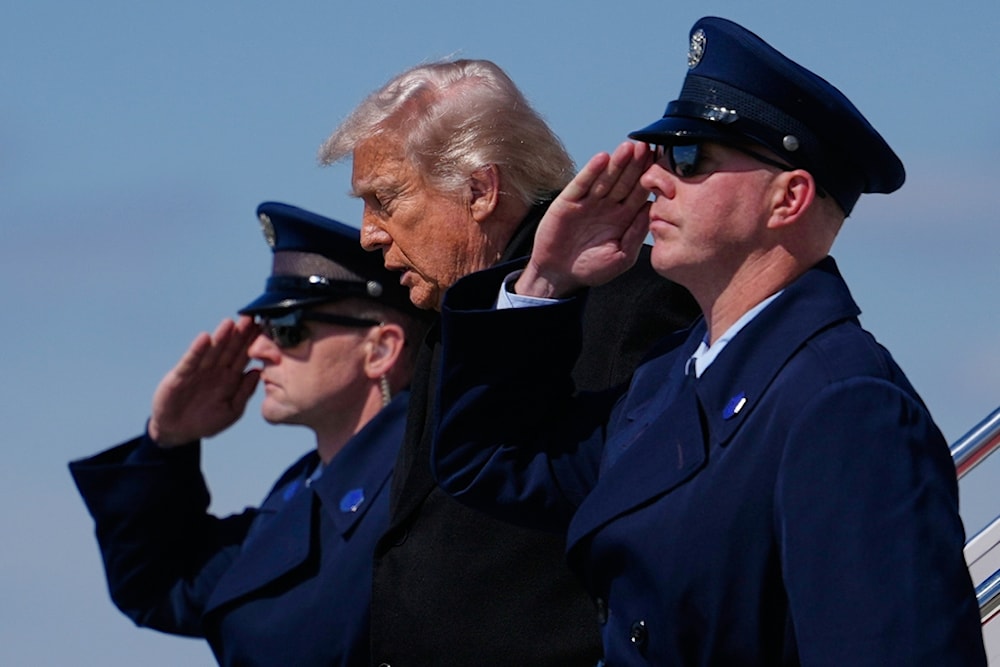
President Donald Trump arrives on Air Force One, Wednesday, March 18, 2026, at Dover Air Force Base, Del., to attend the casualty return for the six crew members of an Air Force refueling aircraft who died when their plane crashed in western Iraq while supporting operations against Iran. (AP)
According to an analysis published in The Economist by Oman’s foreign minister, Badr al-Busaidi, the United States and Iran were closer than many knew to finalizing a deal regarding Tehran’s nuclear programme.
Twice in less than a year, negotiations approached a breakthrough. The latest round of talks in late February was described as the most substantive yet, raising real hopes that a diplomatic solution was within reach. Yet within hours of those discussions, the United States and "Israel" carried out an aggression against Iran, abruptly ending any momentum toward a deal.
From Tehran’s perspective, retaliation was unavoidable. Iran framed its response, targeting what it described as American-linked sites across the region, as a reaction to an existential threat. While such escalation is widely condemned, the author argues that, given the framing of the war as an attempt to dismantle the Islamic Republic, Iran’s leadership likely saw few viable alternatives.
The result is not just a regional crisis, but a deeper strategic failure. The analysis suggests Washington has lost control of its foreign policy direction, allowing short-term military decisions to override long-term diplomatic opportunities.
What could have been a breakthrough moment has instead spiraled into a widening and dangerous war.
What are Washington's real interests?
The author argues that US policy must be grounded in a clearer understanding of its core interests:
- Preventing nuclear weapons proliferation
- Securing stable energy supply chains
- Expanding economic and investment opportunities in a globally significant region
All of these objectives, he contends, are best achieved through regional stability, specifically, with Iran at peace with its neighbors.
However, now reopening negotiations will be politically and diplomatically difficult. Trust has been severely damaged, with Washington pivoting twice from talks to military action.
At the same time, Iran is unlikely to re-engage easily with an administration it sees as unreliable. Yet despite these barriers, the analysis stresses that returning to dialogue may be the only viable path away from a prolonged war.
A broader regional solution
To make diplomacy possible again, both sides need a meaningful incentive. Al Busaidi proposes linking US-Iran negotiations to a wider regional framework focused on nuclear transparency and long-term energy transition.
As West Asian countries prepare for a post-carbon future, cooperation on nuclear energy, its use, oversight, and limits could transform a source of tension into an area of shared interest.
Such a framework could evolve into confidence-building measures and, ultimately, a regional consensus on nuclear policy. Backed by Gulf states, it may even lay the groundwork for a broader non-aggression agreement.
The outcome remains uncertain, especially amid active war. But the central argument is clear: diplomacy was within reach once, and, despite everything, it may still be the only way out.


