
External pressure shaped Trump’s Iran war decision: Bloomberg
 3 Min Read
US President Donald Trump’s reported decision to launch a war against Iran was influenced in part by pressure from figures including Benjamin Netanyahu and media mogul Rupert Murdoch.
-
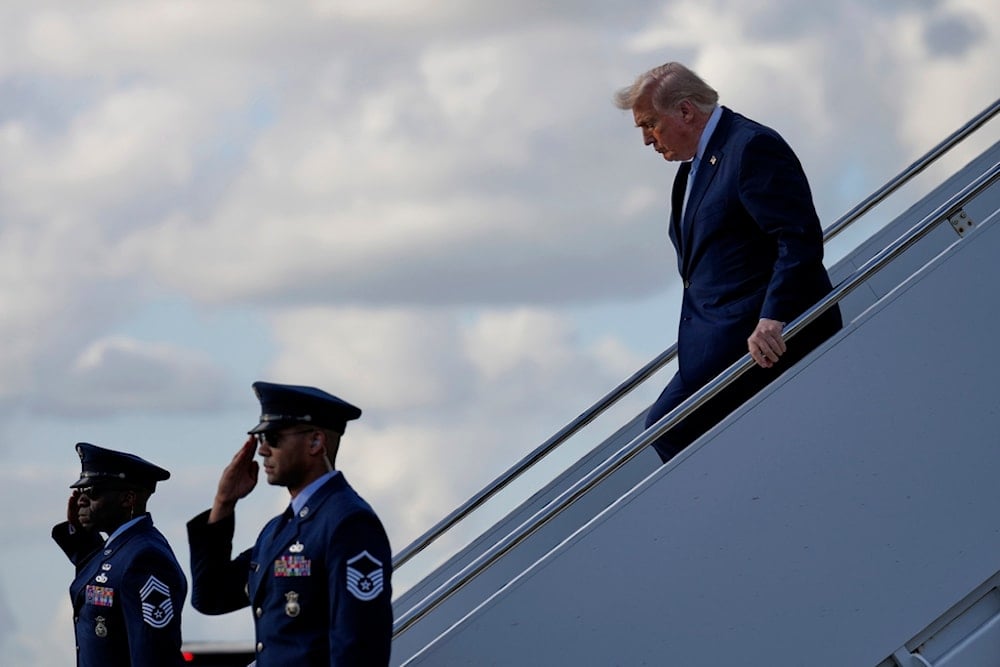
President Donald Trump steps off Air Force One, Friday, March 20, 2026, at Palm Beach International Airport in West Palm Beach, Fla. (AP)
US President Donald Trump’s decision to launch a war on Iran was shaped in part by pressure from influential outside figures, while his own White House advisers largely remained restrained.
Those privately urging Trump toward aggression reportedly included Israeli Prime Minister Benjamin Netanyahu, media mogul Rupert Murdoch, and several conservative commentators. Murdoch, in particular, is said to have raised the issue with Trump multiple times, according to sources familiar with the exchanges.
Inside the administration, key figures, including Vice President JD Vance, Secretary of State Marco Rubio, and White House Chief of Staff Susie Wiles, are described as having expressed fewer objections to the prospect of war.
While Wiles focused on ensuring Trump understood his options, Vance reportedly pushed for open discussion among officials and raised questions about how a potential war would unfold.
War decision deepens political and economic stakes
Trump’s decision to proceed with the war has intensified domestic and international pressure, straining US alliances and contributing to rising energy costs. It also complicates Republican prospects ahead of the upcoming midterm elections, with economic concerns and inflation expected to dominate voter sentiment.
Former national security adviser John Bolton noted that Trump prefers advisers who align with his instincts rather than challenge them, contrasting with earlier administrations where debate was more pronounced. That said, Trump officials have largely aligned with the president’s decisions.
Director of National Intelligence Tulsi Gabbard said Trump alone determines whether Iran poses an imminent threat. Meanwhile, former counterterrorism director Joe Kent decided to resign from his position, stressing he could not support sending Americans into a war he viewed as unnecessary.
In an extended interview on Wednesday with former Fox News host and podcaster Tucker Carlson, Kent said that access to Trump was limited in the run-up to the war with Iran, saying that a “good deal of key decision makers were not allowed to come and express their opinion” to the president.
“In the lead-up to this last iteration, a good deal of key decision makers were not allowed to come and express their opinion to the president,” Kent said, adding that there had been “robust debate” before US strikes on Iranian nuclear sites last year
Kent also said he believed "Israel" had drawn the United States into the war and was broadly shaping American policy in West Asia.


