
JD Vance privately opposed US war on Iran: Politico
 5 Min Read
Politico reported that JD Vance privately expressed skepticism and concern about the success of the US war on Iran before Donald Trump decided to launch the military campaign, though he later publicly supported the administration’s actions.
-
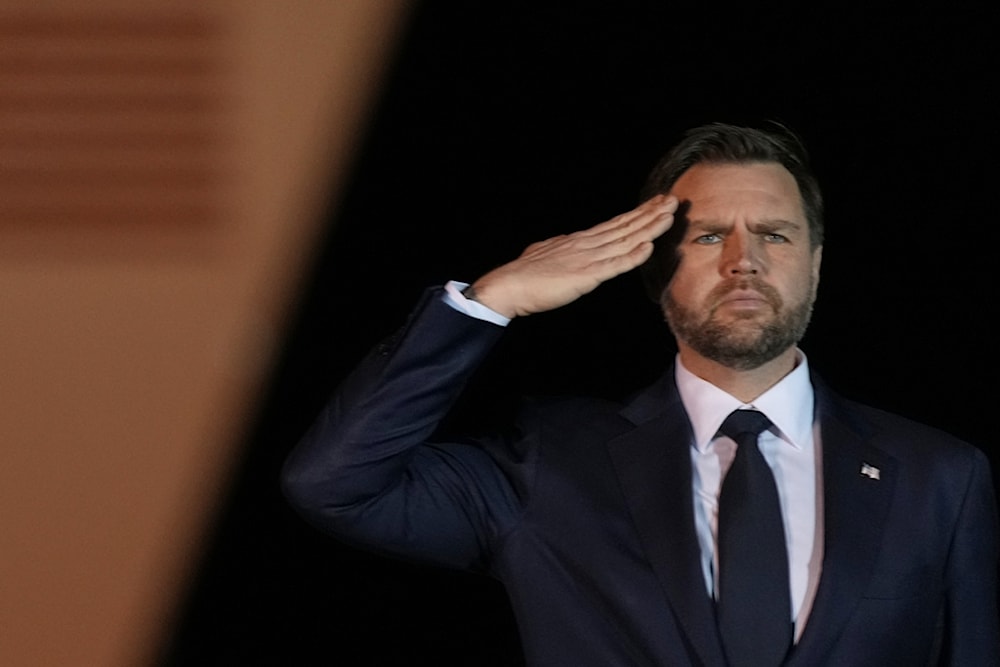
Vice President JD Vance salutes as an U.S. Army carry team moves the transfer case containing the remains of Sgt. Benjamin N. Pennington, 26, of Glendale, Ky., Monday March 9, 2026, at Dover Air Force Base, Del. (AP Photo/Julia Demaree Nikhinson)
Politico on Friday reported that US Vice President JD Vance privately expressed doubts about launching military action against Iran in the period leading up to President Donald Trump’s decision to initiate the war, according to two senior officials in the administration.
Although Vance has publicly backed the war on Iran since it began, the report indicates that he raised concerns internally before the operation was approved. Officials said the vice president questioned the prospects of success and voiced opposition during internal discussions surrounding the decision.
One senior administration official described Vance’s stance in a text message, saying he was “skeptical,” “worried about success,” and “just opposes” the war on Iran. The official spoke on condition of anonymity to discuss internal deliberations.
A second official said Vance’s role within the administration was to provide different perspectives before a final decision was made. “His role is to provide the president and the administration, you know, all points of views of what could happen from many different angles and, you know, he does that. But once the decision has been made, he’s fully on board,” the official said.
Vance’s longstanding war skepticism
Vance’s reservations reflect a long-standing position he has taken on US foreign policy. The vice president, who served in the Marine Corps during the war on Iraq, has frequently expressed skepticism toward American military interventions abroad.
Those views have resurfaced repeatedly in recent years. When the United States carried out strikes against Yemen's Ansar Allah last year, Vance reportedly wrote in what was believed to be a private Signal conversation with other officials that the move was a “mistake.”
The Politico report said Vance’s tone regarding the Iran operation has fueled speculation about differences between him and Trump on the use of military force. Despite those suggestions, the president appeared to dismiss any suggestion of a serious divide.
Speaking to reporters at Mar-a-Lago, Trump said Vance “was, I’d say, philosophically a little different from me. I think he was maybe less enthusiastic about going, but he was still quite enthusiastic.”
Vance’s office declined to elaborate on his internal discussions with the president. His spokesperson, Taylor Van Kirk, criticized what she described as repeated leaks about the vice president’s thinking.
“The Vice President has been the focus of constant leaks left and right by people trying to project their views onto him,” she said. “And as a result, there have been countless inconsistent accounts of the Vice President’s views published, which shows the mainstream media has no idea what they’re talking about.”
She added that “the Vice President, a proud member of the President’s national security team, keeps his counsel to the President private.”
White House spokesperson Anna Kelly also rejected the idea that the administration is divided over the war.
“Efforts to drive a wedge between President Trump and Vice President Vance are totally misguided. The President listens to a host of opinions from his talented national security team and ultimately makes decisions based on what is best for our country and national security. Vice President Vance is a tremendous asset to the President and the entire administration,” Kelly said.
According to a person familiar with Vance’s thinking, the vice president ultimately believed that if the United States was going to strike, the operation needed to be carried out quickly. Delays, the person said, could increase the risk of leaks about military planning and potentially expose US forces to retaliation.
Backing war carefully
Since the start of the war, Vance has publicly defended the administration’s actions while acknowledging that many Americans remain wary of another prolonged overseas war. After earlier US strikes on Iranian nuclear facilities, he wrote on social media that Americans are “right to be worried about foreign entanglement.”
Despite supporting the aggression, Vance has maintained a more cautious tone than the president. While Trump recently declared that “we won” the war, the vice president has framed the objective in more limited terms.
“Trump will not get the United States into a years-long conflict with no end in sight and no clear objective,” Vance said in an interview with Fox News on March 2, arguing that the “simple” objective of destroying Iran’s nuclear capability would help avoid the kind of prolonged wars the United States experienced in Iraq and Afghanistan.
His position is consistent with earlier statements he made before the war escalated. Two days prior to the launch of the strikes, Vance told the Washington Post that he sees himself as a “skeptic of foreign military interventions” and that “we all prefer the diplomatic option.”
In a separate interview two years earlier, during his campaign as vice presidential nominee, he similarly argued that Washington should avoid confrontation with Tehran. Speaking on a podcast hosted by Tim Dillon, Vance said “our interest, I think, very much is in not going to war with Iran” and warned that such a conflict would be a “huge distraction of resources” and “massively expensive to our country.”
Read more: Trump's war on Iran exposes American failure: The Guardian


