
Rubio denies US seeking to oust Cuban President Diaz-Canel
 4 Min Read
US Secretary of State Marco Rubio dismisses as "fake news" a report alleging Washington aims to remove Cuban President Miguel Diaz-Canel from power while preserving the island's political system.
-
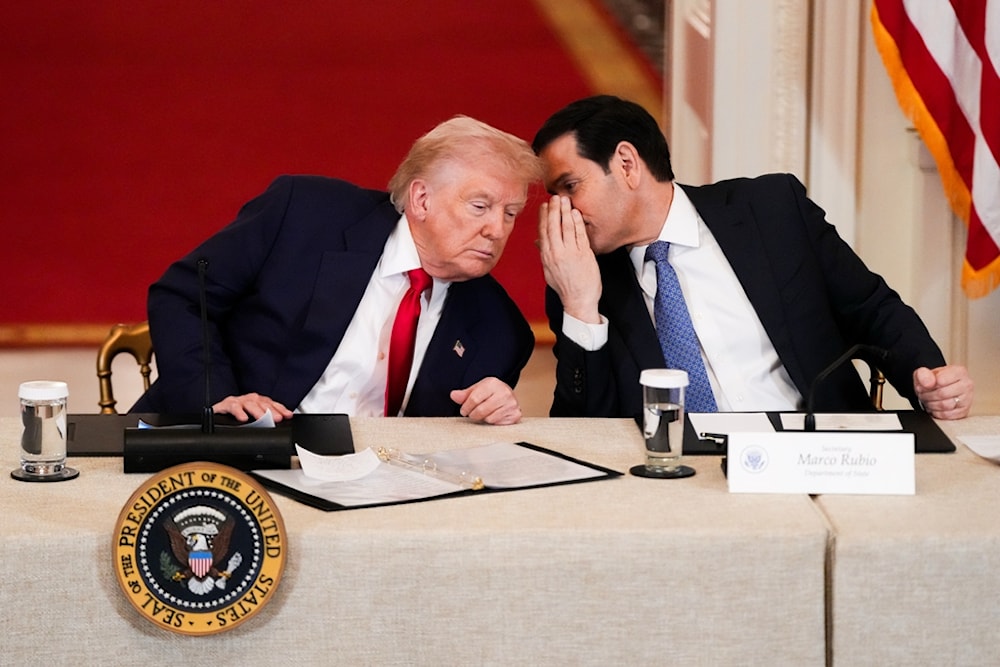
President Donald Trump speaks with Secretary of State Marco Rubio during a roundtable discussion on college sports in the East Room of the White House, Friday, March 6, 2026, in Washington (AP)
US Secretary of State Marco Rubio dismissed a New York Times article alleging the United States seeks to oust Cuban President Miguel Diaz-Canel without altering the political system as fabricated.
"The reason so many in US media keep putting out fake stories like this one is because they continue to rely on charlatans & liars claiming to be in the know as their sources," Rubio wrote on X late Tuesday, linking to the article.
On Monday, the NYT reported, citing sources, that Washington aims to remove Diaz-Canel from power while preserving the island's political structure.
US President Trump on Cuba
US President Donald Trump said on Tuesday he could “take Cuba” as the island faces a nationwide power blackout, triggered by an ongoing US oil blockade and deepening economic crisis.
Speaking at the White House on Monday, Trump suggested Washington has broad leverage over Havana, declaring he could “do anything I want” with the island nation amid ongoing talks regarding its future.
“You know, all my life I’ve been hearing about the United States and Cuba. When will the United States do it?” Trump told reporters.
“I do believe I’ll be … having the honour of taking Cuba,” he added. “Whether I free it, take it, think I could do anything I want with it. You want to know the truth. They’re a very weakened nation right now.”
US ups pressure amid energy crisis
Trump’s remarks came as Cuba plunged into a total power blackout, with its fragile electricity grid collapsing under severe fuel shortages induced by the US siege of the Island.
The crisis follows Washington’s decision to cut off Venezuelan oil supplies to the island, a move that has significantly worsened Cuba’s energy situation and disrupted daily life across the country.
US officials have also increased pressure on Havana during negotiations, reportedly calling for the removal of Cuban President Miguel Díaz-Canel as part of any agreement, according to multiple reports.
Such demands are likely to be rejected by Cuba, which has repeatedly insisted that any talks must respect its sovereignty and political system.
Regime change, regional escalation
Washington’s approach reflects a broader strategy of tightening pressure on Cuba following the kidnapping of Venezuelan President Nicolás Maduro, a key ally and oil supplier to Havana.
US Secretary of State Marco Rubio has long advocated for political change in Cuba, while Trump has previously floated the idea of a “friendly takeover,” though he recently warned it “may not be a friendly takeover.”
The escalating rhetoric signals a potential shift in US-Cuba relations, raising concerns about further instability in the region as Cuba grapples with economic collapse and mounting internal strain.
Despite the pressure, President Miguel Díaz-Canel has reiterated that any dialogue with Washington must be based on “equality and respect” for Cuba’s sovereignty and self-determination.
'Running on fumes'
Cuba had been receiving an average of 35,000 barrels of Venezuelan oil per day through late 2025, used both to power the island and generate export revenue for essential imports. That lifeline collapsed following the abduction of Maduro. Analysts now warn Cuba could exhaust its remaining fuel reserves by mid- to late March, bringing life on the island to a standstill.
A 2025 survey by the Food Monitor Program found that 78% of respondents described the current crisis as the worst they had experienced in terms of food access, while seven in ten Cubans skipped at least one meal last year due to shortages or inability to pay. Fuel has grown so scarce that a tank of gas now fetches over $300 on the black market, more than most Cubans earn in a year.
Trump had repeatedly insisted that negotiations with Havana are well underway. But reporting by Drop Site News in February complicated that picture considerably. According to five Cuban and American officials speaking on condition of anonymity, no high-level negotiations between Washington and Havana exist.
Read More: Trump says US could ‘take Cuba’ amid siege induced blackout crisis


