
'Israel' warns US it is running critically low on interceptors: Report
 4 Min Read
"Israel" has warned the United States that its supply of ballistic missile interceptors is running critically low as sustained Iranian missile attacks place growing strain on its air defense systems.
-
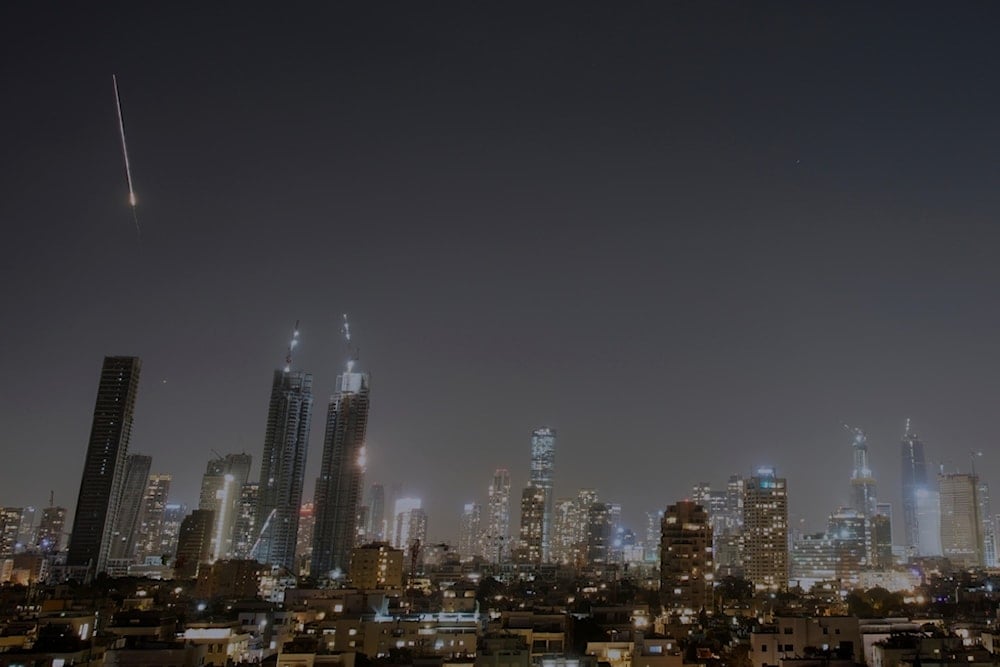
Missiles launched from Iran are seen in the sky over central occupied Palestine, Thursday, March 12, 2026 (AP Photo)
"Israel" has informed the United States that its reserves of ballistic missile interceptors are nearing "critically low" levels as the war on Iran intensifies, according to US officials cited by Semafor.
Israeli authorities reportedly warned Washington that sustained Iranian missile attacks are placing increasing pressure on the entity's air defense network, particularly the systems designed to intercept long-range ballistic missiles. "Israel" is believed to have entered the current war already short on some interceptor supplies after expending significant quantities during last year's aggression.
US officials acknowledged that the shortage was anticipated. “It’s something we expected and anticipated,” one official said.
The Israeli air defense architecture relies on several systems operating at different ranges. While Iron Dome is designed primarily to intercept short-range rockets, long-range threats are countered by systems such as Arrow, which can intercept ballistic missiles outside the atmosphere. These interceptors are technologically sophisticated but extremely expensive and produced in limited quantities. Analysts estimate that each Arrow interceptor can cost several million dollars and requires lengthy manufacturing cycles.
Iran missile attrition strategy
The pressure on "Israel’s" defenses comes amid a broader dynamic that analysts describe as a war of attrition between Iranian offensive capabilities and the interceptor inventories of the United States and its proxies.
Some experts note that the balance between offense and defense is inherently uneven. Iranian missiles can cost a few hundred thousand dollars to produce, while the interceptors used to destroy them may cost several million dollars each. This disparity means that large missile barrages can quickly force defenders to expend expensive defensive munitions faster than they can be replaced.
At the same time, Iran’s missile production capacity is believed to significantly exceed the rate at which interceptor missiles are manufactured by "Israel" and the United States. Analysts estimate that Iran may produce dozens of ballistic missiles each month, while only a handful of advanced interceptors can be produced during the same period.
This imbalance has led some analysts to argue that Tehran may be pursuing a deliberate strategy of attrition aimed at exhausting the defensive “magazine depth” of its adversaries. Western military experts have increasingly framed the confrontation as a race between Iranian missile production and the available supply of US and Israeli interceptor systems.
US interceptors depleted
The issue is not limited to "Israel." The United States has also expended large numbers of interceptors during previous confrontations with Iran. During the 12-day war on Iran last year, US forces reportedly launched more than 150 THAAD interceptors along with dozens of other missile defense systems while helping defend Israeli and regional targets.
Because such systems are expensive and complex to manufacture, replenishing them can take years. Analysts warn that if the current war continues for several weeks, shortages of advanced interceptors could emerge across US and allied arsenals.
US officials nevertheless insist that American forces currently retain sufficient defensive capacity. “We have all that we need to protect our bases and our personnel in the region and our interests,” a US official said, while adding that "Israel" is “coming up with solutions to address” its interceptor shortage.
Arsenal endurance
The strain on missile defenses reflects the scale of the war, which has seen extensive missile exchanges across the region. Military planners increasingly acknowledge that the outcome of the war may depend not only on battlefield operations but also on which side can sustain its weapons stockpiles the longest.
For Tehran, the growing pressure on Israeli and US interceptor inventories is seen by some as evidence that sustained missile operations can gradually erode the defensive shield built around "Israel" and its allies, potentially shifting the strategic balance if the war continues.
Read more: Gulf states may have spent $5.1B on interceptor missiles: report


